
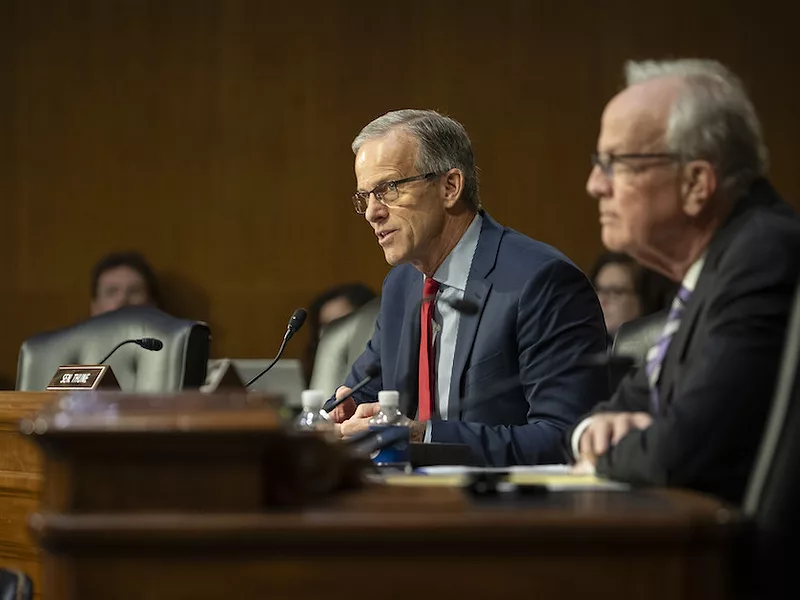
Top GOP ag committee senators who have spoken with Senate Majority Leader John Thune, R-S.D., say he is willing to attach more farm aid to any bill to fund war in Iran.
Senate Ag Committee Chair John Boozman, R-Ark., said in recent discussions Thune has been “very open” to using a funding vehicle. Meanwhile, Sen. John Hoeven, R-N.D., says that the leader is “supportive.”
For his part, though, Thune isn’t committing to anything publicly. He told Agri-Pulse Thursday that he has been in discussions on the issue. But he added that senators won’t know what can ride with the legislation until the White House makes a proposal.
“If and when that happens, we'll start gaming that out and determine what else might be a part of that legislation,” he said.
Effects of Iran conflict will linger in fertilizer markets through 2026, analyst warns
Even if the Iran war were to end overnight, the conflict will keep nitrogen fertilizer supplies tight through 2026, StoneX’s Josh Linville warns.
“A lot of the damage has already been done,” he said in his latest analysis. It will take time for plants to restart and to clear a backlog of ships that have been waiting to load.
“It is going to take a long time for this market to get back to normal,” Linville said.
Current prices don’t fully capture the scale of current and future competition for nitrogen fertilizer, he added. India, a major producer, has seen its natural gas supplies interrupted, denting production, which could soon inject significantly more demand into the global market.
“That is just going to be throwing gasoline on this fire,” Linville added. “There is an easy case to be made that prices are substantially undervalued from where they should be, given all the stuff that’s going on.”
Take note: In a statement broadcast on Iranian state television Thursday, the new supreme leader vowed to keep blocking the Strait of Hormuz.
It’s not just fertilizer costs that are squeezing farmers. At current high diesel prices, farmers would be looking at $2,000 in increased production costs each year, Soy Transportation Coalition Executive Director Mike Steenhoek said in an email to reporters. A typical grain elevator could face added costs of almost $100,000.
Interested in more news on farm programs, trade and rural issues? Sign up for a four-week free trial to Agri-Pulse. You’ll receive our content - absolutely free - during the trial period.
Senate Ag Dem: More pressure needed on SNAP cut
A Democrat on the Senate Agriculture Committees says even conservative county commissioners are concerned about the cost-share requirement for the Supplemental Nutrition Assistance Program. But New Mexico Sen. Ben Ray Luján says on this week’s Agri-Pulse Newsmakers that more GOP governors and county commissioners need to weigh in on the issue as the committee considers a new farm bill.
“It would be certainly helpful to have more Republican governors speak up, reach out to their senators and country commissioners, reach out to everyone as well. Make sure you’re getting everyone on the horn, and get them to agree that we can get this delayed, so that your budgets are not blown open,” Luján
says.
The requirement is intended to induce states to lower their SNAP error rates.
Luján
also talks about the impact of tariffs and the war in Iran. “The tariffs are already hitting the American consumer and the American producer hard. And now with this war and the uncertainty of when fertilizer and inputs are going to move, it’s just making everything more expensive, in addition to the cost of fuel,” he said.
Newsmakers will be available today at Agri-Pulse.com.
Renewable fuel wish lists
The 45Z tax credit is in sharp focus as policymakers work to finalize its final rules for the biofuel production subsidy.
Nearly two dozen Republican lawmakers are telling the Trump administration that farmers must be able to take full advantage of the credit. That includes ensuring ag producers can smoothly link regenerative practices, such as cover cropping, with 45Z incentives, Sen. Joni Ernst, R-Iowa, and 22 other senators and representatives said in a letter to top administration officials on Thursday.
Read our coverage of the letter at Agri-Pulse.com
‘Bring back’ old credit
Meanwhile, top fuel retailing groups want Congress to bring back the Biodiesel Blenders’ Tax Credit that 45Z replaced last year.
As conflict in the Middle East pushes fuel prices higher, the biodiesel market has “completely dried up.” That’s what NATSO, representing truck stops and travel centers, SIGMA, a leading trade group for fuel marketers, and the National Association of Convenience Stores say in a letter to Senate Agriculture Committee Chairman John Boozman, R-Ark., and Sen. Amy Klobuchar, the panel’s top Democrat.
The 45Z credit’s base value hinges on the greenhouse-gas footprint of a fuel's entire production chain. The now expired blenders’ credit was a flat $1-a-gallon credit that stemmed back to 2005.
The groups say 45Z has structural flaws, is overly complex, and is “stifling demand for renewable fuels made from corn and soybeans, leading to higher fuel prices for consumers.”
EU issues tariff warning, calls for clarity following 301 probe
European officials are seeking clarity on how a new U.S. investigation into unfair trade practices will impact their deal.
Spokesperson Olof Gill said during a press conference Thursday that the Commission is reaching out to U.S. officials for details on what it might mean for the deal struck last year. Gill added that the European Union would respond “firmly and proportionately” to any breach of the deal’s terms.
He added that the Commission has had no indication that the U.S. intends to “deviate from those commitments.”
The chair of the European Parliament’s international trade committee, Bernd Lange, complained that “uncertainty persists” in a post to X.
“There is still no clear commitment from the U.S. government to honor the Turnberry obligations,” he said. “Who can guarantee that the end result won't mean even higher tariffs for the EU?”
CBP gives update on tariff system
Customs and Border Protection says it is building out an automated tariff refund system that will accept claims, process them and issue refunds.
As of this week, the claim portal is about 70% complete, an official said in a court filing. The processing system is 40% complete, a review system is almost in the testing stage, and the refund component is 60% complete.
In a filing last week, CBP estimated that refunds could begin in late April.
Take note: The Court of International Trade has also agreed to expedite two cases challenging the administration’s global tariff. Although they haven’t been formally combined, the court will hear a case brought by Democratic attorneys general on the same day as a case brought by two small businesses.
Jeffrey Schwab, a Liberty Justice Center lawyer who is representing the small businesses, told reporters that the schedule shows the court “understands the urgency and seriousness” of the cases.
Final word
Agri-Pulse’s Lydia Johnson: “What are you seeing back home in Ohio?”
"Data centers on every corner like Dollar Generals. … Six months ago, we were just hearing soft murmurs, and there is so much behind the scenes going on in these companies that are processing data…. All we're asking, from an agricultural standpoint, is transparency. We want to make sure that we're in the conversation " - Ohio Farm Bureau Federation President Bill Patterson discussing shifting land use in his state on Agri-Pulse Newsmakers.
Ohio is a popular state for data centers, with about 200 such facilities, according to the state.
For more news, go to Agri-Pulse.com

.webp?t=1762183428)


