
The European Union has agreed to provide “preferential market access” for a range of agricultural goods, in a joint trade agreement framework announced Thursday with the United States, with the U.S. withholding tariff perks on auto imports until the bloc follows through with its commitments.
The framework, which would cap tariffs on most European goods at 15%, is the first jointly issued work product since President Donald Trump and European Commission President Ursula von der Leyen announced a deal in Scotland last month.
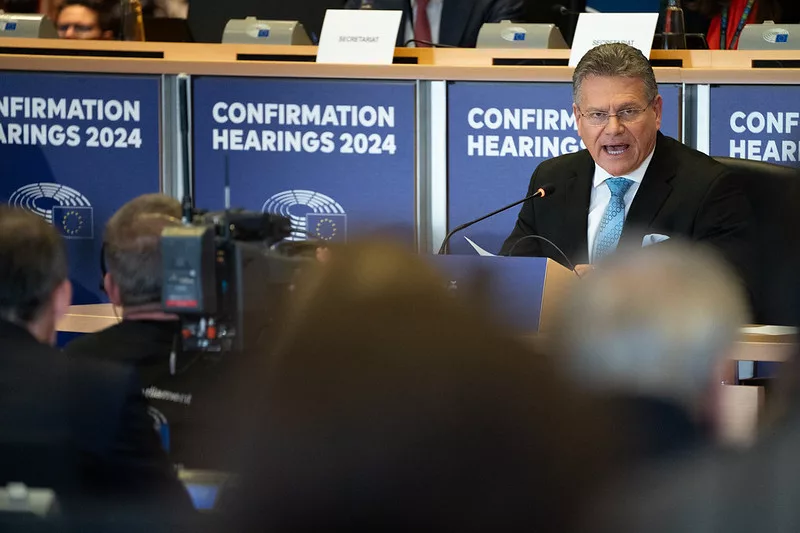
But there’s much more work to do to flesh out the language in the framework, said Maroš Šefčovič, the European Commissioner for Trade.
“This is not the end, it's the beginning,” he said at a press conference in Brussels Thursday. “This framework is the first step, one that can grow over time to cover more sectors, improve market access and strengthen our economic ties even further.”
The framework says the U.S. will lower current 27.5% tariffs on European cars and car parts once the EU introduces legislation to eliminate tariffs on all U.S. industrial goods and provide “preferential market access” to U.S. ag goods. Those include “tree nuts, dairy products, fresh and processed fruits and vegetables, processed foods, planting seeds, soybean oil, and pork and bison meat,” according to the framework.
The U.S. tariff reduction will occur retroactively from the beginning of the month in which the EU legislation is introduced. Šefčovič said the EU hopes to get the legislative process moving quickly.
“We are striving and working very hard” to start the legislative process this month, he said, so European automakers “can benefit from retroactive application of the 15% tariff” as of Aug. 1, as specified in the framework.
Von der Leyen hailed the announcement on X as providing “predictability for our companies & consumers; stability in the largest trading partnership in the world; and security for European jobs & economic growth in the long term. This EU-US trade deal delivers for our citizens & companies, and strengthens transatlantic relations.”
A European Commission explainer released after last month’s deal was announced said about $8.7 billion of “non-sensitive” U.S. ag exports would receive tariff-rate quotas. It did not say whether ag products would receive duty-free access under the quotas or merely a lower tariff rate. The document only said U.S. ag exporters would see “better market access.”
The framework also contains language addressing the EU’s deforestation regulation, which has been criticized by the U.S. beef and soy industries.
“Recognizing that production of the relevant commodities within the territory of the United States poses negligible risk to global deforestation, the European Union commits to work to address the concerns of U.S. producers and exporters regarding the EU Deforestation Regulation, with a view to avoiding undue impact on U.S.-EU trade,” the framework says.
There is also open-ended language saying the two sides will “commit to work together to address non-tariff barriers affecting trade in food and agricultural products, including streamlining requirements for sanitary certificates for pork and dairy products.”
The commission has repeatedly stressed, however, that streamlining sanitary and phytosanitary requirements will not involve adjusting regulations.
Cut through the clutter! We deliver the news you need to stay informed about farm, food and rural issues. Sign up for a FREE month of Agri-Pulse here.
Streamlining “essentially means changing the types of forms you use,” European Commission trade spokesperson Olof Gill said last month. “So, we’re not moving on our regulations. We’re not moving on our rules.”
The U.S.-UK trade deal announced in May also includes a pledge to continue working together “to enhance industrial and agricultural market access," according to a fact sheet.
In addition, the framework says the EU and U.S. will collaborate on adopting and maintaining “technology security requirements in line with those of the United States, in a concerted effort to avoid technology leakage to destinations of concern” – an apparent reference to export controls on technology such as semiconductors.
As with an earlier deal that the Trump administration struck with the United Kingdom, the joint statement on the EU-U.S. deal also includes language suggesting that this initial agreement could serve as a springboard for further negotiations that will eventually lead to a broader deal.
"The United States and the European Union intend this Framework Agreement to be a first step in a process that can be further expanded over time to cover additional areas and continue to improve market access and increase their trade and investment relationship," the framework says.
Initial responses from U.S. ag groups were positive.
“America’s pork producers are encouraged by the specific inclusion of pork in the U.S.-EU framework to address tariff and non-tariff barriers to trade,” National Pork Producers Council President Duane Stateler said. “We look forward to continued collaboration to address longstanding market access issues.”
The International Dairy Foods Association also welcomed the framework.
“The EU is notoriously difficult to negotiate with on trade,” said Becky Rasdall Vargas, senior vice president of trade and workforce policy at IDFA. “Today’s announcement represents the first time the EU has agreed to consider preferential tariffs for U.S. dairy exports in a decade. This is truly a testament to the commitment of U.S. negotiators. Moving forward, it will be important to keep discussions active given the significant amount of dairy processing equipment, inputs and other important goods that come from Europe and support the $9 billion of investment in dairy processing in the United States."
"For U.S. exports to the EU, the statement promises that the EU will work to provide U.S. dairy products with preferential tariffs, streamline its sanitary certificates for U.S. dairy imports and address U.S. concerns with various EU sustainability measures that were acting as non-tariff barriers to trade," IDFA's press release said. "Notably, the joint statement does not clarify which dairy products may be in scope, when such tariffs may be reduced, nor does it note any agreement on the EU’s geographical indications policies."
For more news, go to Agri-Pulse.com.


