
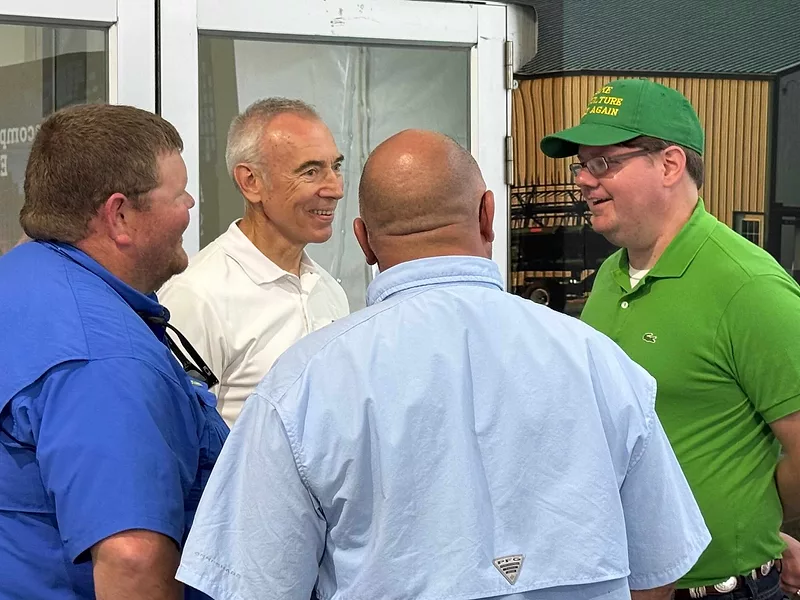
The Trump administration is discussing some type of “bridge” financial assistance to help farmers make it into 2026, says Deputy Agriculture Secretary Stephen Vaden.
Talking to reporters at the Farm Progress show in Decatur, Illinois, on Tuesday, Vaden provided no details of what the assistance would look like, but he noted that the department’s spending authority under the Commodity Credit Corporation (CCC) would typically be refreshed in November.
The first Trump administration used the CCC to provide two rounds of compensation to farmers for the trade war with China, and some sectors, most notably soybeans, are seeing prices depressed again this year by disrupted export markets.
Congress enhanced the two main commodity programs for row crops, Price Loss Coverage and Agriculture Risk Coverage, in the budget reconciliation law enacted in July, but farmers won't see any payments as a result of those changes until October 2026.
“We're seeing the same thing that farmers are seeing with regard to commodity prices, and we know that many of the most important pieces of the One Big Beautiful Bill don't come into effect until 2026. … So, we've got to get them from this growing season to the next growing season,” Vaden said.
He added, “We are seeking to develop policy solutions to bridge that … and that's what the secretary and I are working on, and what she's constantly talking to not only the president but other members of her cabinet about. You can rest assured that when we have those announcements to make, we'll do it.”
He also reiterated that the Trump administration is trying to expand export markets for U.S. agriculture. Soybean growers in particular have been hurt by a lack of sales to China due to retaliatory tariffs.
“Look, we're fully well aware that we've got to not only focus on markets that have worked for us in the past but open up new markets. … We're looking at the same commodity prices that the farmers are. We know those have got to come up, and the only way those can come up is to increase demand,” Vaden said.
“So, getting us back our own markets won't be enough, given the level of productivity that we have. We've got to open up new markets. That's our focus. But you can bet that on every conversation that we're going to have with administration officials from whatever department, opening up new markets, focusing on the commodity prices and focusing on the possible record yields we are seeing this fall is first and foremost in every conversation that we are having.”
He also noted in an interview on stage at the show that U.S. Trade Representative Jamieson Greer has initiated a countervailing duty case against Brazil over the idea that deforestation is unfairly subsidizing its exports to China in competition with U.S. farmers.
"Obviously, we don't harm the environment, but we certainly don't burn down the rainforest to generate our agricultural productivity,” Vaden said.
He urged farm groups to testify in support of the case at a hearing in September. He suggested a decision could come relatively quickly.
Interested in more news on farm programs, trade and rural issues? Sign up for a four-week free trial to Agri-Pulse. You’ll receive our content - absolutely free - during the trial period.
Vaden downplayed concerns about a human case of New World screwworm in someone who had returned to Maryland from Central America. He said such cases occur from time to time, were treatable and didn't threaten U.S. livestock.
Vaden was pressed by a reporter about concerns that information about the case had resulted in a drop in cattle markets on Aug. 8.
"If there are issues dealing with our markets, that's for the people that regulate markets to do. You're making an insider trading allegation. We at USDA are focused on the risk to cattle producers from the screwworm itself. This case does not represent that," he said.
Vaden also defended the Trump administration’s plans to reorganize USDA staff into five regional hubs. About half of the department’s staff in Washington would be moved to the hubs.
He said the new hubs in Raleigh, North Carolina; Indianapolis, Kansas City, Fort Collins, Colorado; and Salt Lake City will be more appealing to employees because of the lower cost of living and shorter commutes than in Washington.
“If you're a young person … you are literally driving, on average, a minimum one hour each way to commute to USDA headquarters,” Vaden said. “There are people who commute 90 minutes, two hours every day to do so. How many 25-year-olds do you think that sounds attractive to?”
Lydia Johnson contributed to this report.
For more news, go to Agri-Pulse.com.

