
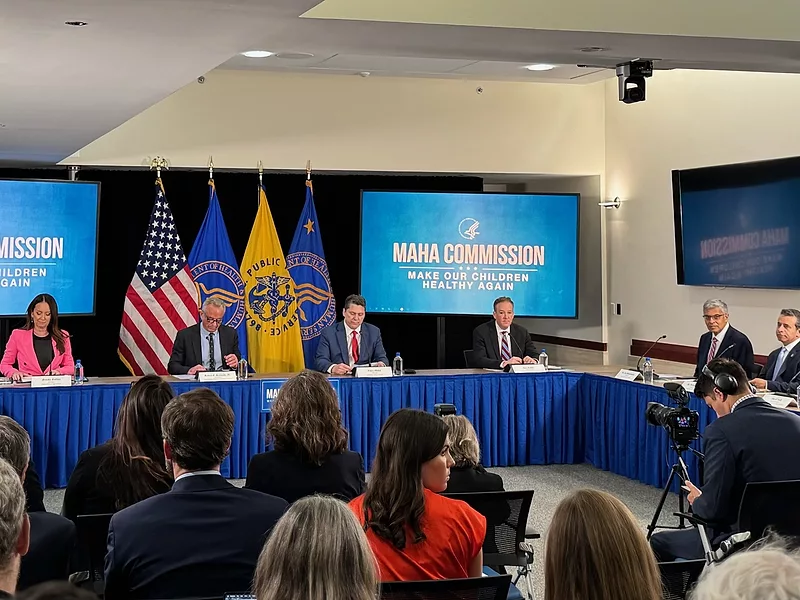
The Make America Healthy Again Commission recommends continued research on the role pesticides and plastics play in development of chronic disease in children and also suggests easing some regulations on farms.
The final report released Tuesday appears to be almost indistinguishable from the draft that was leaked last month, avoiding any mention of specific pesticides. The first MAHA report, billed as an assessment of the health threats facing children, highlighted the potential health impacts of glyphosate and atrazine.
That angered the ag community, which is worried about the loss of crop protection tools, and caused Health and Human Services Secretary Robert F. Kennedy Jr. to say that the administration did not want to do anything to hurt farmers.
Kennedy chairs the commission, and Ag Secretary Brooke Rollins is a member.
This time around, the commission recommended research on precision agriculture and said the Environmental Protection Agency, “partnering with food and agricultural stakeholders, will work to ensure that the public has awareness and confidence in EPA’s pesticide robust review procedures and how that relates to the limiting of risk for users and the general public and informs continual improvement.”
The final report also said EPA, USDA and the National Institutes of Health would “develop a research and evaluation framework for cumulative exposure across chemical classes.” The research will focus on the use of non-animal methods, including the use of computational tools.
“Consistent with statutory obligations under the Federal Insecticide, Fungicide, and Rodenticide Act and the Food Quality Protection Act, EPA will focus on pesticides acting through a common mode of action,” the report says.
"The Surgeon General will launch an education and awareness initiative on the impact of alcohol, controlled substances, vaping, and THC on children’s health." the report says.
On the food side, the report recommends removing restrictions on whole milk sales in schools, “allowing districts to offer full-fat dairy options alongside reduced-fat alternatives.”
The report says EPA and USDA will work with NIH to evaluate water contaminants and “update guidance and prioritizations of certain contaminants appropriately. For example, EPA will review new scientific information on the potential health risks of fluoride in drinking water to inform Centers for Disease Control and Prevention (CDC) recommendations.”
In addition, USDA, “through its Research, Education, and Economics mission area, in consultation with the Farm Production and Conservation mission area, will continue research on ways to improve water quality and adoption of applicable conservation practices. Agency research could also include research to inform the understanding of levels of pharmaceuticals in our water supply that could be adversely affecting animal and human health.”
Don’t miss a beat! It’s easy to sign up for a FREE month of Agri-Pulse news! For the latest on what’s happening in Washington, D.C. and around the country in agriculture, just click here.
The report suggests offering some regulatory relief to livestock farms and the produce industry.
For livestock operations, the report says the government should “ensure flexibility for farms to manage manure and process water without triggering industrial-grade permitting requirements and avoiding the forced mandates of costly technologies or practices that do not consider geography, weather, species, and operation size.”
For produce operations, the government should “more clearly define post-harvest rinse and wash water as non-hazardous “ to protect packers and handlers from “unnecessary wastewater treatment burdens.”
Among other recommendations from the report:
- Eliminate mandatory reduced-fat requirements in federal nutrition programs to allow consumer choice.
- Remove barriers preventing small dairy operations from processing and selling their own milk products locally.
- Eliminate zoning restrictions that prevent mobile grocery units from serving food deserts.
- Fast-track permits for grocery stores in underserved areas.
- Work with grocers on sustainable incentive programs that provide fresh, frozen, canned, or dried fruits and vegetables.
- Prioritize research and programs to help growers adopt precision agricultural techniques.
- Reform future Dietary Guidelines for Americans development processes, including structure and members of the advisory committee and scientific review of future DGAs.
- Continue to advance and implement policies to limit or prohibit the use of petroleum based food dyes in all food products approved in the U.S.
- Develop a U.S. government-wide definition for “ultra-processed food” to support potential future research and policy activity.
Reaction was positive from ag groups and negative from environmental groups.
The National Corn Growers Association said the report "reflected NCGA’s recommendation of reinforcing the Environmental Protection Agency’s robust, globally respected pesticide review process."
“The policy recommendations related to crop production, released today by the MAHA Commission, appear to be a reasonable and science-based approach for achieving its objectives," Illinois farmer and NCGA President Kenneth Hartman Jr. said.
International Dairy Foods Association President and CEO Michael Dykes said, “IDFA appreciates that the MAHA Commission’s strategy recognizes milk and other dairy foods as wholesome, nutrient-dense options that play a vital role in health and wellness.
"We urge the federal government to follow through on this strategy by acknowledging the health benefits of dairy foods at all fat levels in the upcoming Dietary Guidelines for Americans and throughout all federal nutrition programs," Dykes continued. "Additionally, we encourage USDA to use this strategy as the basis for working with Congress to expand SNAP dairy incentives to include more wholesome varieties of milk, cheese, yogurt and cultured dairy products for SNAP participants."
The American Soybean Association said the MAHA strategy "acknowledges [EPA's] robust, science-based pesticide approval process, a welcome shift from earlier critiques, and highlights the benefits of precision agriculture while proposing policies to expand access to these tools."
Kyle Kunkler, who was senior director of government affairs at ASA, focused on pesticides, regulatory policy and the Endangered Species Act, is now deputy assistant administrator for pesticides in EPA's Office of Chemical Safety and Pollution Prevention.
Western Growers President and CEO Dave Puglia said the commission "finally places a long-overdue emphasis on realigning our national food and nutrition policies to greatly enhance the role of fresh produce. At the same time, the commission has created a roadmap that cuts regulatory red tape and fosters innovation in much-needed research necessary to protect and strengthen the ability of American growers to provide these fresh fruits, vegetables and tree nuts."
Food & Water Watch, however, said the report, "in keeping with White House promises to monied industrial agriculture lobbyists ... does not endorse increased regulation for toxic pesticides. Fully 71% of Democrats and 66% of Republicans support increasing restrictions on the use of pesticides in agriculture."
The Environmental Working Group also was highly critical of the report.
"The MAHA plan echoes the pesticide industry’s talking points," EWG said in a statement. "The recommendations for improving Americans’ health includes blather about 'precision' agriculture. The report acknowledges 'confidence' in [EPA's] 'robust' pesticide review process, with zero words about banning the use of harmful pesticides."
Lori Ann Burd, environmental health director at the Center for Biological Diversity, said the strategy's "directive for the EPA and Big Ag to coordinate on a PR campaign aimed at convincing Americans that our pesticide regulatory process is robust is frankly insulting. The reality is that our pesticide regulatory process is as full of holes as Swiss cheese, and a slick PR campaign can’t change that."
The National Cattlemen's Beef Association called the report's findings a "perfect fit" with American beef.
"This report confirms the science-based recommendation that making America healthy again has to start with safe, nutritious, fresh, whole-ingredient and American beef hits the target on all of the above,” said Ethan Lane, NCBA senior vice president of government affairs.
The American Farm Bureau Federation, the largest general farm organization in the U.S., expressed appreciation for the commission's "willingness to meet with farmers across the country, hear our concerns and develop smart solutions," said AFBF President Zippy Duvall.
State farm bureau presidents met with multiple Trump administration officials, including EPA Administrator Lee Zeldin, Ag Secretary Brooke Rollins and senior MAHA adviser Calley Means, at the White House in July.
Lydia Johnson contributed to this report.
For more news, go to www.Agri-Pulse.com

