
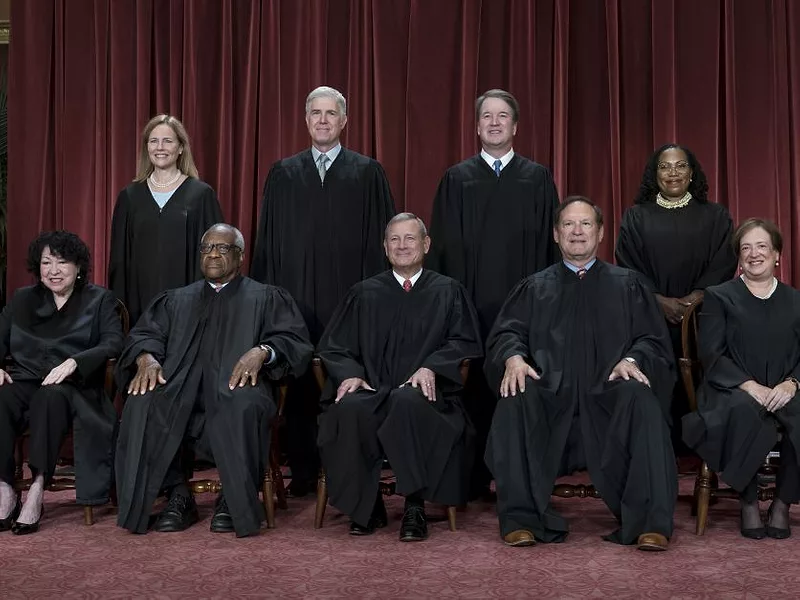
The Supreme Court has agreed to an expedited schedule for considering two cases challenging the legality of President Donald Trump’s tariffs. Oral arguments are set for the first week of November.
Both cases challenge Trump’s use of the International Emergency Economic Powers Act (IEEPA) to enact sweeping retaliatory tariffs on countries around the world. IEEPA is a law that affords presidents power over the regulation of imports.
A federal appeals court last month upheld a May Court of International Trade decision finding that Trump overstepped his authority in enacting tariffs on all countries. IEEPA powers are only available, the court said, when there is an “unusual or extraordinary” threat to the nation’s national security, foreign policy or economy.
The Supreme Court set Sept. 19 as the deadline for opening briefs, with responses due by Oct. 20.
Read more here
FONA photo
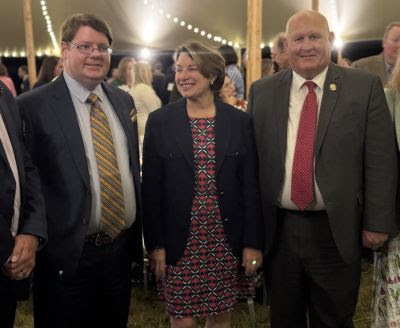 Deputy Agriculture Secretary Stephen Vaden with Senate Ag Committee Ranking Member Amy Klobuchar, D-Minn., and House Ag Committee Chair Glenn "GT" Thompson, R-Pa., at the Friends of the National Arboretum's annual Dinner under the Stars event Tuesday night (Agri-Pulse photo)
What’s next for MAHA? Lots of things
The agriculture community is happy with the MAHA Commission report, but critics of conventional farming practices are not.
The MAHA Commission steered clear of recommending restrictions on pesticides and heartily endorsed whole milk. It also recommended beefing up research on the roots of chronic disease. (See our story on the strategy here, at Agri-Pulse.com).
From the key players: At a press conference, Health and Human Services Secretary Robert F. Kennedy Jr., Ag Secretary Brooke Rollins and other administration officials promised action on a host of issues. Many of them focus on research on food, nutrition and cumulative chemical impacts.
There also is precision agriculture, which Kennedy and EPA Administrator Lee Zeldin mentioned.
“In partnership with the private sector, EPA is working to advance precision agriculture,” Zeldin said. “I've seen demonstrations in my travels throughout the U.S. using drones, computer assisted spray technologies and robotic monitoring.”
Kennedy also said agencies across the government would work together “to provide more assistance to farmers to support soil health, unleash innovation, and remove the barriers that hamper small farms.” He did not go into specifics.
Don’t miss a beat! It’s easy to sign up for a FREE month of Agri-Pulse news! For the latest on what’s happening in Washington, D.C. and around the country in agriculture, just click here.
Rollins said USDA would “promote solutions that not only improve nutrition programs and their outcomes, but also regenerative agriculture practices and other conservation programs.”
Food and Drug Administration Commissioner Marty Makary said at the strategy’s release event, “We're talking about the microbiome and food as medicine and micronutrients and soil and microplastics and all sorts of topics that we know are central to the health of kids.”
“Today's report makes it clear that we really are just getting started,” Rollins said.
Public perception: The MAHA movement is not quite as popular as it was a few months ago. A survey by experts at Purdue University and the University of Illinois found a marked drop-off among Democrats who have a “very positive” view of MAHA. In May, 33% of Dems held such a view. In August, that had fallen to 17%.
Republicans lost only a little enthusiasm. In May, 60% held a “very positive” view. In August, that figure was 58%.
Democrats air concerns about SNAP impact
Democrats used a hearing on the Supplemental Nutrition Assistance Program (SNAP) Tuesday to air their concerns about the new costs imposed by the One Big Beautiful Bill enacted in July.
Under the law, states will be required to start paying 75% of SNAP administrative costs, up from the current 50%. And states with a SNAP payment error rate above 6% will have to start sharing the cost of SNAP benefits as well.
The chairman of the House Ag Committee’s nutrition subcommittee, Brad Finstad, R-Minn., said the changes to SNAP in the new law would protect American taxpayers. “SNAP must be based on the goal of reaching nutrition independence, financial independence, and the American dream,” said Finstad.
But the top Democrat on the full committee, Angie Craig of Minnesota, said none of the bill’s changes to SNAP would “help reduce hunger in our communities.” Other Democrats highlighted the impact of the new costs on states. “This conversation has shifted totally away from limiting eligibility to certain people to eliminating the program for everyone,” said Rep. Shomari Figures, D-Ala.
Looking ahead: The House Ag Committee will hold a hearing on Tuesday, Sept. 16, examining the state of the specialty crop industry.
SCOTUS stays foreign aid order
In other news from the high court, the Supreme Court has temporarily stayed a lower court order to release about $4 billion in foreign aid payments.
In an emergency order, Chief Justice John Roberts issued the stay and gave the groups who have sought the payments until Friday to respond to the Trump administration.
Final words
“The commission’s strategy importantly acknowledges how EPA’s transparent, science and risk-based regulatory system is key to a safe and sustainable food supply. The United States regulatory system for pesticides is recognized as the gold standard around the world, and it is critical that American farmers and consumers can continue to trust the rigorous process and oversight.” – Alexandra Dunn, CEO of CropLife America, on the MAHA strategy.
“Clearly, eliminating the words ‘glyphosate and atrazine’ (that were in the first report) is not a result of new science that shows these two most widely used herbicides to be safe, but rather a tactic to appease the pesticide companies. We would rather that this MAHA Commission report had put the health and safety of our children first and made a bold commitment to reduce our children’s exposure to thousands of harmful pesticides, many of which are banned in other countries, many more which have been given emergency use authorization without safety studies.” – Zen Honeycutt, founder of Moms Across America, also commenting on the strategy.
Lydia Johnson, Parker Litterick and Noah Wicks contributed to today’s Daybreak.


