
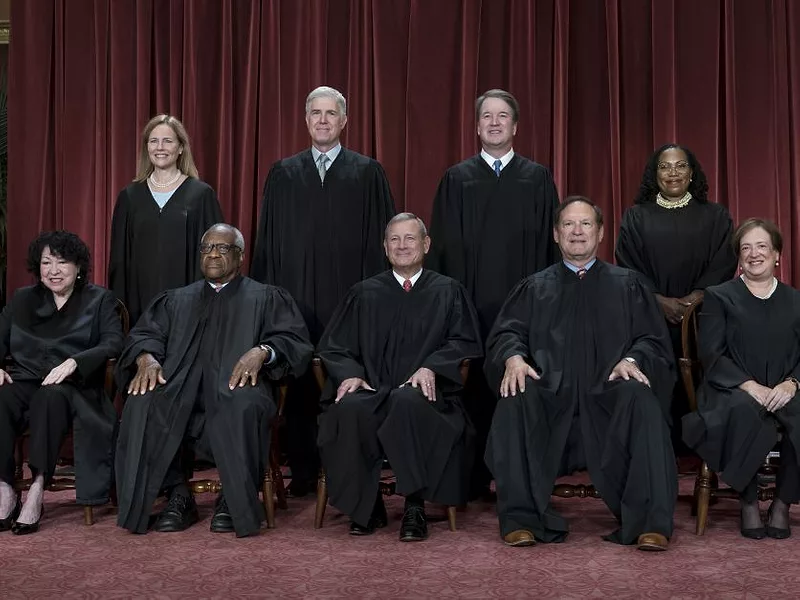
The Supreme Court is set to hear oral arguments next week in a landmark case challenging President Donald Trump's use of emergency powers to impose broad tariffs across almost all U.S. trading partners.
Trump is already billing the case as “one of the most important” in U.S. history and has even suggested he could attend the arguments in person.
“If we don’t win that case, we will be a weakened, troubled, financial mess for many, many years to come,” Trump told reporters earlier this month.
In a sign of confidence, the administration successfully petitioned the court to consider the case on an expedited timeline, rather than letting the case play out over many months while it continued to reap the revenue and negotiation leverage the tariffs can offer.
But trade lawyers say the case is a close one to call. They point out that both sides have solid legal arguments that could ultimately prevail. Accordingly, they say the most likely outcome is a ruling that leaves both sides wanting more.
“I'd say there's probably a 50% chance that they're going to do the middle-ground approach,” said a trade lawyer granted anonymity to provide a frank assessment of the case.
The lawyer added if the Supreme Court rules definitively on the tariffs, it is more likely to align with the lower court rulings and side with the challengers. “I think the chance of them fully affirming the administration is the lowest of the three,” they added.
The U.S. Court of Appeals for the Federal Circuit in August held that the president had exceeded his emergency authorities in using the International Emergency Economic Powers Act – or IEEPA – to impose widespread tariffs, although the 11-judge panel was divided 7-4.
“There's definitely arguments on both sides,” said Everett Eissenstat, a trade lawyer at Squire Patton Boggs who served as deputy director of the National Economic Council during the first Trump administration and a onetime chief trade counsel for the Senate Finance Committee. “They could go either way.”
Big questions
The case before the Supreme Court consolidates three cases – one brought by two family-owned toy manufacturers in the District of Columbia district court, another from a coalition of five small businesses in the Court of International Trade (CIT) and the third involving 12 Democratic state attorneys general.
The Supreme Court will consider many of the same questions that the CIT, district court, and court of appeals did in prior judgements, including whether Congress specifically delegated tariff authorities in IEEPA and, if it did, whether those authorities allow for tariffs of the magnitude that the president has imposed.
“They might look behind the statute to see what was Congress's intent,” Eissenstat said. Adding that they could also go even further and dig into whether Congress can ever fully delegate powers that the constitution specifies lie under its purview, like tariffs.
“There's a number of different ways they could go with this,” Eissenstat said.
 Everett Eissenstat (Squire Patton Boggs photo)
 The court could opt to side entirely with the respondents and strike down the tariffs for everyone, triggering a complex and challenging tariff refund process and, potentially, a scramble from the administration to pursue other tariff authorities to keep some duties in place.
“There might be some curbing of it,” Iowa Republican Sen. Chuck Grassley told reporters on Tuesday. “Or they could say what he's doing is entirely against the 1977 law.”
On the other hand, they could side entirely with the administration and leave all of the duties intact. But there is also a wide array of potential decisions in between, that would leave neither side fully victorious.
Some tariff refunds?
Wall Street at least sees some tariff refunds as a strong possibility. Some financial institutions are buying the rights to tariff refunds for around 20 cents for every dollar paid, according to reporting from the Washington Post last month.
But lawyers are skeptical that an adverse ruling for the government will see widespread tariff refunds. Earlier this year, the Supreme Court issued a ruling that constrained the ability of federal courts to issue nationwide injunctions that could have implications for this case.
Cut through the clutter! We deliver the news you need to stay informed about farm, food and rural issues. Sign up for a FREE month of Agri-Pulse here.
In Trump v. CASA Inc., the court held that a district court could only issue relief to the parties directly involved in a case.
This Supreme Court decision shaped the outcome of the Federal Circuit ruling on Trump’s tariffs in August. Although the court agreed with the CIT that the Trump administration’s tariffs were unlawful, it vacated the trade court’s universal injunction that would have seen the administration have to begin issuing remedies within 10 days. The appeals court cited Trump v. CASA Inc. in its decision and remanded that part of the case to CIT to assess the scope for a narrower injunction.
Lawyers note that the Supreme Court could adopt a similar stance in the tariff case and grant relief only to the parties directly involved in the case.
Under such a scenario, companies would be required to pursue their own litigation, either individually or part of a class action lawsuit, to secure tariff relief, said Greta Peisch, a lawyer at Wiley Rein who served as general counsel to the Office of the U.S. Trade Representative under President Joe Biden.
Some tariffs left standing?
Both the CIT and the appeals court decisions concluded that IEEPA can be used to impose tariffs but noted that the statute does not give the president carte blanche to place duties on all imports, from nearly all partners, for an indefinite amount of time.
The “president must act within some set of limits,” the Court of Appeals decision reads. The majority on that decision suggested that IEEPA tariffs should be temporary, limited to a subset of imported products or constrain them to a set rate.
Accordingly, Peisch said some of the tariffs Trump has imposed using IEEPA authorities could emerge unscathed, even if others are struck down.
 Greta Peisch (Wiley Rein photo)
“That's also a question,” Peisch said, “how broad is [a decision] going to be potentially?”
She pointed out that the president has used IEEPA authorities to impose a 40% tariff on Brazil, separate from the 10% tariff rate applied during the “Liberation Day” tariff rollout. Those tariffs came with a lengthy list of exemptions, making them more targeted than other tariffs the administration has pursued, and could be allowed to stand.
Similarly, Trump has also used the powers to impose tariffs specific to India for its continued purchases of Russian oil, which could also emerge intact if the Supreme Court is open to IEEPA justifying some tariffs.
Major questions?
Which way the case could ultimately go may hinge on how the judges view what is known as the “major questions” doctrine – a legal concept that argues Congress must use specific and clear language when delegating powers that are later used for significant economic policy actions from the president.
Conservative members of the court championed the major questions doctrine under the Biden administration and used it to curb the Environmental Protection Agency’s powers to address climate change.
“One thing to watch for” Peisch said, will be how the conservative judges that advanced this philosophy apply it to this case.
Given the expedited timeline, the administration may not have to wait long for a decision after the Nov. 5 hearing. Multiple lawyers said they anticipated a decision before the end of 2025, or early next year.
“It's a huge decision,” the trade lawyer granted anonymity said, adding that the case is a “judgement” on Congress’ role in tariff policymaking, and could force lawmakers to grapple with that same question.
If the Supreme Court keeps the tariffs in place, the lawyer said, it would send the message to Congress that “you gave the president the authority to put in place tariffs and raise and lower them on a plenary basis as you see fit. You don't like that? Take the power away.”

