
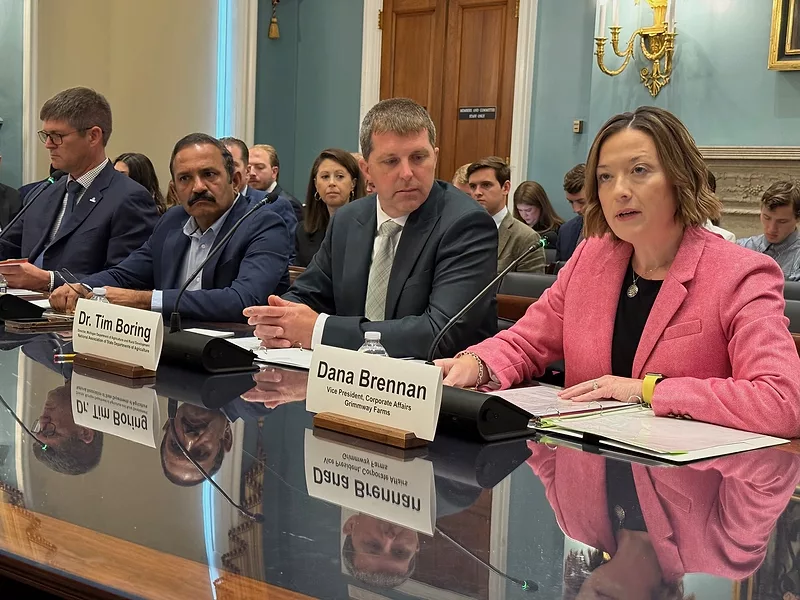
Tight labor supplies and President Donald Trump’s shifting tariff policies are increasing financial pressure on producers of a wide range of specialty crops, producers say.
At a House Agriculture Committee hearing on Tuesday, lawmakers were told that producers are struggling to deal with both the direct impact of tariffs on critical equipment as well as uncertainty about the impact of tariffs on their exports.
Producer groups also appealed to lawmakers to overhaul the H-2A program to lower wage rates and make it easier to apply for workers.
“Our business hasn't been materially affected by tariffs yet, but the uncertainty around them has already increased our costing, which has forced us to increase our prices. So we need price stability,” said Michael Frantz, president of Frantz Wholesale Nursery, a tree producer in Hickman, California. Frantz testified on behalf of AmericanHort.
Frantz said the Trump administration needs to exempt from tariffs specialty machinery that his operation can only get from Europe. He also said tariffs affected the cost of the burlap his operation needs for trees.
But the political challenge facing Frantz and other producers affected by tariffs was underscored by Illinois GOP Rep. Mary Miller’s response to his appeal for a tariff exemption. She essentially defended President Donald Trump's use of tariffs to promote domestic manufacturing.
Cut through the clutter! We deliver the news you need to stay informed about farm, food and rural issues. Sign up for a FREE month of Agri-Pulse here.
“And we do want free and fair trade, which is important, and we want to be producing our own equipment here,” Miller said.
Meanwhile, the specialty crop industry needs the Trump administration to remove non-tariff barriers to U.S. exports, said Dana Brennan, vice president of corporate affairs for Grimmway Farms, the carrot producer based in Bakersfield, California.
“Fresh produce is one of North America's most actively traded commodities, yet non-tariff barriers such as excessive residue limits and packaging standard standards block U.S. exports,” said Brennan, who was testifying on behalf of the International Fresh Produce Association.
As for the industry’s labor challenges, Congress “needs to step up and step in to look at bipartisan reform because something’s got to give, frankly,” said Brennan.
At another point in the hearing, she said, “I think it goes without saying that topic [immigration] has been top of mind for many in our industry. … It’s not just our industry being affected by these issues, but yet we, of course, are at the forefront where we feel it first.”
Frantz said a “lack of sufficient labor at times has prevented us from having the quality products we wish, because we can’t get the work done, and it’s preventing us from growing our business and seizing opportunities that are coming our way.”
Democrats on the committee repeatedly called out the Trump administration on the issues of immigration and trade.
“Like many of our row crop growers, specialty crop farmers are in a tough spot today,” said the committee’s ranking member, Angie Craig, D-Minn.
“Labor costs are high. Production costs are being driven up by tariffs or inputs that simply cannot be sourced within the United States. The trade wars are causing market turmoil and impacting the cost of machinery and equipment."
Rep. John Mannion, D-N.Y., said, “When trade relationships are fickle and labor rules change week to week, we are not serving our farmers well. We need to fix that.”
Republicans targeted the H-2A wage rates for criticism. The Trump administration is writing new regulations for the adverse effect wage rate, or AEWR, that effectively sets the minimum wage that producers must pay H-2A workers in each state. USDA recently killed the Farm Labor Survey that is used to set the state AEWR each year.
The adverse effect wage rates under the H-2A program are “artificially high” and have “led to increased imports. It’s led to fewer jobs,” said Rep. David Rouzer, R-N.C. Small farms “can’t make the numbers work, so they hang it up,” he said.
For more news, go to Agri-Pulse.com.

