
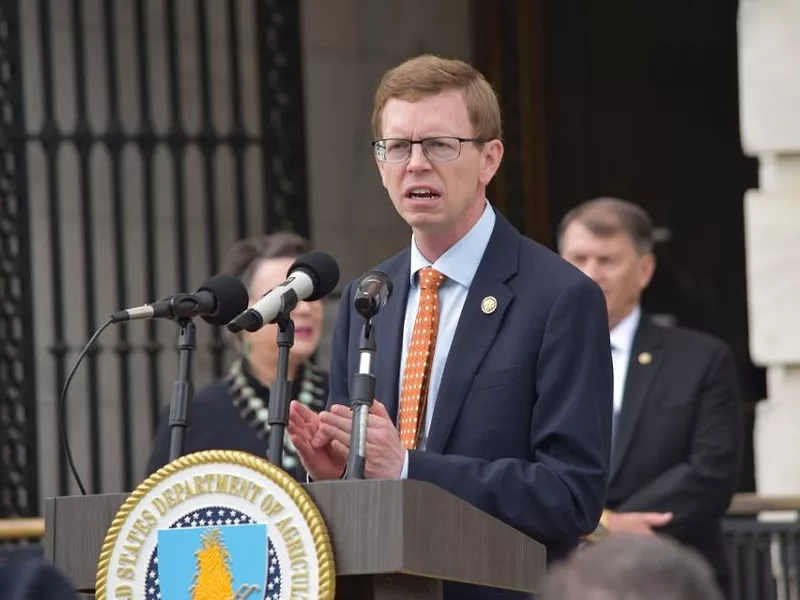
USDA’s Rural Development mission area needs enough staff at the local level to help producers take advantage of the array of available RD programs, witnesses told a House Agriculture Committee panel Thursday.
Former Deputy Secretary Xochitl Torres Small was among the panel of rural development experts who emphasized the value of having boots on the ground.
Torres Small said the departure of a significant portion of RD’s workforce and program cuts by the Department of Government Efficiency have “hobble[d] an already struggling mission.”
“Many state and field offices are currently operating at half capacity,” she said. “In some places it's worse, like Mississippi, where 90% of Rural Development staff were cut last year. Nationally, only 16 engineers remain in the RD state system.”
Under the Deferred Resignation Program, RD lost about 1,500 employees, or approximately one third, according to DRP figures obtained by Agri-Pulse.
“Vital projects are sitting on desks waiting for approval,” Torres Small said. “Phone calls are going unanswered. That’s not serving rural people.”
Lynne Keller Forbes, president and CEO of the South Eastern Council of Governments, urged the members of the subcommittee on commodity markets, digital assets, and rural development to “preserve USDA’s local footprint. As USDA reorganizes, maintaining field staff in communities is essential.” Forbes testified on behalf of the National Association of Development Organizations.
Asked to elaborate on his recommendations, Paul Heimel, a county commissioner in Potter County, Pennsylvania, said, “The key factor, number one, is that the staffing be adequate at the regional level."
“Keep these folks in the communities,” he continued. “That service has existed for decades. It's actually just part of our way of life in Potter and many, many rural counties. So the number one priority I would ask for is that the field staff be protected, at least at its current level, maybe even built upon – it’s that important to all of rural America.”
Heimel testified on behalf of the National Association of Counties. His message seemed to resonate with Rep. John Rose, a Republican from Tennessee.
“I appreciate that perspective, and I think probably [for] most folks who've dealt with USDA Rural Development, continuity of that staff is critical to delivering on the promise that RD has for our counties and states across the country,” he said.
The witnesses had numerous suggestions for how to improve the services and programs provided by RD. Torres Small and Keller Forbes both said core programs need to be funded.
“We need to resist the temptation of adding a program to solve every problem and instead double down on grant investments and bread and butter programs like community facilities that can fund a lot of different things,” Torres Small said. “We need to consider multi-year funding that gives a longer runway to adjust to the challenges of federal grants.”
Don’t miss a beat! It’s easy to sign up for a FREE month of Agri-Pulse news! For the latest on what’s happening in Washington, D.C. and around the country in agriculture, just click here.
She also called for simplifying the application processes. “I remember talking with a farmer who had a four-inch binder that his wife put together so that they could get a more efficient grain dryer. Those are the folks you've got to talk to,” she said.
Heimel said he’d like to see a fast-track application process for small-dollar grants. “Many, many very rural counties just do not have the resources to handle all the administrative burden” of applying for grants, he said.
Members on both sides of the aisle seemed to agree on the importance of Rural Development. At the end of the hearing, Subcommittee Chair Dusty Johnson, R-S.D., thanked the witnesses and the subcommittee members for not engaging in “partisan infighting that sometimes we see in this town.”
And Torres Small said, “I have to admit, my soul is just happy seeing this bipartisan effort, because the rural way of life is worth fighting for.”
The hearing did contain some sharp criticism of the Trump administration’s activities and policies. Speaking of staff losses at USDA that cut the agency by at least 15%, Torres Small said, “Let me be clear: The problem I'm raising here today isn't simply that federal staffing was cut. The problem is that those cuts happened without consulting the very people they affect.”
And Rep. Angie Craig, D-Minn., and ranking member of the full committee, criticized the One Big Beautiful Bill Act for cutting Medicaid, and said the $50 billion Rural Health Transformation Fund “that my colleagues are touting … does not come close to correcting the damage that the bill will do in rural America, both to our health infrastructure and other areas.”
Bette Brand, a former deputy undersecretary for RD, now president and CEO of Strategic Consulting, also testified. She cited a National Rural Lenders Association report that showed from 2014 to 2022, the Business & Industry guaranteed loan program created more than 750,000 jobs in rural America at a federal cost of just $438 per job.
“A direct example of the B&I program at work is in Virginia, where Maryland-Virginia Milk Producers Cooperative (in business for over 100 years) representing nearly 1,000 dairy farmers was able to purchase and upgrade a processing facility in November 2023,” she said in written testimony. “This allowed them to expand their product mix and put more money in the farmer/members’ pockets. This project retained 178 jobs, sustained regional dairy processing, and kept MDVA milk in the market.”
For more news, go to Agri-Pulse.com

