
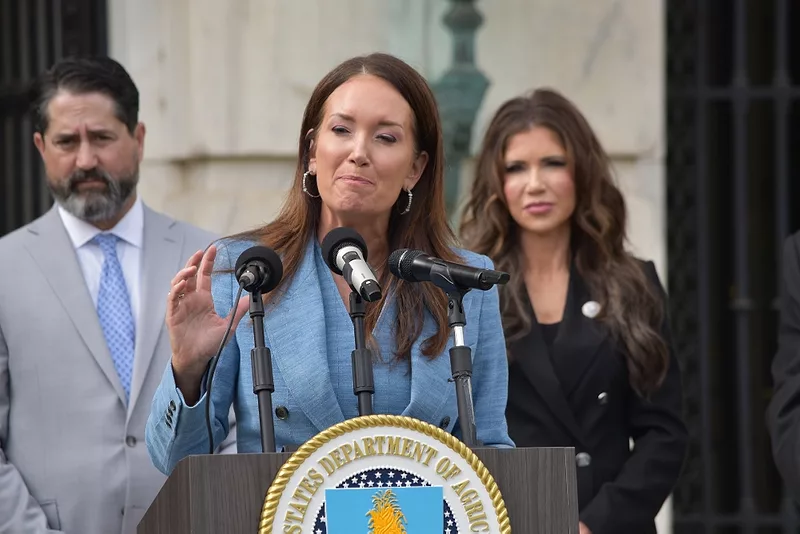
Ag Secretary Brooke Rollins will address the annual Ag Outlook Forum in Kansas City, Missouri, today during this pivotal moment in time for U.S. agriculture.
The forum at the Kansas City Marriott Downtown, is sponsored by the Agribusiness Council of Kansas City and Agri-Pulse Communications.
Rollins goes on at 10 a.m. Central Time (11 a.m. Eastern). Before Rollins at 9:30 a.m. Central is Alex Sayago, vice president of Ag & Turf Sales & Marketing for John Deere.
Other speakers include USDA Chief Economist Seth Meyer, Sen. Roger Marshall, R-Kan., and Harrison Pittman, director of the National Agricultural Law Center.
Judge says IG firings were illegal, but will not require reinstatement
A federal judge says President Donald Trump's abrupt January firing of federal inspectors general violated a 1978 law requiring Congress to be notified in advance but she did not order their reinstatement.
Federal Judge Ana C. Reyes in Washington, D.C., ruled Wednesday that Trump violated the Inspector General Act by not giving lawmakers the required notice and rationale for removal. USDA Inspector General Phyliss Fong was among those fired.
But Judge Reyes says the fired IGs could not prove that being fired had caused them “irreparable harm” and noted that even if they were reinstated, they could still be lawfully removed once Trump did provide notice.
"The court recognizes plaintiffs’ exceptional service as IGs, marked by decades of distinguished leadership across multiple administrations,” Reyes wrote. "They sacrificed much to take on the role of an IG and its many demands — no doubt including substantial time away from family and far larger paychecks available in the private sector. They deserved better from their government. They still do.”
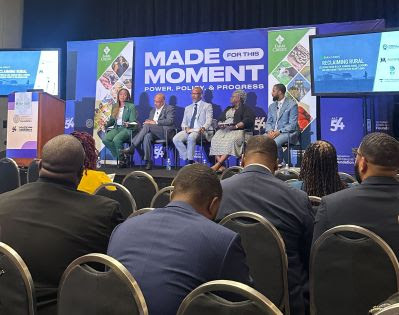
A panel at the Congressional Black Caucus annual legislative conference discusses issues facing Black farmers. Left to right: Rep. Shontel Brown, D-Ohio; Cornelius Blanding, executive director of the Federation of Southern Cooperatives; Ryan Locke, national president, Minorities in Agriculture, Natural Resources and Related Sciences; Jennie Stephens, Center for Heirs' Property, and Kent Roberson, Black Professionals in Food and Agriculture. (Agri-Pulse photo/Parker Litterick)
China to forgo ‘developing economy’ perks at WTO
China says that it will no longer self-identify as a developing economy at the World Trade Organization and will forgo the benefits and flexibilities associated with the status.
Chinese Premier Li Qiang made the announcement at the United Nations General Assembly this week.
Why it matters: Developing economies can get “special and differential treatment” in WTO negotiations. They can also sometimes take on lesser obligations, or be exempt from certain obligations, in agreements.
Former WTO Deputy Director-General Alan Wolff told Agri-Pulse the move shows that China wants more leadership in international trade.
“If China ever wanted to take a real leadership role in the WTO,” Wolff said, “this was an obstacle. [China] was claiming that it was something that it was not.”
Alternatively, Wolff said China’s move could be an effort to sweeten ongoing trade negotiations with the U.S. American officials had long been frustrated by China’s insistence that it was a developing country to get special treatment.
“This is long overdue. It should have happened 15 or 20 years ago,” Wolff said.
Customs brokers urge APHIS not to let government shutdown disrupt trade
An industry group representing U.S. customs brokers and freight forwarders is urging agencies to protect trade operations if the federal government shuts down.
Cut through the clutter! We deliver the news you need to stay informed about farm, food and rural issues. Sign up for a FREE month of Agri-Pulse here.
In letters to APHIS and other agencies, the National Customs Brokers & Forwarders Association of America urged the agencies to exempt enough employees to maintain import and export operations. Exempted employees keep working through government shutdowns.
“Safe and healthy trade supply chains are necessary to both the economic and physical security of our country and for American agriculture,” the letter to APHIS reads. “In the event of a government shutdown, we ask APHIS to prioritize import and export processing.”
The government will shut down on Sept. 30 unless lawmakers can break a deadlock over government spending.
Europe eyes further delay for deforestation rules
The European Commission is considering further delaying implementation of deforestation rules that would require importers of some ag commodities to show supply chains are deforestation-free.
The rules were set to come into effect this December, after being delayed by a year. Environment Commissioner Jessika Roswall told reporters on Tuesday that the Commission is weighing another one-year delay due to IT issues.
Why it matters: US officials and ag producers have repeatedly railed against the regulation, most recently in a 2025 report on global trade barriers. They decry onerous traceability requirements and argue the U.S. poses only a slight deforestation risk.
As part of the EU-U.S. trade framework agreed on last month, the European Commission committed to addressing U.S exporters’ concerns.
Agri-finance executive downplays rate cut impacts
The Federal Reserve is trimming interest rates. But John Maman, North America senior director for Nutrien Financial, says that’s not going to help the farm economy very much in the near term.
“It takes a long time to recover from such a rapid inflationary period,” Maman told reporters at Nutrien’s headquarters in Saskatoon, Saskatchewan. “Small, minimal drops” in rates don’t compensate for the 4%, 5% increase and everything else that came with that over a sustained period of time,” Maman said.
At the same time, he stressed that the situation today is much different than the 1980s. “Land values are as high as ever, and cash rent isn't going down anytime soon, and the cost of doing business continues to rise,” he said.
Senate Dems express concern about FNS reorganization
Ten Senate Democrats say they’re concerned USDA plans to close three of seven Food and Nutrition Service offices. The senators say the closures could “lead to reduced oversight quality, diminished technical assistance, and weakened relationships with state partners.”
In a letter, the lawmakers said USDA is planning to “reduce the number of FNS regional offices from seven to four locations.” They cited an Aug. 6 briefing by USDA legislative adviser Taylor Keel.
The lawmakers, who include Senate Ag Committee ranking member Amy Klobuchar, D-Minn., also said 500 FNS staff have left the agency since Jan. 20, which the senators claim has led to “longer wait times for state agencies needing support, delayed financial audits and management evaluations, and overall deterioration of nutrition programming.”
“Closing regional offices and relocating staff will only exacerbate these issues,” they wrote.
Final word
“There's a problem of, if you have the land, do you even have equal and proper access to USDA programs to support the land that you have? As you all know, USDA recently finalized a rule eliminating the Socially Disadvantaged Farmer and Rancher designation, claiming that race and gender-based discrimination has already been resolved. Now we know that isn't true, so I was quick to send a letter to the USDA, asking them for their reasoning behind this claim. But beyond the practical impact, I'm deeply concerned about the message that this sends.” – Rep. Shontel Brown, D-Ohio, moderating a panel sponsored by the Farm Credit Council at the Congressional Black Caucus Foundation’s annual legislative conference.
Philip Brasher, Oliver Ward and Noah Wicks contributed to today’s Daybreak.


