
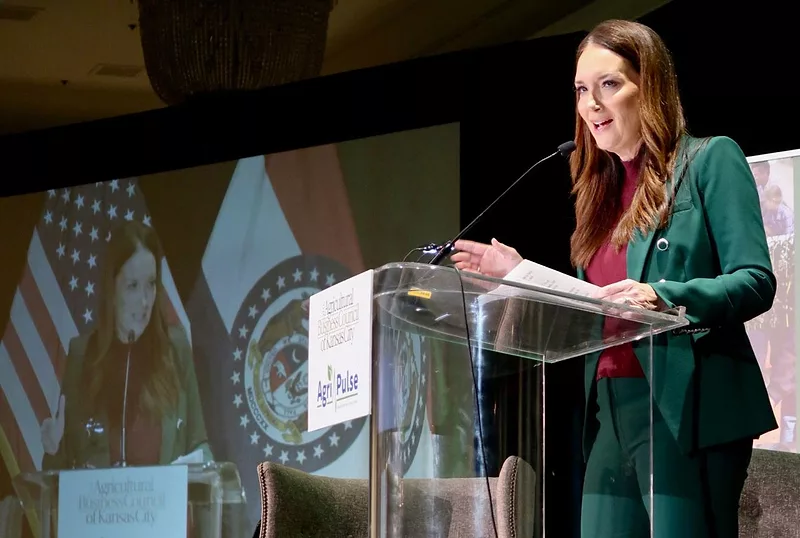
Rollins rules out cattle payments, takes on agribusiness
We’ve wrapped up a newsy, annual Ag Outlook Forum in Kansas City. Our headliner, Agriculture Secretary Brooke Rollins, made news in several ways. She ruled out a payment program for cattle producers. She announced the department’s releasing another $2 billion in payments to row crop producers through the Emergency Commodity Assistance Program. Some $8 billion in ECAP payments have already gone out to farmers.
And not least, she announced a joint effort with the Justice Department to investigate pricing of fertilizer and ag inputs.
“Yes, this is a Republican administration, but it’s definitely not your father’s GOP,” Rollins said. “This is a new, populist GOP. And as several of our speakers in Kansas City noted, this populism is going to affect agriculture in a number of ways, from corporate consolidation to ag technology.”
Take note: After speaking at the forum, Rollins ducked into a smaller meeting room to swear in the department’s new undersecretary for farm production and conservation, Richard Fordyce. Fordyce will be thrown right into crafting a new round of farm assistance on top of implementing provisions in the One Big Beautiful Bill Act.
Read more of our coverage at Agri-Pulse.com.
 Ag Secretary Brooke Rollins swears in Richard Fordyce as USDA's Undersecretary for Farm Production and Conservation in Kansas City (Ag Secretary photo) Trump tariff assistance comments spark questions of ‘how?’
President Trump says that the administration will use tariff revenues to support farmers amid an export slowdown. But his comments triggered questions from attendees at Agri-Pulse’s Ag Outlook Forum over how the administration could legally build such a program.
“Getting to this money is not going to be so easy,” said Harrison Pittman, director of the National Agricultural Law Center.
In his first term, Trump used the Commodity Credit Corporation to fund a bailout. But the CCC’s $30 billion borrowing authority has been depleted, and the fund will also be tapped in the coming months for other financial support programs.
The administration could use a statute known as Section 32, which is topped up by tariff revenues, but there are strict limits on how much officials can divert to support farmers.
Whether that statute would allow the administration to raid Section 32 for an assistance program remains an “open question,” added Pittman.
Don’t miss a beat! It’s easy to sign up for a FREE month of Agri-Pulse news! For the latest on what’s happening in Washington, D.C. and around the country in agriculture, just click here.
But, but, but: Texas A&M University’s Bart Fischer isn’t betting against the administration just yet.
“Don't underestimate USDA attorneys and their ability to find authority for a president to be able to do what he wants when he wants," Fischer said during a forum panel. "I wouldn't rule that out. But honestly, Congress has a lot to say too."
Stocks drop at input companies following DOJ-USDA announcement
Shares of some of the world's biggest farm input companies fell Thursday as the Trump administration announced plans to ratchet up oversight of higher costs for everything from fertilizer to seeds.
Fertilizer giant Mosaic, seed maker Corteva and pesticide supplier FMC all closed more than 3% lower after Agriculture Secretary Brooke Rollins told the annual Ag Outlook Forum in Kansas City, Missouri, that USDA and the Department of Justice are teaming up to protect growers from an onslaught of volatile and elevated input costs over the last four years even as crop prices have dropped sharply.
The move comes as producers of corn and other crops are struggling anew with high farming costs and the prospect of excess supplies piling up in bins ahead of next spring's plantings.
President Donald Trump's tariffs are sending the cost of fertilizer, tractors and other agriculture tools higher. The new price scrutiny includes DOJ's antitrust division, raising the specter of potential government crackdowns.
Shares in Nutrien, the largest maker of fertilizer, fell 1.5%, while nitrogen fertilizer behemoth CF Industries dropped 2.2%.
Rollins claims Mexican noncompliance with screwworm commitments
Agriculture Secretary Brooke Rollins on Thursday claimed Mexico is failing to live up to some of its commitments to fight New World screwworm, including tending to fly traps and enforcing the movement of cattle in infected regions.
At the Ag Outlook Forum in Kansas City on Thursday, Rollins said the U.S. will not consider lifting its restrictions on cattle imports across the border until Mexico displays “100% compliance.” She called on the Mexican government to “expand surveillance immediately and lock down cattle movements in infected zones.”
Take note: During the forum, Steve Boren, Boehringer Ingelheim’s vice president for livestock, said screwworm could have a $1.8 billion economic impact on the state of Texas alone, if it were to be introduced in the U.S.
Also at the forum, Sen. Roger Marshall talked up regenerative agriculture, saying he believes farmers will “one day make as much, maybe more, from carbon credits as you do from selling corn.”
Marshall extolled the virtues of healthy soil and the use of precision agriculture to cut back significantly on the use of fertilizer and pesticides.
But he also was adamant about a perennial issue – year-round E15. “I think E15 should be the number-one priority of the administration right now,” he said. “And anyone that cares about agriculture, all your groups, that should be the number-one ask of the White House right now.”
Marshall also said growers are wrong to think more trade will solve their woes. “I think the focus needs to be turning corn, turning commodities into protein or to biofuels next,” he said.
Read more at Agri-Pulse.com.
Beijing says soybean purchases will resume when tariffs are lifted
A spokesperson for China’s Ministry of Commerce says U.S. soybean orders will return when the U.S. drops its tariffs.
He Yadong outlined what it would take for Chinese buyers to return to the U.S. soybean market during a press conference on Thursday.
“On soybean trade, the United States should take positive steps by canceling unreasonable tariffs to create conditions for expanding bilateral trade and inject greater stability and certainty into global economic development,” he said.
Virginia Houston, director of government affairs at the American Soybean Association, said the comments confirmed what many in the industry have been hearing from Chinese buyers.
“We've heard that they want to buy our beans,” she said, but “soybeans are a strategic leverage for the Chinese.”
Take note: China hasn’t placed any orders for the new U.S. soybean crop. The country’s domestic stockpiles are high, analysts say, and buyers could hold off for several more months if no political settlement materializes.
Chinese buyers also got some relief this week when Argentina temporarily suspended an export tax on grain. Reuters reported that Chinese buyers ordered some 20 shipments of soybeans before Argentina reinstated the tax on Thursday.
China to probe US and Mexican pecans over dumping allegations
China’s Commerce Ministry says it will investigate pecan imports from the U.S. and Mexico to determine if they are being sold at below market value.
The move is the latest convulsion in the already strained trade relationships between China and North American nations. The U.S. and China remain locked in ongoing trade negotiations, while Mexico this month unveiled proposals to hike tariffs on a slate of Chinese exports.
China is the U.S.’s second-largest market for in-shell pecan exports, behind Mexico. But a portion of exports to Mexico return to the U.S. shelled, according to research from Texas A&M.
Liu Pengyu, a spokesperson at China’s embassy in Washington, told Agri-Pulse that imports from Mexico and the U.S. have caused “substantial damage” to China’s pecan sector.
Final word
“If you think that trade is going to solve all our woes, I think you're wrong. I think the focus needs to be turning corn, turning commodities into protein or to biofuels next.” – Roger Marshall, R-Kan., at the Ag Outlook Forum Thursday.
Philip Brasher, Kim Chipman, Oliver Ward and Noah Wicks contributed to today’s Daybreak.

.webp?t=1762183428)


