
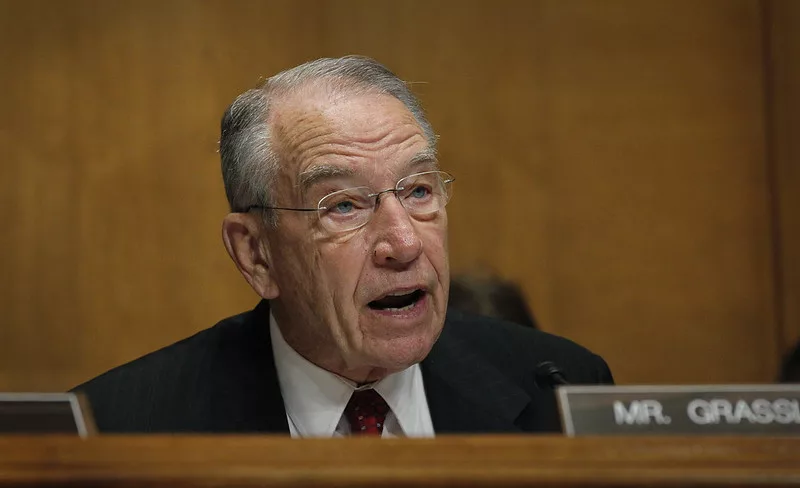
Senate Ag Rs want Trump’s ear
Republicans on the Senate Agriculture Committee are seeking a meeting with President Donald Trump as soon as possible about the situation in farm country. That’s according to committee member Chuck Grassley, R-Iowa, who spoke to reporters Monday.
As of Monday evening, there was no timetable for a meeting.
Farm groups are pushing for a bailout to deal with the impact of Trump’s trade war with China.
Government shutdown imminent after talks fail
It looks like there will be a government shutdown at midnight tonight after a White House meeting Monday ended without a deal.
The Women, Infants and Children nutrition assistance program, better known as WIC, would be at risk during a shutdown much sooner than SNAP because states haven’t received WIC funding for fiscal 2026.
House Speaker Mike Johnson, R-La., told reporters after the White House meeting that the WIC “will not be funded,” if the government shuts down. The Office of Management and Budget said in a statement to Agri-Pulse that WIC “would run out of money in October and women and children could no longer receive benefits.”
“If it's a prolonged federal government shutdown that lasts more than a week, it is going to put babies and young children at risk,” said Georgia Machell, president and CEO of the National WIC Association. She recommends WIC participants check the WICShopper app for closure updates and guidance.
As for SNAP: The Food Research & Action Center says SNAP benefits won’t be affected in October, but November benefits could be delayed unless states are given the go-ahead to process them.
Don’t miss a beat! It’s easy to sign up for a FREE month of Agri-Pulse news! For the latest on what’s happening in Washington, D.C. and around the country in agriculture, just click here.
“If a shutdown extends beyond mid-October, USDA could technically tap its contingency reserve funding to cover SNAP costs,” FRAC Interim SNAP Director Gina Plata-Nino says in a blog post. “Under the prior administration, this reserve stood at $6 billion, but it is unclear how much remains available or whether the current administration would choose to use it.”
RIFs can move forward during funding lapse
Office of Personnel Management guidance confirms reductions in force can take place at federal agencies during a government shutdown. OPM says the Office of Management and Budget “determined that agencies are authorized to direct employees to perform work necessary to administer the RIF process during the lapse in appropriations as excepted activities.”
“The RIF notice period continues during a lapse in funding (i.e., the effective date of release occurs as planned),” OPM’s guidance says.

The image of Bessent's phone (AP photo)
Soybean farmers’ messages are getting through to Bessent
A photo taken at the UN General Assembly shows a text message to Treasury Secretary Scott Bessent conveying soybean producers’ ire at proposed financial help to Argentina.
“Just a heads up. I am getting more intel, but this is highly unfortunate,” reads the message from an unnamed sender with the apt initials “BR.” Neither the Treasury Department nor USDA responded to questions from Agri-Pulse on whether “BR” refers to Ag Secretary Brooke Rollins.
“We bailed out Argentina yesterday and in return, Argentina removed their export tariffs on grains, reducing their price to China at a time when we would normally be selling to China,” the message continued. “Soy prices are dropping further because of it. This gives China more leverage on us,” BR warned.
The message, captured by an AP photographer, also includes a link to a social media post from Ben Scholl, a grain trader at Osterbur and Associates. Scholl made multiple posts last week criticizing the administration’s announcement that it would give Argentina assistance at a time when China is pivoting to South American soybeans.
Bill introduced to strengthen cotton supply chain
Rep. Ronny Jackson, R-Texas, will introduce a bill today directing USDA’s Risk Management Agency to create an incentive program for cotton producers to use indemnified cotton to support the supply chain.
With rising input costs and U.S. cotton production challenges, Jackson says the legislation will “help stabilize the cotton industry, ensuring that our cotton gins, warehouses, merchants, and cooperatives have ample product to continue serving America’s cotton producers and supporting rural communities across the U.S.”
The National Cotton Council, Plains Cotton Cooperative Association, Cotton Warehouse Association of America and Southwest Council of Agribusiness, among others, support the bill.
Rural veterinarians, stakeholders air concerns
Participants in a USDA-sponsored listening session on rural veterinarians aired concerns about several issues, including severe workforce shortages, student debt, limited educational access, burnout, and administrative hurdles. Both rural vets and interested stakeholders took part in the online session.
Kayla Williams, a food safety and inspection veterinarian at American Foods Group, urged USDA to continue seeking out local perspectives on the issue. “If the people at the top don’t understand what’s happening on the ground, how can they fix it?”
Another session is scheduled today.
Final word
"Farmers who don't have storage are going to have to take a hit to pay for storage, and perhaps even store on the ground, which isn't ideal at all, especially for soybeans," Minnesota Ag Commissioner Thom Peterson, speaking to Agri-Pulse about grain storage availability in the northern Great Plains.
Philip Brasher, Parker Litterick, Oliver Ward and Noah Wicks contributed to today’s Daybreak.


