
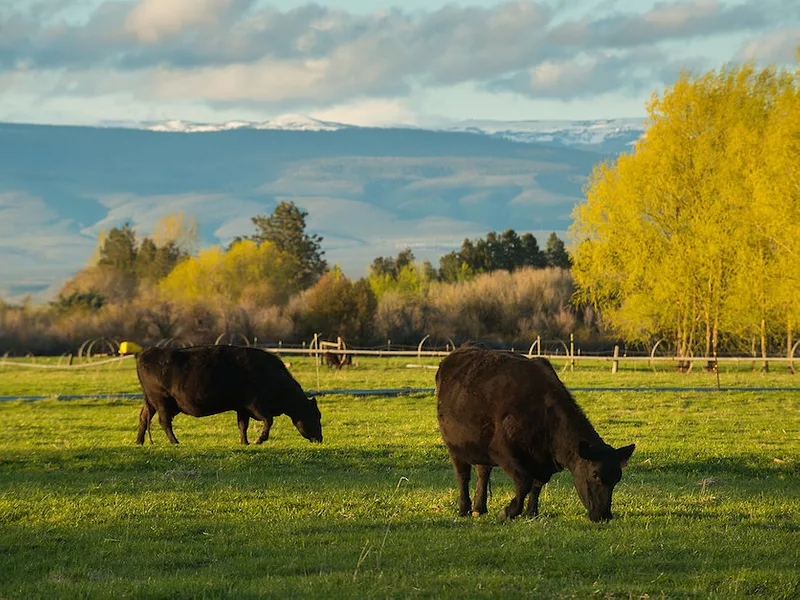
Agriculture Secretary Brooke Rollins has teased a plan to spur beef producers to restock their shrunken herds, but economists already expect U.S. cattle inventories to begin growing soon. It’s just a matter of when.
“I think the market’s well on its way to a natural remedy,” said Terrain economist Don Close, who has heard anecdotes of cattle producers holding back heifers but hasn't seen any firm evidence that herd expansion has started.
The size of the U.S. beef herd, including calves, dropped to 94.2 million head in July, a low not seen since the early 1950s, according to USDA estimates. Meanwhile, retail ground beef prices climbed to an average of $6.58 per pound in August, the highest since 1984, when the Bureau of Labor Statistics began collecting data.
“Low inventory and high demand is not sustainable if we wish to be a country that can feed ourselves,” Rollins recently said at the Ag Outlook Forum in Kansas City, Missouri, where she announced that USDA was working on a “robust plan to revitalize and diversify the U.S. beef industry."
While Rollins said more details would be released in mid-October, she hinted that it would focus on “opening up more working lands,” expanding beef industry risk mitigation tools and “hopefully inspiring the next generation of farmers.” She said the announcement would include Interior Secretary Doug Burgum, suggesting the Bureau of Land Management could be involved.
She said USDA has “no current plans to offer any payment to beef producers. We see how the government getting involved can completely distort the markets.”
Speculation over that possibility had spread following a Sept. 21 USDA press release that said a plan was in the works to “help rebuild the American cattle supply, incentivizing our great ranchers, and driving a full-scale revitalization of the American beef industry."
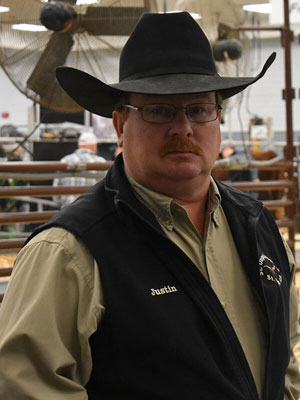 Justin Tupper (USCA photo)
Justin Tupper, president of the U.S. Cattlemen’s Association, said he was glad to hear the plan would not include direct payments to producers, arguing that such an action would be “messing with the market."
“We are definitely against monetary payments to try and incentivize people to keep heifers,” Tupper said. "We don’t think that’s a good way to do it at all. ... When the markets are this high, guys are going to start to keep a few more heifers, and it’ll take care of itself.”
Producers have been cautious about restocking amid future uncertainty about a number of factors, including weather, labor and trade, said Kansas State University economist Glynn Tonsor. He expects to see ranchers display “sizable interest in holding back heifers” next summer.
Cut through the clutter! We deliver the news you need to stay informed about farm, food and rural issues. Sign up for a FREE month of Agri-Pulse here.
Likewise, Terrain's Close expects to see a shift in the cattle cycle next year, noting that producers "have been liquidating for seven years now, and there’s just not a lot of spare cows left to harvest.” When expansion begins, he said it will likely be slower than in 2015, when supply grew quickly and many producers “got burned really hard.”
“It did roll over unexpectedly quick. And when it did roll over, it was vicious,” Close said of the cattle market in 2015, pointing to producers’ memories from that year as one likely reason they’ve been so cautious in expanding this time around.
Close said he was glad Rollins clarified that there would be no direct producer compensation, which he thought “was a horrible idea.” While opening up additional acres of public lands “would help,” it “may not be that significant,” he said. However, increasing stocking rates on public lands could provide “real opportunity,” he added.
Increased public land access could incentivize expansion, but may fuel conflicts with other users
Tupper believes there could be a benefit to increasing public land access, “as long as it's handled correctly.” In particular, increasing stocking rates, or allowing more animals on certain tracts, would be help producers looking to expand their herds, he said.
The number of livestock operators authorized to graze on BLM land has risen and fallen at various points in the last 14 fiscal years, but has generally remained between 15,000 and 17,500, according to an Agri-Pulse analysis of data from yearly agency reports. During that time, it has increased from 15,751 in FY2010 to 17,045 in FY2024.
Meanwhile, the number of livestock permittees authorized to graze on Forest Service lands has generally decreased since FY2010, going from 6,329 that year to 5,364 in 2021, the most recent year with available data.
Jonathan Wood, vice president of law and policy at the Property and Environment Research Center, said he would be surprised if USDA and Interior Department leaders could dramatically increase grazing acreage. A 2017 Congressional Research Service report suggests around 17.7 million acres of available Forest Service land and 16 million acres of BLM land were not used in FY2015, leaving some room for additional acres.
 Jonathan Wood (PERC photo)
However, Wood said some of this available grazing land was voluntarily retired due to negotiations between ranchers and conservation groups, with the land management agencies signing off in the end. If producers were once again access these acres, he said conservation groups would probably stop trying to work with landowners and turn to litigation instead.
“If part of this is to reopen those areas and essentially void those agreements, that is going to encourage much more conflict,” Wood said, adding that litigation is "not really a great outcome for anybody, but that would definitely be how many in the conservation community would respond if some of those closed allotments got reopened."
Wood noted that based on the CRS report, each agency has roughly 100 million acres put towards other uses that grazing could theoretically be expanded to, but that also could stir up conflict with other land users. He also said some federal lands have low-quality forage or are hard for cattle to get to, which limit their potential usefulness to beef producers.
When expansion does occur, Tonsor said it will likely take less time for the U.S. cattle herd to peak than in past cycles. This is because beef production has grown increasingly more efficient, with ranchers better able to produce more meat per animal.
“The difference between the trough and the peaks is narrowing over time because we don’t need to move the number of cows as much to have the same beef production change effect,” Tonsor said.

