

Farmers could face a sharp net income drop in coming years barring a price turnaround for row crops or a continuation of the massive government funding packages that are shoring up the ag economy.
Congress passed $31 billion in special farm assistance, including disaster aid, last December, and two more rounds of assistance are currently in development, the first totaling about $12 billion to $13 billion that the Trump administration is preparing to initiate using USDA’s Commodity Credit Corporation spending authority. Congressional appropriators are preparing for a second round of payments that would be funded through tariff revenue.
Agriculture Secretary Brooke Rollins calls the Trump administration’s planned payments a “bridge” to get farmers “from the Biden years to the new Trump era.”
Without those two new bailout packages, net farm income is projected to peak at nearly $177 billion this year before plunging to under $142 billion in 2026 and under $140 billion in 2027, according to projections by the University of Missouri’s Food and Agriculture Policy Research Institute (FAPRI).
FAPRI, which advises Congress on policy impacts, is projecting that commodity prices will remain relatively flat through 2031, the last year of its latest forecast, even with export markets returning to levels seen prior to the recent disruptions with China.
“For sure, if we get a trade deal that results in higher commodity prices, that can be a different world, of course,” said FAPRI Director Pat Westhoff.
FAPRI projects that total government payments will drop by about $20 billion a year despite a historic increase in the amount of money farmers will be getting from farm bill commodity programs because of changes made by the sweeping domestic policy law known as the One Big Beautiful Bill Act, which passed in July.
The bill added 30 million eligible acres to the programs while also making changes that increase the likelihood and size of payments.
Payments from commodity programs are expected to jump to $9.7 billion a year, primarily from the Price Loss Coverage program, starting in fiscal 2027. That’s up from less than $700 million that was paid out in FY25, which ended Sept. 30. FY27 is when farmers will receive their first payments under the One Big Beautiful Bill.
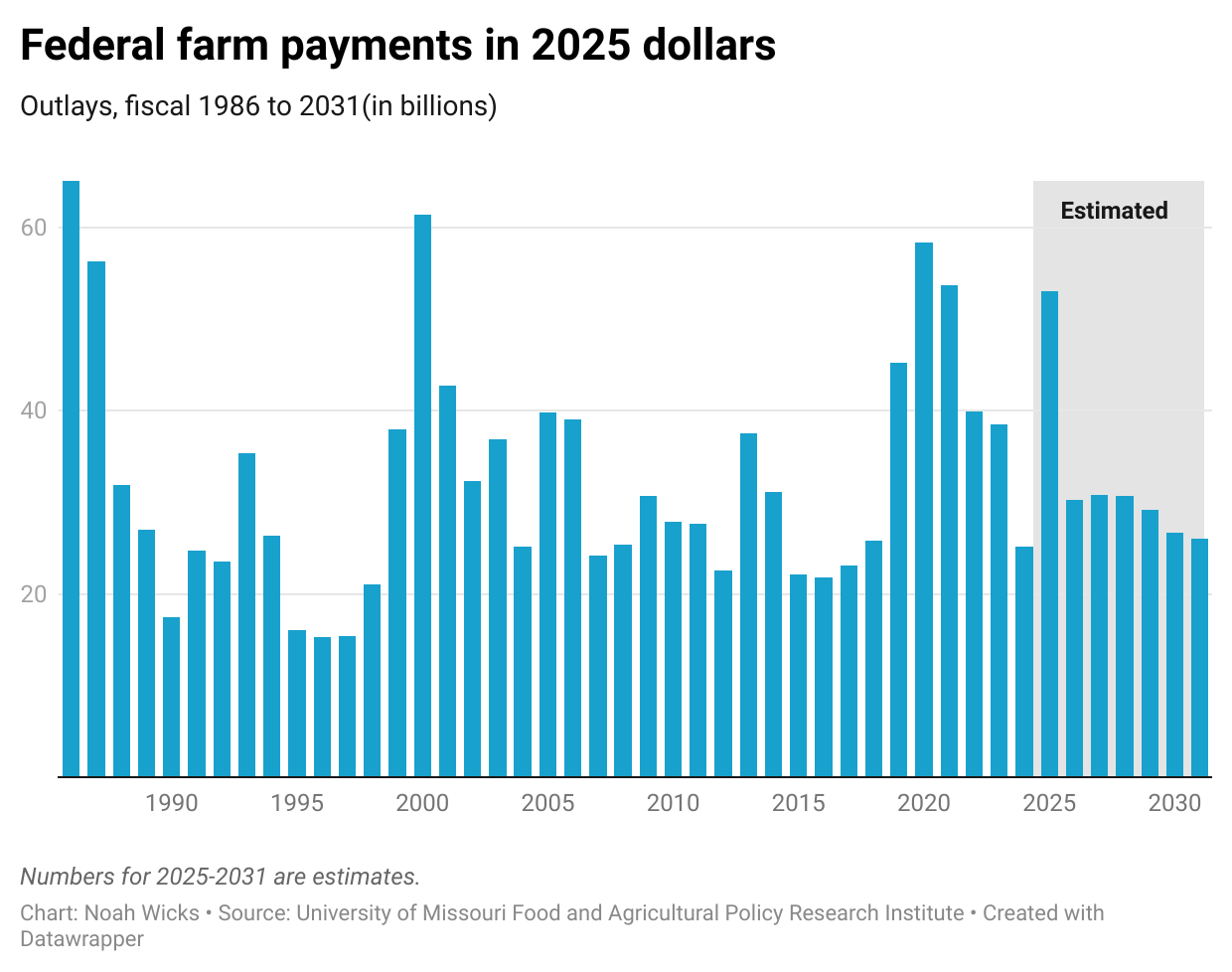
Still, despite that expansion in commodity programs, total government payments are projected to drop from $53 billion in FY25 to $32 billion in FY27, assuming there are no new rounds of ad hoc supplemental assistance, according to FAPRI.
Adjusted for inflation, the estimated government payments are still above the $27 billion a year that farmers received between fiscal 2009 and 2018, the year Trump launched his first trade war with China and initiated his first bailout of the farm economy. In FY19, total government payments jumped to $45 billion due to Trump's Market Facilitation Program.
“It is not sustainable to be dependent on government payments,” said Caleb Ragland, president of the American Soybean Association, describing them as a "Band-aid on a wound." He said farmers continue to be squeezed between input costs and slumping commodity prices, and they aren’t to blame for the disruption in exports to China.
Cut through the clutter! We deliver the news you need to stay informed about farm, food and rural issues. Sign up for a FREE month of Agri-Pulse here.
“This is a situation of the government picking winners and losers and taking away a market … that has been 50 years in the making,” he said.
GOP senator: We need 'positive news' on trade
The monthly Purdue University-CME Group Ag Barometer suggests farmers’ confidence in Trump trade policy is slipping, although it's still relatively strong. In June, 63% of survey respondents were confident Trump’s plan would provide long-term net benefits. In September, 51% were still sure that policy would pay off.
The survey was conducted well before Trump announced that he was adding 100% tariffs on China in retaliation for Beijing’s decision to tighten exports of critical minerals.
Farm-state Republicans are for the most part still giving Trump time to cut more trade deals that will benefit agriculture.
“We just need some positive news,” said Sen. Deb Fischer, R-Neb. “We need to have some positive news about trade.”
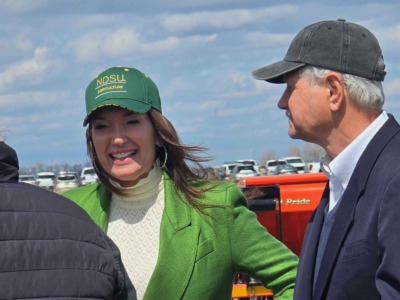 Ag Secretary Brooke Rollins with Sen. John Hoeven, R-N.D. (Agri-Pulse photo)
Asked if he’s confident Trump’s trade policy will work for farmers, Sen. John Hoeven, R-N.D., replied, “I’m hoping.”
Noting that Trump and Chinese President Xi Jinping are scheduled to meet later this month, Hoeven added, “I'm hoping we start to see some breakthroughs there, but there's no guarantees. Remember, it took two years [to secure the [phase one deal] with China.”
West Virginia GOP Sen. Jim Justice, a member of the Senate Ag Committee, said he supports Trump’s use of tariffs, “but at the same time, you’ve got a lot of farmers that are really hurting. If we don't step up right here and help those farmers, shame on us.”
Sen. Mike Rounds, R-S.D., said Trump is “trying something different” when it comes to trade policy. “I’m not going to second-guess him yet. We’re going to do our best to support the president as he tries to get some trade deals that will actually help our farmers and ranchers.
“China's not buying any soybeans. We know that. They're not buying any corn. We know that. And so, for our farmers and ranchers, we've got to have other alternatives. One thing that could be done that would be very helpful would be year-round E15 sales across the United States that wouldn't cost anybody anything.”
Hoeven, who chairs the Senate Agriculture Appropriations Subcommittee, stresses that promising farmers additional payments this year gives the Trump administration leverage in negotiations with China.
“That's why it's so important we do this the way we are. It's not just to get our farmers a bridge to where they have the sales. It's to send a very clear message to China that they're not going to be able to retaliate against our farmers,” he said.


