
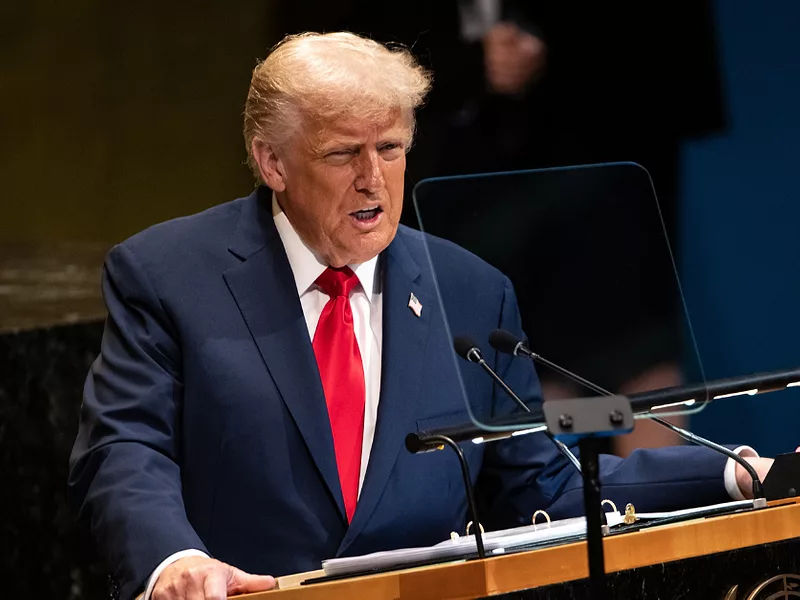
President Donald Trump on Friday said he will impose a new 100% tariff on imports from China starting Nov. 1 following Beijing’s decision to tighten exports of critical minerals. The fresh flare-up of U.S.-China tensions leaves a planned meeting between the two countries’ leaders at the end of the month in jeopardy.
“China has taken an extraordinarily aggressive position," Trump wrote in a social media post Friday afternoon. He added that “starting November 1st, 2025 (or sooner, depending on any further actions or changes taken by China), the United States of America will impose a Tariff of 100%.”
In addition to the new tariff, the president also said that the U.S. would adopt new export controls on "critical software."
On Thursday, Beijing unveiled new controls on rare earth exports – minerals essential for the manufacturing of high-tech products including an array of electronics, military equipment and medical products.
Trump denounced the move in a lengthy social media post on Friday morning as “sinister and hostile” and accused Beijing of “lying in wait” while U.S.-China tensions thawed in recent months.
“I was to meet President Xi [Jinping] in two weeks, at APEC, in South Korea, but now there seems to be no reason to do so,” Trump added, referring to a forthcoming leaders meeting hosted by the Asia-Pacific Economic Cooperation.
Later on Friday Trump told reporters that he hadn't cancelled the meeting with Xi, but added, "I don't know that we're going to have it.... We might have it." Trump said that he would still travel to the APEC leaders meeting.
The Chinese embassy in Washington did not immediately respond to Agri-Pulse's request for comment.
The U.S. and China reached a tariff truce earlier this year in which both sides reduced triple-digit tariffs as part of a commitment to continue discussions on a long-term tariff solution. That arrangement was set to end in mid-November.
U.S. Treasury Secretary Scott Bessent had signaled that he expected both sides to secure a pact before the November deadline. But the latest frictions have cast doubt on a potential deal, leaving U.S. soybean farmers anxious.
The American Soybean Association “was hopeful that these upcoming talks between the United States and China would lead to a deal that would restore U.S. soybean exports to China, traditionally soybean farmers’ largest export by far,” ASA Presidet Caleb Ragland said in a statement following Trump’s fresh tariff threat.
“ASA is extremely disappointed that the planned meeting at the end of the month between President Trump and Chinese President Xi is canceled as of right now,” Ragland added.
Cut through the clutter! We deliver the news you need to stay informed about farm, food and rural issues. Sign up for a FREE month of Agri-Pulse here.
Trump had also signaled that he could travel to Beijing early next year, and that Xi could visit Washington.
“ASA hopes that talks can be put back on track to restore markets and trade relationships,” Ragland said.
Some analysts are doubtful whether China wants to smooth over the trade disputes at this time, however. A trade lawyer told Agri-Pulse on Friday morning that he is skeptical a deal could be reached.
“We're just seeing a lot more aggressive action from China,” the lawyer said. The lawyer was speaking after China’s actions on rare earths but before Trump’s reaction.
China’s regulators said this week they would be opening a new anti-trust investigation into U.S. tech giant Qualcomm’s acquisition of an Israeli firm. The Financial Times also reported that Beijing has stepped up enforcement of its controls on semiconductor imports – part of an effort to reduce the country’s reliance on U.S. technology. On the U.S. side, officials expanded an export blacklist at the end of September to add more Chinese subsidiaries.
“They're trying to call the U.S.’ bluff and assert themselves,” the lawyer said of China's recent actions.
China has also benefitted from some of the strained U.S. trade relationships with other countries over the introduction of new tariffs, they argued.
“It's opened up more market opportunities for China because we've cut off a lot of access,” the lawyer said. “I'm more and more skeptical of where a potential strategy would go.”
For more news, go to Agri-Pulse.com.

