
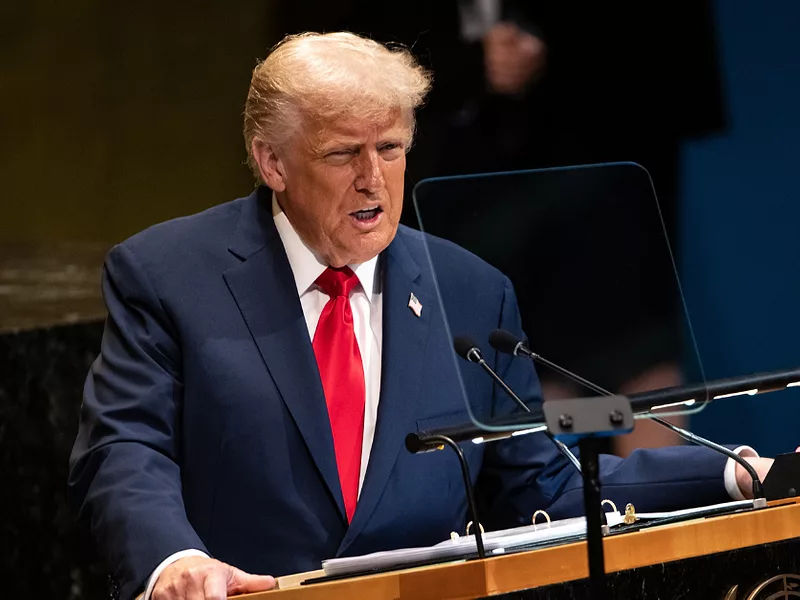
President Donald Trump announced trade pacts with Malaysia and Cambodia on Sunday during a trip to a regional summit in Malaysia, and provided fresh details on potential Thailand and Vietnam deals.
Both the Thai and Cambodian pacts keep the U.S. reciprocal tariff in place but say that the U.S. will provide tariff carveouts for certain products from a White House list of goods not produced in the United States in sufficient quantities to supply the domestic market. On the list are a slate of agricultural products, including coffee, cocoa, and various fruit products.
Trump and U.S. Trade Representative Jamieson Greer touted the agreements’ potential during signing ceremonies with Malaysia and Cambodia on Sunday.
“These landmark deals demonstrate that America can maintain tariffs to shrink the goods trade deficit while opening new markets for American farmers, ranchers, workers, and manufacturers,” Greer said in a statement.
The agreements, as well as the frameworks under discussion with Thailand and Vietnam, also include a slate of agriculture-specific trade provisions.
Malaysia has committed to providing “significant preferential market access” to U.S. ag exports, including dairy, horticultural products, poultry, processed food products, beverages, pork and ethanol, according to a joint statement.
A USTR fact sheet also says Malaysia will open its market for U.S. sorghum.
Malaysia will also loosen its non-tariff barriers to U.S. ag trade, including by accepting certificates issued by U.S. regulatory authorities, streamlining halal facility registration requirements and adopting a regionalization approach to limiting exports from U.S. areas with animal diseases.
Like other deals the administration has inked with Asian trade partners, the Malaysia deal includes a commitment to invest in the U.S. – in Malaysia’s case $70 billion. The pact also includes a provision that allows the U.S. to raise tariffs if third-party countries benefit from the agreement,but does not lay out a comprehensive rules-of-origin approach.
The two countries also signed a deal to cooperate on critical minerals.
Meanwhile, Cambodia agreed to eliminate tariffs on all U.S. ag products, according to the joint statement – which it has already implemented. The two countries also commit to addressing non-tariff barriers that limit U.S. ag exports, including import licensing, regulatory approvals and recognizing SPS measures.
The texts of both the Malaysia and Cambodia deals include commitments to ensure their sanitary and phytosanitary (SPS) measures are in accordance with a science-based approach and “do not operate as disguised restrictions on bilateral trade.” They also include commitments to not limit U.S. market access for certain cheeses and meats over geographical indicators – including brie, cheddar, feta, gouda, mozzarella, parmesan, pancetta, salami and others.
The timing comes as Malaysia and the European Union resumed negotiations on a free trade agreement earlier this year, which had been on ice since 2012, according to the European Commission. The EU has long pushed geographical indicators in its FTAs to protect iconic food products, to the chagrin of U.S. officials.
Notably, the Malaysia deal text also includes a broad provision that allows the U.S. to end the agreement if Malaysia enters into a bilateral trade deal with another country that “jeopardizes essential U.S. interests.”
Unlike the Malaysian and Cambodian deals, which the joint statements refer to as completed agreements, the Thailand and Vietnamese pacts are in earlier stages of discussion. Both are referred to as frameworks in the joint statements, but both parties say they hope to complete agreements in the coming weeks.
In its negotiations, Thailand has agreed to buy some $2.6 billion in U.S. ag products annually, including corn, soybean meal, and dried distillers grains, the joint statement reads. It also promised to eliminate tariffs on 99% of goods, including “a full range of U.S. industrial and food and agricultural products.”
The U.S. and Thailand also pledged to work together to address non-tariff barriers, including for U.S. ethanol exports by allowing import licenses for U.S. ethanol for fuel uses. Thailand also committed to expediting procedures for U.S. Food Safety and Inspection Service-certified meat and poultry products and adopt certificates issued by U.S authorities.Both sides also commit to more work to “finalize commitments” around geographical indicators ahead of a finished agreement.
The Vietnam joint statement is leaner than the others, with many of the details being left for further talks.
Cut through the clutter! We deliver the news you need to stay informed about farm, food and rural issues. Sign up for a FREE month of Agri-Pulse here.
It says that Vietnam will provide “preferential market access” for “substantially all” U.S. ag products, although offers no details on what that preferential access might entail. Both sides commit to working “constructively” on non-tariff barriers in “priority areas,” including agriculture, but the only barrier highlighted is Vietnam pledging to accept more U.S. regulatory oversight and the acceptance of certificates issued by U.S. bodies.
Former U.S. trade negotiator and Senior Vice President at the Asia Society Policy Institute Wendy Cutler said that the Malaysia deal in particular is a comprehensive pact with measures to address longstanding trade barriers.
"This is a serious, detailed agreement which will surprise many," Cutler said in a LinkedIn post on Sunday. The pact, she added, could serve as a template for other countries seeking tariff deals.
"Other countries may be surprised when they see the range of commitments that may be coming their way soon," she said.
The U.S. dairy sector was quick to welcome the announcements on Sunday.
"These agreements with Malaysia and Cambodia open new doors for U.S. dairy exports in two dynamic markets," Krysta Harden, president and CEO of the U.S. Dairy Export Council, said in a statement. The "frameworks with Vietnam and Thailand offer the promise of more to come."
Similarly, Gregg Doud, president and CEO of the National Milk Producers Federation and former chief ag negotiator during Trump's first term, called the announcements "big wins" for U.S. dairy.
The Consortium of Common Food Names also celebrated the Trump administration's efforts to protect common food names from geographical indicators in Asian markets.
"These new agreements with Malaysia and Cambodia finally fight fire with fire by directly protecting at-risk common names and establishing detailed due process safeguards for common names," said CCFN Executive Director Jaime Castaneda. "For far too long, producers relying on common names to market their products have faced protectionist attacks driven by the European Union to harm fair competition."
The American Soybean Association also celebrated Thailand's commitment to purchase U.S. soymeal, efforts to reduce SPS barriers and language around easing biotechnology restrictions.
"We look forward to future deals like these that reduce tariffs and ensure continued and increased market access for U.S. agriculture and urge all parties to swiftly bring these frameworks and agreements to fruition," ASA President Caleb Ragland said in a statement.
In addition to announcing the spate of deals, the president also hinted at a future tariff agreement with Brazil. In a bilateral meeting with Brazilian President Luiz Inácio Lula da Silva on Sunday, Trump told reporters he thinks both sides will “be able to do some pretty good deals.”
Some U.S. imports from Brazil currently face 50% tariffs, due to a 10% “reciprocal” tariff, as well as a 40% duty imposed over Brazil’s prosecution of Trump’s political ally, former President Jair Bolsonaro.
Trump told reporters that the two sides now have a clear understanding of what the other wants and said that he plans to discuss potential tariff reductions with the Lula.
“We've been speaking, and I think we'll end up having a very good relationship,” Trump said.
Trump continues his Asia trip tomorrow when he leaves for Japan. He is set to meet with Chinese President Xi Jinping later in the week.
For more news, go to Agri-Pulse.com.

