
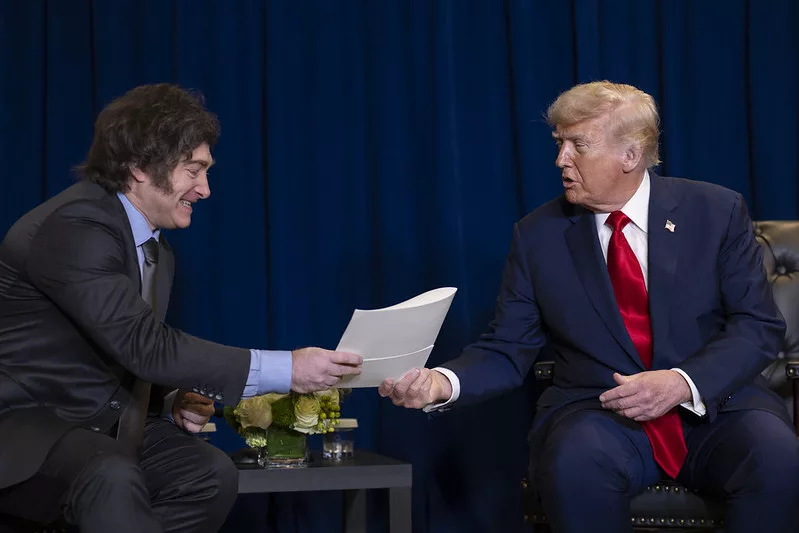
The U.S. is on the cusp of finalizing trade pacts with four central and south American countries, the White House says, after both sides published joint statements on the forthcoming deals Thursday. Among the countries is Argentina, which has been at the center of a spat between U.S. ranchers and the president in recent weeks over plans to increase U.S. beef imports.
The four deals, with El Salvador, Guatemala, Ecuador and Argentina, are still just “frameworks.” A senior administration official told reporters Thursday that he expected the agreements could be finalized and signed in the next two weeks. But the joint statements provide a glimpse into the deal's ag provisions, which include commitments to remove several trade barriers for agricultural exports.
U.S. ranchers and their allies in Congress have pushed back against administration officials’ suggestions in recent weeks that the U.S. could increase a tariff-rate quota on Argentinian beef to allow more imports and lower domestic consumer prices.
The joint statement on the Argentina deal makes no specific reference to raising the beef TRQ, but says that both parties have agreed to “improved, reciprocal, bilateral market access conditions.”
“There's not some administration plan to have government-sponsored shipments of millions of tons of beef to come in,” the senior administration official told reporters. But he added that the administration wants to “let the market work for beef – make sure that American supply can be met.”
The official said they expect that the final deal will be “natural imports of beef from Argentina to meet supply.” The official added that they expect the administration will lift the 10% reciprocal tariff currently applied to Argentinian beef, however.
In return, Argentina will provide “preferential market access” for a range of U.S. products, including many agricultural products, the statement says. It will also allow live cattle imports from the U.S. and grant market access for U.S. poultry.
The Argentinian government is also set to “simplify product registration processes” for U.S. beef and pork products and suspend facility registration requirements for U.S. dairy exports.
The deals with Guatemala, Ecuador and El Salvador all share similarities with recent deals announced with Southeast Asian countries. They feature intentions to reduce barriers to U.S. agricultural exports and, in the case of Guatemala and El Salvador, include commitments to accept U.S. regulatory oversight and certification.
Guatemala has also made a commitment to adhere to “science- and risk-based regulatory frameworks.”
The parties also agreed to protect market access for certain meats and cheeses, in another echo of the recent Malaysia and Cambodia deals.
The Ecuador framework also teases tariff reductions for ag products and the establishment of tariff-rate quotas. Ecuador also made specific commitments to reform its import licensing and facility registrations for U.S. ag exports, “to enhance transparency and predictability and reduce onerous and unnecessary barriers,” according to the joint statement.
In all of the deals, the U.S. has committed to provide some relief for products not grown or produced domestically. Treasury Secretary Scott Bessent said earlier this week that the administration was planning to cut tariffs on products like coffee and bananas, which are grown in some of these central and South American countries.
The administration official told reporters these tariff carveouts for South American countries should help lower domestic prices.
“We certainly would expect that retailers and wholesalers in America who have this would pass along any positive effects to the American producer,” the official said.
It’s easy to be “in the know” about what’s happening in Washington, D.C. Sign up for a FREE month of Agri-Pulse news! Simply click here
The administration is also trying to use tariff carveouts to boost U.S. cotton exports, the administration official said.
El Salvador and Guatemala are party to the Dominican Republic-Central America-United States Free Trade Agreement. Under the terms of the trade pacts, textile and apparel products covered by the agreement will see their reciprocal tariffs dropped.
“The Central American supply chain for textiles is quite important to American cotton producers,” the administration official said. “We certainly want to have textile supply chains as close to United States as possible.”
The official also teased further trade announcements before the end of the year, citing progress in negotiations with countries like Switzerland – whose negotiators were in Washington on Thursday – India, and other Latin American and Asian countries.
“There are a handful of agreements out there that could be nearer term,” they said.
This story has been updated to clarify a senior administration official's comments around Argentinian beef imports.
For more news, go to Agri-Pulse.com.

