
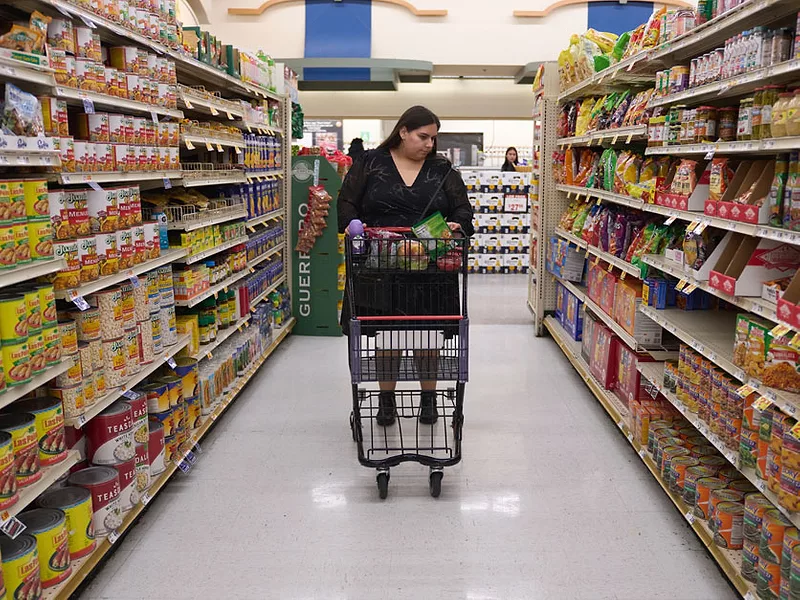
USDA nixes using fund to pay SNAP benefits as Dems urge action
The Agriculture Department says it’s illegal to use a contingency fund to pay Supplemental Nutrition Assistance Program benefits in November.
A USDA document says the fund, which is estimated to include more than $5 billion, can’t be used to support benefits in fiscal year 2026 “because the appropriation for regular benefits no longer exists.”
Democrats on Friday called on the Trump administration to use the money to pay SNAP benefits as the government shutdown stretches into a fourth week. Experts on hunger and nutrition say losing benefits could hurt low-income families already struggling to pay other bills.
“It means that some families may not be able to pay their rent, that their electricity gets turned off or that they can’t repair the car that they depend on to get to work,” says Kate Bauer, an associate professor of nutritional sciences at the University of Michigan’s School of Public Health.
USDA says the contingency fund “is a source of funds for contingencies, such as the Disaster SNAP program, which provides food purchasing benefits for individuals in disaster areas, including natural disasters like hurricanes, tornadoes, and floods”.
Democratic representatives and senators wrote to Agriculture Secretary Brooke Rollins Friday urging her to use the fund.
“At a minimum under the law, [USDA must] use the contingency funding that is available for SNAP,” 45 Democratic senators said in their letter to Rollins. House Democrats quoted USDA’s own shutdown plan, which says “[c]ongressional intent is evident that SNAP’s operations should continue since the program has been provided with multi-year contingency funds.”
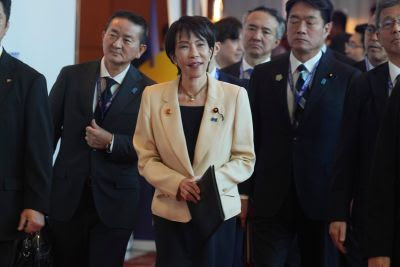 Japanese Prime Minister Sanae Takaichi (AP photo)
Trump’s Asia trip rolls on amid flurry of trade announcements
President Donald Trump heads to Japan today for the second leg of a three-stop Asia trip.
The president spent the weekend in Malaysia meeting with leaders at a regional summit, where he unveiled new trade pacts with Malaysia and Cambodia. He also noted progress in discussions with Vietnam and Thailand, with both sides releasing joint statements on the negotiations.
Meanwhile, Treasury Secretary Scott Bessent teased “substantial” Chinese ag purchases after meeting with his Chinese counterpart.
Trump will visit the Japanese emperor today, before meetings with the new Japanese Prime Minister Sanae Takaichi and business leaders on Tuesday.
Both leaders spoke by phone on Saturday, in which Takaichi told Trump that bolstering the U.S.- Japanese alliance is a “top priority” for her administration.
Among the topics will be implementing a U.S.-Japan trade pact Trump secured with her predecessor. Takaichi has said she will honor the deal, including a commitment to buy $8 billion in U.S. ag products.
Cut through the clutter! We deliver the news you need to stay informed about farm, food and rural issues. Sign up for a FREE month of Agri-Pulse here.
But she said that she could offer new terms for Trump’s consideration.
Asked on Air Force One on Saturday whether he would reexamine the deal’s terms, Trump said he is “open."
"We have a great relationship with Japan, and we’re going to have a fantastic relationship with her,” he added.
Current and past lawmakers, former officials file anti-tariff briefs
Current and former lawmakers and officials filed amicus briefs at the Supreme Court last week in a case challenging President Trump’s tariffs.
More than 200 sitting Democratic lawmakers, and Alaska Republican Sen. Lisa Murkowski, signed on to
an amicus brief arguing that tariff policymaking lies under Congress’ purview and that the president has overstepped.
Former Biden-era officials Janet Yellen, Jake Sullivan and Avril Haines also signed on to other briefs, along with multiple Republican former judges, officials and lawmakers, including former judge Michael Luttig, former Missouri Senator John Danforth and former USTR’s Bob Zoellick and Carla Hills.
There were more than 30 briefs filed opposing Trump’s use of emergency powers to impose tariffs
There were seven briefs in favor of the administration’s tariffs, with the America First Policy Institute and America First Legal Foundation among them.
Ag groups celebrate probe of China Phase One purchases
Multiple ag industry representatives welcomed Friday’s announcement that the U.S. will investigate China’s lack of Phase One deal purchases, but also hope there’ll be a new deal.
“We appreciate the Trump Administration’s efforts to hold China accountable for its lack of compliance with the Phase One agreement,” former National Sorghum Producers Chair Craig Meeker said in a statement. “However, we hope negotiations in the coming days and weeks will lead to a new agreement that restores trade and renders a Section 301 action unnecessary.”
The U.S. beef industry lamented China’s retreat from its Phase One commitments and market access tightening in recent months.
“At a time of record-high costs of production, we are missing a top customer and unable to truly maximize the value of every animal produced,” U.S. Meat Export Federation CEO Dan Halstrom said. “USMEF greatly appreciates USTR’s focus on China’s Phase One Agreement commitments.”
Take note: Trump will meet with Chinese President Xi Jinping later this week and intends to raise ag trade issues.
New Jersey farm likely to remain intact after housing battle with township resolved
A New Jersey town appears to be backing off its attempt to claim parts of a 175-year-old local farm for a new housing development after its plan drew national attention.
Cranbury Township and the Henry Family Farm are exploring a settlement in a dispute over the township’s housing plan, which called for constructing affordable housing on farm property. The township’s plan to use eminent domain was criticized by state and national figures, including New Jersey Governor Phil Murphy and Agriculture Secretary Brooke Rollins.
The settlement would eliminate the farm site in the plan, as well as using eminent domain on that site, according to a court filing. All parties believe it is the “best path forward,” Cranbury Township attorney Kevin Van Hise wrote in the filing.
Used cooking oil theft can be as much as $500 million annually
Theft in the U.S. of old grease used to make hamburgers, fries and other food is valued between $300 million to $500 million a year, according to the North American Renderers Association.
That’s up from a widely cited figure of $75 million according to a survey dating back to 1980, the trade group says. Since then, used cooking oil (UCO) has skyrocketed in value as a highly sought after commodity for making lower-carbon diesel and sustainable aviation fuel.
The updated estimate is both conservative and preliminary, with final numbers still to come.
Final word
"We are going to have some people starve. It's a certainty. I mean, we've got customers that are starving today. We've got areas within our reach where it's near 50% food insecurity and without those SNAP benefits, it would be near 100% food insecurity." — RF Bouche, a fourth-generation South Dakota grocer, on the effect of lost SNAP benefits on his customers. Most of Bouche's 25 stores are located on or near Indian reservations.
Kim Chipman, Oliver Ward and Noah Wicks contributed to today’s Daybreak.
.webp?t=1762183428)


