
Multiple Supreme Court justices, including some conservatives, expressed skepticism at oral arguments Wednesday that President Donald Trump can impose across-the-board tariffs using a 1977 law that doesn't even mention the word.
The high-profile case consolidates multiple legal challenges to President Donald Trump’s use of emergency powers to impose tariffs. Justices that included Trump picks Amy Coney Barrett and Brett Kavanaugh asked probing questions of Solicitor General D. John Sauer about Congress’s intent when it passed the International Emergency Economic Powers Act in 1977. They also asked Sauer how Congress could ever claw back those powers once they ceded them to the president.
Before the packed courtroom, several conservative-leaning justices, including multiple Trump appointees, pushed back against the administration’s arguments.
Tariffs, Chief Justice John Roberts said, have “always been the core power of Congress.”
The Constitution grants Congress, not the president, tariffing powers. But Sauer argued that lawmakers devolved those powers when they gave the president the authority to “regulate” commerce under the 1977 law.
“I want you to explain to me how you draw the line?” Trump-appointed Justice Neil Gorsuch asked Sauer.
The Supreme Court has previously ruled, including in a case that struck down President Joe Biden’s plan for student loan forgiveness, that Congress must be explicit when it delegates authorities that are used for policy decisions of major economic significance. But Sauer argued that because tariffs in this instance are dealing with a national security issue and are being used as a foreign policy tool, the court should defer to the president.
“You say we shouldn't be concerned, because this is foreign affairs, and the president has inherent authority,” Gorsuch said before adding, “What would prohibit Congress from just abdicating all responsibility to regulate foreign commerce?”
“Congress decides tomorrow, well, we’re tired of this legislating business. We’re just going to hand it all off to the president. What would stop Congress from doing that?”
Similarly, Roberts grappled with whether the use of tariffs in a foreign policy context overrides Congress’ constitutional authority.
Justice Amy Coney Barrett – another Trump appointee, who has sided with the liberal justices in cases challenging other administration policies – also needled Sauer over the administration’s determination of what constituted an economic emergency.
“Is it your contention that every country needed to be tariffed because of threats to the defense and industrial base?” she asked. “I could see it with some countries, but explain to me why as many countries needed to be subject to the reciprocal tariff policy.”
“It is a global problem,” Sauer insisted.
The tariff challengers, which include several private companies and a group of state attorneys general, have already received favorable rulings in a District of Columbia District Court, the Court of International Trade and the U.S. Court of Appeals for the Federal Circuit.
One of the key issues that the lower courts have weighed in each of these cases is whether IEEPA’s use of the word “regulate” allows the president to invoke tariffs.
Sauer argued that the verb is “capacious” and should be interpreted broadly to allow the president a suite of policy tools to deal with an economic emergency.
But several of the more left-leaning justices, as well as Neal Katyal, who represented a group of private companies in the case, and Oregon Solicitor General Benjamin Gutman, who spoke on behalf of a group of Democratic state attorneys general, pointed out that in other statutes that delegate trade authorities, Congress explicitly mentions tariffs.
Cut through the clutter! We deliver the news you need to stay informed about farm, food and rural issues. Sign up for a FREE month of Agri-Pulse here.
Barrett pushed back against Sauer’s arguments. She asked Sauer whether he believes other words in the IEEPA statute are equally “capacious.”
“To me, things like ‘nullify’ and ‘void’ have definite meanings,” she said. “They pack a punch, but I wouldn’t describe them as capacious in the sense that they have a wide range of meanings.”
Barrett, however, also probed the limits of the other side’s argument on which trade policy actions IEEPA can and cannot justify.
Both Katyal and Gutman argued that the president would be well within his rights to impose embargoes or quotas under the statute, but that tariffs – which they said is a tax used to raise revenues – are beyond the scope of acceptable measures.
If Congress authorized more extreme measures like shutting down all trade with a country, Barrett said, “Doesn't it seem like it would make sense then that Congress would want the president to use something that was weaker medicine than completely shutting down trade as leverage to try to get a foreign nation to do something?”
Justice Brett Kavanaugh, another Trump appointee, raised a similar point in his questions to Gutman. He pointed out that his and Katyal’s interpretation of the statute would allow for a significant quota on imports from every country in the world, but not a 1% tariff.
It would leave an “odd donut hole” in the statute, Kavanaugh said, borrowing a term from the Justice Department’s brief.
“It's not a donut hole, it's a different kind of pastry,” Gutman said, drawing chuckles from the court’s spectators. He argued that the power of taxation is a “fundamentally different power” than limiting imports.
Kavanaugh, who worked in the White House during the George W. Bush administration in the aftermath of the 9/11 terrorist attacks, has a record of advocating for presidential flexibility in times of emergency. But he has also been wary of government overreach and has endorsed the “major questions” doctrine that requires specificity from Congress when delegating authorities.
At one point in the hearing, he pointed out that some of the president’s IEEPA tariffs, including those applied to India over its continued purchases of Russian oil, serve a clear national security purpose in that they are trying to end the war in Ukraine – “the most serious crisis in the world,” he said.
Kavanaugh expressed some concern about throwing that tool “out the window.”
Gutman pointed out that there are plenty of other tools a president can use to achieve the same ends.
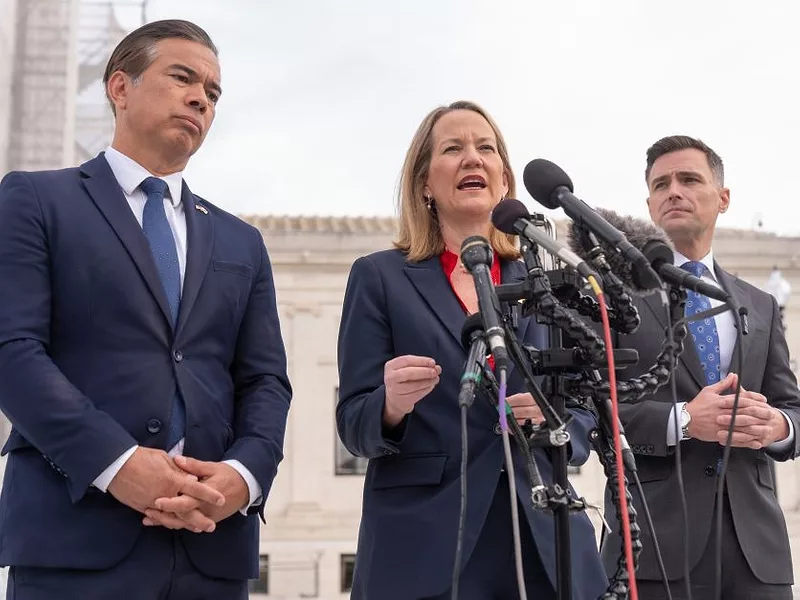
In comments to reporters after the hearing, several Democratic state attorneys general, including Gutman, said they were buoyed by the justices’ lines of questioning.
“We feel really good about the arguments today and the questions that were asked by the justices,” said Arizona Attorney General Kris Mayes. She stressed that the case is “maybe the most important case that this court has heard in 100 years.”
Other analysts also suggested that the justices’ positions and hostility towards the administration’s arguments could portend an adverse decision for the president.
“The odds seem higher following the argument that the Supreme Court will rule against the administration,” Ryan Majerus, a trade lawyer at King & Spalding law firm, told Agri-Pulse in an email. “Justices Barrett, Gorsuch and Kavanaugh raised questions that certainly signal where the decision may go.”
In one exchange, Barrett asked Katyal what the process would look like for issuing tariff refunds in the event that the court rules against the Trump administration.
“Would it be a complete mess?” she asked.
Majerus, who served in the Department of Commerce under the Biden administration added that the outcome remains difficult to predict, however.
“There are several key constitutional and interpretive issues at play,” he added. “I could see the court hold that IEEPA allows tariffs subject to certain limitations.”
Senate Finance Committee Ranking Member Ron Wyden, D-Ore., was not convinced, however, that the case would be a close call.
“It is in the Constitution, right there, in Article One – trade,” Wyden told Agri-Pulse on Capitol Hill after the oral arguments. “So we're confident.”
But he added, “No matter how it turns out, Donald Trump will come back and try to invent something else to get his regressive damage-causing process through the tariffs. So we're going to be in this for the duration.”
The hearing, which took place in a courtroom packed with administration officials and lawmakers, was supposed to last around 80 minutes but extended to almost three hours of questioning. Treasury Secretary Scott Bessent sat in a row with U.S. Trade Representative Jamieson Greer, Commerce Secretary Howard Lutnick and House Ways and Means Committee Chair Jason Smith, R-Mo.
Across the aisle sat Senate Ag Committee Ranking Member Amy Klobuchar, D-Minn., and Sen. Ed Markey, D-Mass., themselves both former lawyers. Ways and Means Ranking Member Richard Neal, D-Mass., was also in attendance.
Trump, however, did not attend – after suggesting that he could make the trip down Pennsylvania Avenue for the event.
Philip Brasher contributed to this report.
For more news, go to Agri-Pulse.com
.


