
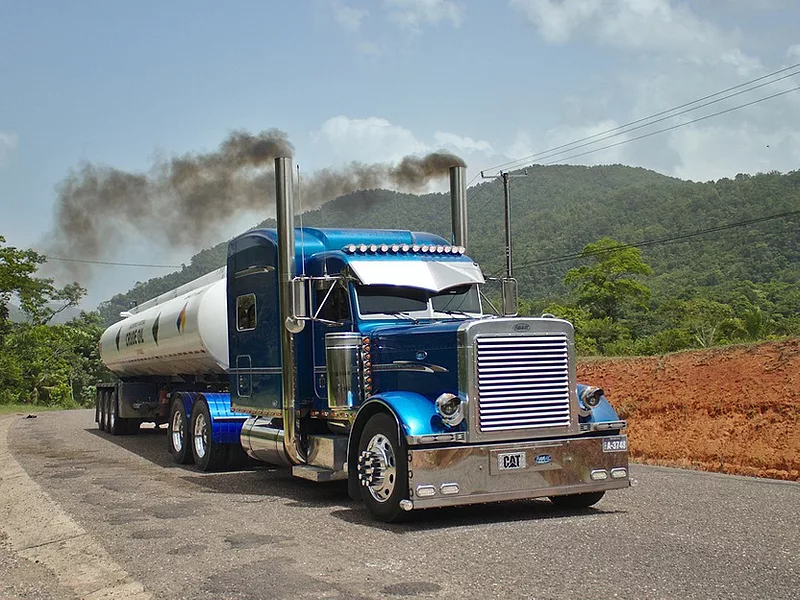
Federal efforts to strip California of decades-old authority to set its own clean air standards are triggering alarm across the state, but nowhere more intensely than in the San Joaquin Valley, where communities endure the nation’s worst particulate pollution and where agriculture and rural residents say the fallout threatens public health, transportation funding, and farm to market commerce.
State housing, transportation and air quality leaders are hearing blunt warnings that weakening federal clean air waivers will jeopardize pollution control efforts, risk billions in highway and transit dollars, and undermine successful incentive programs like California’s tractor replacement grants. Yet they are also facing criticism over pulling back on state climate investments.
Rural transportation and agriculture brace for fallout
The scale of the region’s vulnerability came into perspective at a California Air Resources Board hearing last week. Stacie Guzman, executive director of the Merced County Association of Governments, explained in a presentation to the board that the valley’s eight counties span more than 27,000 square miles and are home to 4.5 million people, who face higher poverty rates than the statewide average and unemployment rates hovering around 10%. The air basin is bordered on three sides by mountains, creating stagnant conditions and trapping pollution.
CARB, meeting jointly with the California Transportation Commission and the California Department of Housing and Community Development, focused the hearing on the “potential impacts of federal attacks” on California vehicle emissions standards. Guzman took the opportunity to stress to the broad array of Sacramento-based policymakers the region’s critical role in feeding the nation, noting that the valley produces more than 250 commodities, accounts for more than a quarter of the nation's food production, and generates 70% of California's agricultural value from just a sixth of the state's land. Local roads and state highways, which transport the goods and depend in large part on federal infrastructure spending, are “vital links to jobs, education and health care.”
 Stacie Guzman, Merced County Association of Governments (LinkedIn photo)
Federal efforts to revoke Clean Air Act waivers have already triggered sanctions against California under a “conformity lockdown.” Since the valley has not conformed to federal air standards, it cannot access transportation funds, potentially halting bridge repairs, rail safety upgrades, and microtransit investments that serve farming towns. It places more than $2 billion in projects at risk, including upgrades on Highway 99. Another $5.8 billion in projects could be threatened after 2026 if the issue remains unresolved.
“Providing rural transit continues to be very difficult across such a large, low-density region,” said Guzman, who described microtransit as “a very expensive solution” but essential for connecting isolated communities to jobs and medical care.
CARB staff warned these freezes are already occurring statewide, explaining that the loss of anticipated emission reductions under rescinded federal waivers means that many regional governments may not be able to demonstrate transportation conformity.
Infrastructure dollars vs. ZEV mandates
Before President Donald Trump returned to office this year, CARB and regional air districts had been leaning on federal waivers to enforce new sales bans on gas-powered cars and diesel trucks and to shore up regional clean air plans. Yet agricultural organizations have long warned of the steep infrastructure hurdles and high costs for transitioning rural regions to clean trucks and equipment.
“The infrastructure for our agricultural products across California is not there for the trucks to move food,” said Manuel Cunha, president of the Nisei Farmers League, adding that fresh food cannot sit for hours while a truck charges and that the delays would impact trade agreements with Canada and Mexico.
Cunha also told the agencies that utilities are already falling behind on developing grid connections to build packing houses and processing facilities in rural communities and are not in a position to rapidly scale up the deployment of energy-hungry charging facilities for electric trucks.
“We're willing to help try to figure out how we get through some of this with the waivers being pulled,” he said.
At its October hearing, CARB highlighted steady but uneven progress toward meeting national ambient air quality standards for ozone and fine particulate matter, or PM2.5, and laid out an aggressive course to defend California’s clean air authority.
“We have a long way to go to meet the standards throughout the state and provide healthy air for all Californians,” said Lauren Sanchez, presiding over her first hearing as CARB chair. “More than 17 million Californians still breathe unhealthy air and 1,500 die from air pollution every year in Southern California alone.”
Sanchez framed the moment as pivotal for public health and for California’s climate legacy.
“California won't back down,” she said. “We will use every tool at our disposal, including litigation, to continue our critical work.”
Staff pointed to recent successes, like the valley reaching the 1997 annual PM2.5 standard and Sacramento attaining the 75 parts per billion ozone standard. Still, monitors place many regions far from meeting California’s toughest ozone thresholds, particularly as extreme heat and wildfire smoke worsen. Staff and board members feel trapped in a catch-22.
“Because of this federal administration, California cannot exercise the authority given to us in the Clean Air Act,” said CARB Executive Officer Steven Cliff. “Because of this federal administration, more Californians will get sick and die from poor air quality. Because of this federal administration, California is at risk of losing federal transportation funds due to Clean Air Act sanctions.”
It’s easy to be “in the know” about what’s happening in Washington, D.C. Sign up for a FREE month of Agri-Pulse news! Simply click here
Public health projections sharpen the stakes. Without the rules, nitrogen oxides could rise 40% by 2037 and PM2.5 by 18%, causing more than 14,500 additional cardiopulmonary deaths, according to CARB. The valley and the South Coast region are in the worst areas for ozone, where emissions threaten to increase asthma, heart disease and emergency room visits.
Waning support for industry-led initiatives
Several businesses and trade associations recognized the threat and urged CARB to instead pivot to low-NOx natural gas and combustion trucks to reduce nitrogen oxide emissions in the short term, since it cannot mandate electric and hydrogen trucks.
“These trucks offer immediate, scalable benefits that shouldn't be overlooked,” said Nicole Rice, president of the California Renewable Transportation Alliance. “While CARB cannot currently mandate its ZEV strategy, your leadership has already moved the market towards the most stringent NOx standard in the nation currently.”
Rice cited a recent industry study indicating renewable natural gas trucks can deliver 88% of the health benefits of electric trucks and can cut NOx emissions by more than 94%, nearly matching electric trucks. She also highlighted research from the University of California, Riverside, showing that replacing older trucks with 2027-certified low-NOx models can account for 95% of NOx emission reductions through 2045.
Agriculture groups, meanwhile, have been frustrated with the state’s declining support for existing programs that have proven track records in combating climate change, particularly those that offer grants for tractor upgrades under FARMER, for efficient processing equipment under the Food Production Investment Program, and for methane-capturing dairy digesters.
The programs did not receive new funding this year and were not a priority in legislation to reauthorize California’s Cap-and-Trade Program. Instead, the market-driven climate fund will dedicate more than $2 billion in total each year to high-speed rail, forestry and fire protection, safe drinking water and affordable housing, among other Democratic priorities.
 Lauren Sanchez (CARB photo)
At the start of the year, several agriculture groups banded together to request from the annual budget $200 million for FARMER, $50 million for FPIP and $75 million for livestock methane reduction. When the legislative session concluded with no new commitments, a coalition of associations under the Climate-Smart Agricultural Partnership criticized California policymakers and regulators for cutting the grants even as they condemn federal clean energy rollbacks. The coalition said in a statement that state actions are worsening the federal cuts to solar, wind and the ARCHES hydrogen hub.
It cited the lagging support for grants as well as the California Public Utilities Commission’s elimination of an agricultural solar aggregation program and a pending CPUC proposal to end the BioMAT program, which supports forestry, agricultural biomass and methane reduction projects.
These “anti-climate actions” sacrifice air and water quality, wildfire mitigation and the state’s climate goals, according to the partnership. It urged the Newsom administration and the Legislature to restore funding for incentive grants next year and for CPUC to reject the BioMAT elimination proposal.
“Criticizing the federal anti-climate crusade is more effective when you are not leading one of your own,” the statement concluded. “The public health, environment and economy of the entire Central Valley hangs in the balance.”
Much of the reluctance to endorse agricultural programs has stemmed from years of intense environmental justice outcry, with claims of incentive grants acting as subsidies. That was again on display at the CARB hearing last week, when dozens of advocates railed against agriculture and the shipping industry.
“Our people deserve better protections and more regulations on ammonia from fertilizers and dairies, nitrous oxides from fertilizer fields, and volatile organic compounds from pesticides,” said Laura Plascencia, a program manager at the advocacy group Valley Improvement Projects. “We are at a critical time, and we can't continue to wait another 20 years.”
The arguments gained traction with board member Diane Takvorian, who pressed her colleagues to hold another hearing to ensure the valley air district is enforcing it rules “to reduce ammonia, stop unnecessary wood burning, the retirement of old trucks and also reduction of pesticides emissions.”
Cliff responded that with the “federal attacks,” CARB lacks the resources to “go back and redo work we've already done.”
The comments also sparked division within the board, which has been recalibrating its approach as it faces increasing public and political pressure to prevent further price hikes for electricity and fuel amid the transition to carbon neutrality.
“While we talk about electrification as a big solution,” said Tania Pacheco-Werner, who represents the valley on the board, “we cannot have solutions proposed that are isolated from the realities of our communities.”
She shared frustration over the emerging silos within the board, stressing that she has closely followed the developments as CARB staff have collaborated across agencies and air districts on enforcing the rules in the valley and that she is “definitely seeing how those are implemented.” Pacheco-Werner charged that the valley’s infrastructure hurdles mean the best available technology and “making everything electric” will not result in real-time reductions and echoed the calls to fund FARMER.
The conversation will continue into 2026, with CARB hosting its third hearing on the Trump administration’s actions next month, while drafting new regulations to implement the cap-and-trade reauthorization. In early January, Gov. Gavin Newsom will unveil his final budget proposal, detailing his climate priorities for the following fiscal year — as he is anticipated to use his last year in office to further elevate his national presence ahead a potential 2028 presidential bid.

