
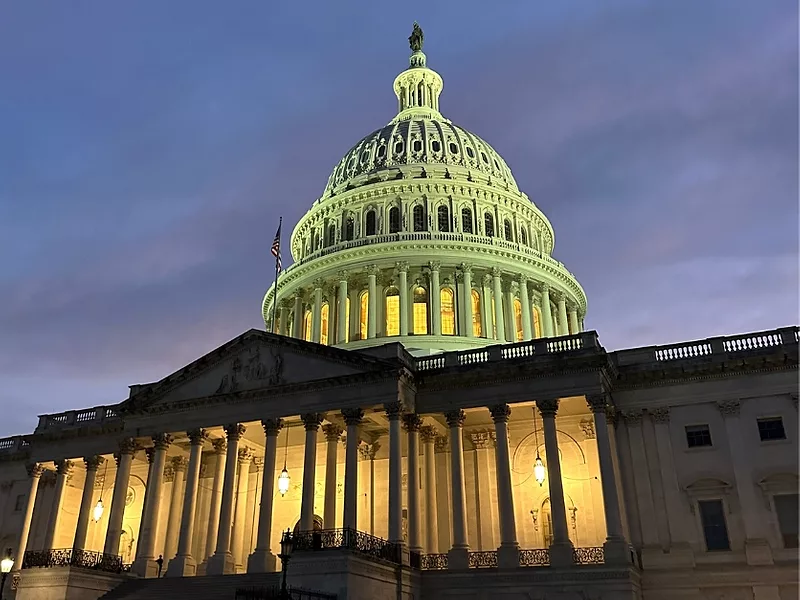
The longest government shutdown in history is over after 43 days. President Donald Trump signed legislation last night that will fund USDA, FDA and the Department of Veterans Affairs for the rest of fiscal 2026, and other departments and agencies through January.
Because they are fully funded for FY26, USDA and FDA are effectively exempt from any further shutdowns that may occur this fiscal year.
SNAP benefits: A USDA spokesperson said Wednesday evening that “most states” will receive funds within 24 hours to provide full monthly benefits to people participating in the Supplemental Nutrition Assistance Program.
According to the Food Research & Action Center, 16 states had started providing full benefits for November as of Wednesday. Most others were providing partial benefits. A handful had suspended any payments.
Thompson: Tariff assistance package will be ‘first tranche’
House Agriculture Committee Chair Glenn “GT” Thompson, R-Pa., says a forthcoming economic assistance package for farmers will only be the first portion, and that further help is likely.
“It won't be the whole amount. It'll be kind of a first tranche,” Thompson said. The administration has already moved more than $10 billion from the Commodity Credit Corporation to the Agriculture Secretary’s office.
Thompson said he had heard that the administration was preparing to unveil its tariff assistance package this week, but that the potential reopening of the government forced a pivot. “I don't know whether they'll be ready by next week, but I think it'll be soon,” Thompson told Agri-Pulse Wednesday evening.
Sen. John Hoeven, R-N.D., has also indicated that further assistance could be made available before the end of the year and may require congressional action.
Take note: Some lawmakers have been working to ensure the assistance includes producers beyond major row crops like soybeans. Rep. Dan Newhouse, R-Wash., told Agri-Pulse Wednesday that he had urged the administration to ensure specialty crops are covered.
“There's a lot of uncertainty, and as far as what it's going to look like, and not a lot of specifics. But we just want to make sure that we're not left out,” he said. “But bottom line is, I don't think there's enough money in the world to get everybody whole.”
Less than half of producers to make profit next year, bankers expect
Lenders expect fewer than half of U.S. ag producers to turn a profit next year, the lowest level in five years, as concern among crop farmers skyrockets, according to a poll by the American Bankers Association and Farmer Mac.
Almost 70% are worried about growers of grains and cotton, up from 15% two years ago. The outlook for livestock is brighter amid robust demand and high prices. Overall, lenders expect about 52% of producers to be profitable in 2025, the survey said.
The poll was released on Wednesday as ag bankers gathered for an ABA conference in St. Louis. A big topic this week will be how bankers can best deal with a row crop economy grappling with low prices, soft demand and surging costs.“
Credit quality concerns have intensified, and lenders are preparing for a more challenging year by placing increased focus on underwriting standards and loan terms," said Ryan Lee, ABA’s research and economic policy manager.
It’s easy to be “in the know” about what’s happening in Washington, D.C. Sign up for a FREE month of Agri-Pulse news! Simply click here
Almost 93% of lenders expect farm debt to increase over the next year. As far as access to funds, bankers over the last year have approved roughly 84% of loan applications and are expected to renew nearly 88% of existing loans in the year ahead, according to the survey.
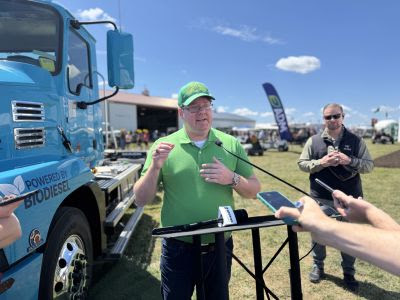 Agriculture Deputy Secretary Stephen Vaden at the Farm Progress Show in Decatur, Illinois, in August (Agri-Pulse photo)
Vaden says more announcements on input prices coming
Saying farmers need to be treated fairly, Deputy Agriculture Secretary Stephen Vaden has promised a series of announcements “in the days and weeks ahead … about things this administration is going to do focused on input prices.”
He said the Trump administration’s announcement that it was continuing to look at the meatpacking industry is the just the start.
Also in his interview with the Red River Farm Network, Vaden said he expects China to live up to its pledge to buy 12 million tons of soybeans by the end of the year. “If there's one thing that I have complete confidence in, that’s anyone who crosses an agreement made with President Trump, it does not end well for them,” he said.
Vaden also said due to higher crop prices, farm aid may need to be recalculated.
“We've hit 15-month highs in soybean prices because of the deals that have recently been cut in Asia,” he said. “That's going to need to be taken into account for any aid payments, because obviously the price of commodities has risen. That's what we want. We want market-based returns. And because the numbers have changed, our numbers will necessarily change.”
Bessent teases tariff cuts on ag products
Treasury Secretary Scott Bessent says the administration is preparing to cut tariffs “over the next couple of days” on ag products not grown domestically.
Coffee, bananas and other fruits will be among the products that see tariff reductions, Bessent told Fox News Wednesday.
“That will bring the prices down very quickly,” Bessent said.
Agri-Pulse first reported in July that administration officials were preparing a list of products not grown in the U.S. for tariff carveouts.
Some food and drink importers are crossing their fingers that their inputs are going to be included among the tariff reductions. The Distilled Spirits Council said in a statement that it had reached out to officials to provide tariff relief on spirits from the European Union and United Kingdom.
Take note: The administration also gave its clearest signal yet that it would lean on other statutes to replicate recent tariffs, if the Supreme Court strikes them down.
During an event at the Economic Club of Washington on Wednesday, National Economic Council Director Kevin Hassett said officials are looking at expanding Section 301 investigations into unfair trade practices and using a statute that allows for 15% duties up to 150 days, among other options.
Final Word
“The past few weeks in the beef industry perfectly capture this Administration’s approach to policy: make big claims, hurt American producers, inject volatility into the marketplace, and do nothing to lower prices for everyday Americans.” – More than 50 House Democrats in a letter to Agriculture Secretary Brooke Rollins and U.S. Trade Representative Jamieson Greer made public Wednesday.
Philip Brasher, Oliver Ward and Noah Wicks contributed to today’s Daybreak


