

The Trump administration says it has a deal with Switzerland that lowers agricultural trade barriers, particularly for beef and poultry.
The U.S. will cut tariffs on many Swiss products to 15% from the 39% reciprocal tariff rate in the deal announced Friday. Switzerland pledged to boost investments in the U.S. and cut tariffs and non-tariff barriers on U.S. exports in return.
Many U.S. ag products will benefit from eliminated Swiss tariffs, including nuts, fruit and spirits. The Swiss will establish tariff-rate quotas for beef and bison, and ease requirements on poultry and dairy, a fact sheet says.
U.S. ag sales to Switzerland in 2024 were around $235 million, with ethanol and tobacco among the top exports.
Take note: The White House last week also provided fresh details on the South Korea deal struck in July.
South Korea says it will work with the U.S. to address trade barriers on ag products, including facilitating imports of U.S. horticultural products, protecting some generic names for meats and cheeses and streamlining biotech product approvals.
Amid new deals, does the U.S. have an enforcement problem brewing?
As uncertainty swirls around China meeting its soybean purchase commitments for this year, and questions remain around accountability, another enforcement challenge may be brewing.
Hong Kong-based Nick Marro, principal Asia economist at the Economist Intelligence Unit, tells Agri-Pulse that the U.S. may struggle to enforce key ag provisions in other trade pacts with the region. In fact, countries may be counting on it.
“Many of these countries, particularly in Southeast Asia, do not have a great track record around enforcement,” Marro said.
He pointed to particularly lofty promises made by countries like Indonesia, which agreed to lower ag trade barriers.
“Enforcement is really going to be tricky,” Marro said, adding that it’s “highly likely” some of the provisions fall by the wayside.
Governments in the region are already being criticized for giving away too much in the U.S. deals. With so many new deals to implement, Marro said, the Trump administration could also face difficulties monitoring partners’ follow-through and holding them accountable.
“Capacity constraints are going to be a pretty permanent feature of this administration,” he added, “particularly when it comes to some of these smaller countries, whereby you will really need pretty tight monitoring to ensure enforcement.”
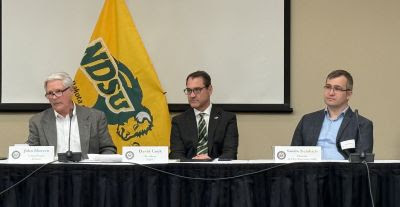 Sen. John Hoeven, R-ND, (left) hosted a listening session with farm and commodity group leaders in Fargo Friday. He was joined by North Dakota State University President David Cook and Sandro Steinbach, Director of the Agricultural Risk Policy Center and the Center for Agricultural Policy and Trade Studies. (Agri-Pulse photo)
Hoeven says aid package is in Trump and Rollins’ court
With the government shutdown over, the timing of market facilitation program payments is ultimately up to the President and Agriculture Secretary Brooke Rollins to decide, noted Sen. John Hoeven, R-N.D., during a discussion with his state’s farm and commodity leaders on Friday in Fargo.
It’s easy to be “in the know” about what’s happening in Washington, D.C. Sign up for a FREE month of Agri-Pulse news! Simply click here
“We just have to recognize that it's not one thing. It’s part of the bigger picture in terms of a bridge to get our guys from where they are now to next year, where we have better support in place because of the One Big, Beautiful Bill,” he said. “But you know, we need the sales, and the timing of the sales matters and some additional support working on year-round E15.
All these things are critical for our producers right now.”
Chevron exits Clean Fuels Alliance America
Chevron Corp., which has committed $8 billion to grow its lower-carbon businesses by 2028, has dropped out of Clean Fuels Alliance America, which is a top U.S. lobbying group for green diesel producers.
CFAA confirmed Chevron’s departure. Chevron, the Houston-based crude oil and natural gas giant, didn't return Agri-Pulse's request for comment.
A flurry of investor excitement about the prospects for lower-emitting diesel in the U.S. has died down lately amid national policy uncertainty and a production slump that's weighed on renewable fuels used to power heavy modes of transportation like trucks, ships and trains.
There's also renewed disagreement over U.S. regulations between fuel refiners and producers of soybeans used to make biodiesel and similar products. A fight over final EPA biofuel-blending rules for 2026-27, especially related to use of foreign feedstocks, is ramping up as the Trump administration works to finish the regulations.
Republican AGs: Major rail merger could have price, service repercussions
Nine Republican state attorneys general on Friday warned members of the Surface Transportation Board that a merger between Union Pacific and Norfolk Southern could result in “high prices, lower reliability and less innovation.”
In a letter, the AGs said shippers in industries like chemical manufacturing and agriculture have seen their “rail service suffer while costs have increased dramatically” as railroads have consolidated over the years. They said further consolidation “could make these problems worse."
"It is vital that the STB determine how this merger will affect all stakeholders, including farmers, workers, consumers, and manufacturers so that increased monopolistic power does not stifle innovation and productivity in industry, put inflationary pressure on household budgets, or otherwise throttle the economy as a whole with the costs of this merger,” they wrote.
AGs from Tennessee, Kansas, Florida, Mississippi, Iowa, Montana, North Dakota, South Dakota and Ohio all signed the letter.
Person in Washington infected with bird flu
A Washington resident who has a mixed backyard poultry flock is the first person in the U.S. to be diagnosed with H5N5, a type of avian bird flu.
The Centers for Disease Control and Prevention says there have been 71 cases of H5 cases in the U.S. since early 2024. More than half were in California and likely came from exposure to dairy cows.
The Grays Harbor, Washington, person who was infected had underlying conditions and was hospitalized. H5N5 has previously been reported in animals but never before in humans. Washington state health officials said the risk to the general public remains low.
“The domestic poultry or wild birds are the most likely source of virus exposure; however, public health investigation is ongoing,” the Washington Department of Health’s news release said.
Read more on bird flu at Agri-Pulse.com.
Final Word:
Maria Bartiromo: “He's expecting $10 a pound ground beef. What's your reaction?”
Scott Bessent: “Maria, the beef market is a very specialized market. It goes in long cycles. This is the perfect storm. Again, something we inherited. … I don’t want to focus on one product. It’s a very important product.”
Treasury Secretary Scott Bessent responding to Fox News’ Maria Bartiromo Sunday about the statement by Omaha Steaks CEO Nate Rempe that consumers will be paying $10 per pound for ground beef by the third quarter of next year.
Kim Chipman, Oliver Ward and Noah Wicks contributed to today’s Daybreak.
.webp?t=1762183428)


