
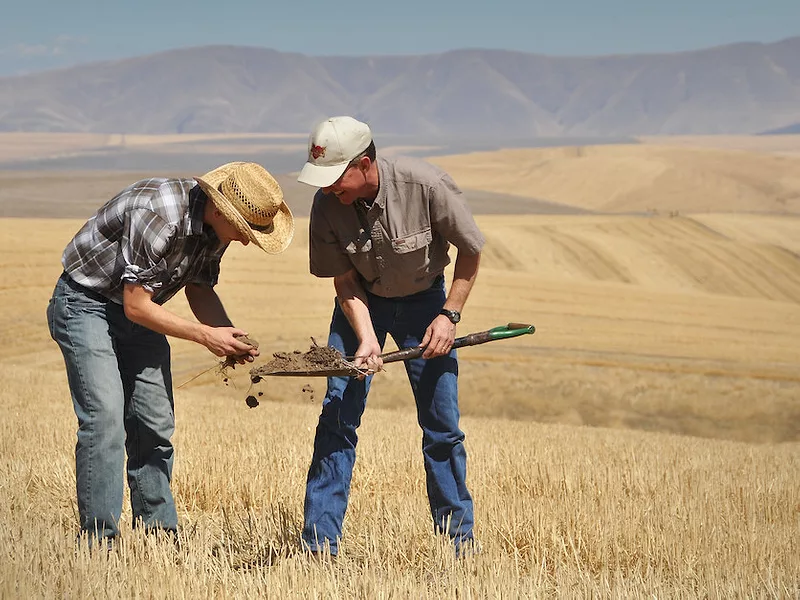
Farmers looking to get federal conservation funding through the Environmental Quality Incentives Program and the Conservation Stewardship Program will no longer face limits on how much they can receive.
A continuing resolution that extends the farm bill another year while funding the government through Jan. 30 does not limit payments for both programs. That allows projects to receive more funds than they have in the past.
Previously, producers enrolled in EQIP could not receive more than $450,000 over a five-year farm bill period (from 2019 through 2023), while those enrolled in CSP could not receive more than $200,000.
This change is not entirely new. Callie Eideberg, a principal at the Vogel Group and a former Democratic staffer for the Senate Committee on Agriculture, Nutrition, and Forestry, said effectively, payment limits have not been in place for the past three years.
EQIP was first established in the 1996 farm bill, merging other conservation programs. The program provides cost-share and incentive payments to producers who sign contracts as long as 10 years promising to implement new environmental practices, like cover crops, no-till and prescribed grazing. The money can also fund new fencing and irrigation equipment.
CSP, which was created in the 2002 farm bill and then overhauled and renamed in 2008, is geared more toward producers who have already implemented some conservation practices in previous years and are looking to expand and use more. The program typically requires a longer-term commitment than EQIP, with producers signing five-year contracts for not only maintaining conservation practices that have already been established but for also adopting new ones.
 Jonathan Coppess (University of Illinois photo)
Jonathan Coppess, an associate professor of law and policy at the University of Illinois, said payment limitations have long been part of conservation programs, dating back to the 1936 Agricultural Conservation Program, one of the earliest federal conservation cost-share programs for farmers. He said payment limits have been a "wonderfully controversial" subject in past farm bill debates, but have generally received lawmaker approval to ensure a few recipients don't end up taking too much of the programs' limited funding.
"You have a specific cap on the budget authority, which means there's only so much money available," Coppess said. "So the more that any large farmer is able to get, the more it squeezes out other farmers."
Advocates for small farmers fear the changes will lead to a greater share of funding going to larger farms with bigger projects when paired with other recent developments impacting the two conservation programs. Those include changes Congress made to adjusted gross income limitations earlier this year through the One Big Beautiful Bill Act (OBBBA) and reduced NRCS staffing levels.
Jesse Womack, a policy specialist for the National Sustainable Agriculture Coalition, says the "trifecta" of policy decisions "really biases conservation programs away from helping small, mid-size and even some reasonably large farm operations, and sort of sets the stage for very, very big contracts going out to operations that were previously ineligible for conservation programs."
Don’t miss a beat! It’s easy to sign up for a FREE month of Agri-Pulse news! For the latest on what’s happening in Washington, D.C. and around the country in agriculture, just click here.
Farmers with adjusted gross incomes of more than $900,000 were previously barred from participating in EQIP and CSP. However, language in the OBBBA, which was enacted in July, exempted producers who derive 75% or more of their average gross income from this requirement.
Five former Natural Resources Conservation Service chiefs in 2023 called for lawmakers to loosen the AGI limitations, arguing they are "counterproductive" to efforts to reduce greenhouse gas emissions and improve water quality, soil health and wildlife habitat.
Specialty crop groups also wanted more full-time producer participation, since those who grow high-value crops often have adjusted gross incomes above the $900,000 threshold.
Dennis Nuxoll, vice president of federal government affairs for Western Growers, said the AGI limitation changes included in the OBBBA opened the conservation title's programs "to a larger universe" of specialty crop growers, since many were previously exempted from these programs.
"That was actually a significant change, because there's a disproportionately higher amount of our growers that used to get caught up in that language," Nuxoll said.
Now that more specialty crop growers will be able to apply for the programs, Nuxoll expects to see more try out conservation practices on their operations.
While loosening AGI limitations is something Western Growers wants, Nuxoll said the group hasn't given much thought or focus to removing payment limitations. While he said it may offer benefits for some growers, he said it's "not one of the items that we were clamoring for."
 Michael Happ (IATP photo)Michael Happ, a program associate for climate and rural communities at the Institute for Agriculture and Trade Policy, has similar concerns to Womack. He worries high-cost projects like methane digesters, manure lagoons or irrigation will take up more dollars, limiting the share of smaller projects that receive funding.
Happ also noted that both programs have traditionally been oversubscribed, which has forced NRCS to turn away many applicants in past award years. For instance, between 43% and 44% of EQIP applicants and between 53% an 55% of CSP applicants in fiscal 2024 were awarded contracts, according to a recent analysis conducted by Happ.
"I think a lot more farmers are going to end up getting closed out of these conservation programs as a result of these changes," Happ said.
Meanwhile, Eideberg said she's unsure whether the payment limits change will result in any large swings of where conservation funding goes, given that payment limits have already not effectively been in place for multiple years.
Still, she said payment limits have long been a source of tension within debates over the conservation title, and the next few years could help illustrate whether past arguments made by advocates on both sides pan out.
"Now we get to see the experiment play out and see who was right," she said.

