
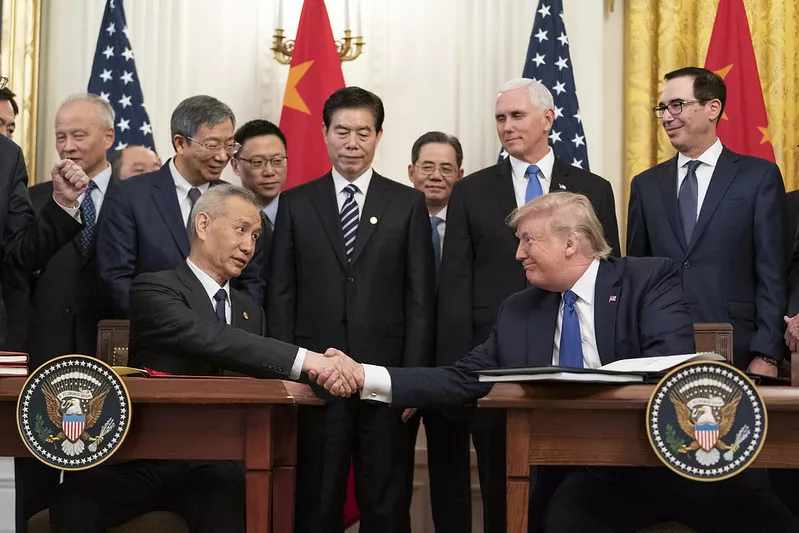
Farm organizations are warning the Trump administration that Beijing never followed through with many of its ag commitments under a 2020 trade deal, but the groups don't agree on what should be done about that, even as the White House prepares to sign a new agreement.
Treasury Secretary Scott Bessent said last month he hoped to formalize an agreement between the U.S. and China by Thanksgiving. Presidents Donald Trump and Xi Jinping agreed on the outline of a deal during an October meeting in South Korea. That Thanksgiving deadline has slipped, but both sides have been quietly implementing parts of the deal.
But as the U.S. careens towards a new pact with Beijing, the administration is still dissecting what went wrong with the last agreement. More than a dozen ag groups weighed in this week, arguing that insufficient commodity purchases were only the tip of the iceberg.
The respondents pointed out that China never fulfilled many of its policy commitments under the deal, leaving barriers to U.S. ag exports in place. In some cases where Beijing delivered on its promises, new obstacles have since sprung up, limiting U.S. export expansion.
Empty promises
China’s unmet purchase commitments under the Phase One agreement have been well documented. Under the terms of the 2020 deal, Beijing agreed to import an additional $200 billion of U.S. goods from its 2017 volume over the following two years.
In the end, it didn’t even match its 2017 import volumes, making none of the extra purchases, according to the Peterson Institute for International Economics.
Don’t miss a beat! It’s easy to sign up for a FREE month of Agri-Pulse news! For the latest on what’s happening in Washington, D.C. and around the country in agriculture, just click here.
Ag purchases were a rare bright spot, with Beijing hitting around 80% of the two-year target. But the bulk of that growth came from surging pork and corn imports as the country recovered from an African swine fever outbreak, and ag groups argue that China never delivered on some of the critical ag policy reforms that would have fostered longer term import growth.
“China made landmark and critical commitments” under the deal, National Corn Growers President Jed Bower wrote to the Office of the U.S. Trade Representative this week as part of a public comment period on the Phase One deal’s implementation. “China has not implemented these commitments,” Bower writes.
 Jed Bower (NCGA photo)
Bower cites Beijing’s inaction on accelerating biotechnology approvals as a major source of disappointment for U.S. corn exporters. Under the deal, China committed to ensuring approvals for new biotechnology traits would be transparent, efficient and rooted in science. Officials also said they would bring average approval times for U.S. biotech products down to two years.
Bower says that the average timeline for approval remains over five years, with two products languishing in the pipeline for more than nine years.
“Delays in biotechnology approvals are very costly for American innovators, farmers who utilize the products, and the broader agricultural economy,” Bower writes.
The American Seed Trade Association in its own submission cited China’s inactivity on its biotech commitments as “one of the single highest barriers” hampering commercialization of U.S. agricultural biotech products.
Elsewhere, industries pointed to other unmet policy commitments that continue to add additional costs to U.S. exporters and erect barriers around the Chinese market.
Under the deal, Beijing committed to carrying out a risk assessment for the beta-agonist ractopamine – a feed additive that promotes muscle growth and boosts efficiency in livestock production.
China continues to restrict beta-agonists, which the National Pork Producers Council argues is not in line with international standards established by the Codex Alimentarius Commission. When it has detected ractopamine in one-off shipments, it has suspended all exports from the U.S. facility, the Meat Institute adds, while the deal stipulates it can only refuse the individual shipment for a single offense.
Officials also agreed to set maximum residue limits for several veterinary compounds under the deal, which they never followed through on.
U.S. poultry exports are also hurting from China dragging its feet over implementing parts of the Phase One deal, groups say. More than 40 states remain banned from exporting to China over concerns about highly pathogenic avian influenza. But many of these states, the Meat Institute argues, meet the criteria set out in the Phase One deal’s HPAI regionalization protocol to have those export restrictions lifted.
“Reinstating these states’ export eligibility is a top priority for the U.S. poultry industry,” Julie Anna Potts, president and CEO of the Meat Institute, wrote to USTR this week. China “is the primary market for U.S. chicken paws and wing tips, and without Chinese demand for these products, U.S. companies are forced to sell feet and paws to renderers for a few cents per pound.”
China also made several commitments under the Phase One deal to comply with its World Trade Organization obligations around domestic subsidies and implement changes based on several of the organization’s dispute settlement panel findings.
A WTO panel in 2018 found that China was exceeding its permitted domestic support limits for Indica and Japonica rice. A separate 2016 panel ruled that it was unfairly managing a rice tariff-rate quota, which allows some volume of rice imports to enter the Chinese market at a reduced duty. USA Rice said in its submission to USTR that Beijing has made limited progress on both commitments.
The U.S. wheat sector reports similar opaque management of China’s wheat quotas.
Old habits
Even industries that enjoyed new market access opportunities under the Phase One deal charge that China has backslid in 2025 as trade tensions between the two countries have escalated.
China responded to new tariffs this year by scaling back purchases of several agricultural commodities. But respondents note it has also revived several trade barriers that the Phase One deal dismantled.
The U.S. Meat Export Federation noted that U.S. beef was a “big winner” under Phase One, with exports jumping from $86 million in 2019 to $2.1 billion in 2022. But Beijing has not renewed five-year export registration certificates for a slate of beef, pork and poultry plants, multiple groups complained.
“Now the China market is closed to U.S. beef,” USMEF President Dan Halstrom wrote, costing the industry around $1 billion in lost exports.
China’s customs administration also closed the market to U.S. bovine semen exports, National Cattlemen’s Beef Association Executive Director of Government Affairs Kent Bacus said, severing the U.S. from its top buyer.
Falling wheat imports in 2025 have also prompted concerns from U.S. Wheat Associates that Beijing is not going to reallocate unused quotas. Even the U.S. dairy industry, which saw substantial progress on non-tariff barriers to China trade as part of the Phase One deal, has seen some backsliding in recent years, with registration timelines occasionally lagging the 20 working days pledged in the agreement.
Shaping the next phase of U.S.-China trade
The feedback from agricultural groups isn’t purely a reflective exercise, Alan Wolff, former WTO deputy director-general who is now a senior fellow at the Peterson Institute, told Agri-Pulse in an interview.
Whatever agreement the administration has secured with China is likely to be fleshed out in subsequent rounds of negotiations and engagement – as trade frameworks with other countries have – and the comments could serve as a useful roadmap for agricultural talks.
“Many of these deals have left details to be determined later,” Wolff said. “This is good information for a negotiator going into a negotiation.”
 Alan Wolff (PIIE photo)
The administration could also use the probe to justify new tariffs. The administration is investigating China’s implementation of the deal as part of a Section 301 investigation – a probe traditionally used to identify unfair trade practices. If USTR determines remedies are needed to address unfair practices, a 301 probe can serve as a legal justification for tariffs.
A similar investigation was used during Trump’s first term to impose tariffs on China.
“301 is the classic way to pursue the non-fulfillment of an agreement,” said Daniel Mullaney, a former assistant USTR and nonresident senior fellow at the Atlantic Council think tank.
As the Supreme Court weighs the legality of other Trump tariffs on China, the 301 probe could also serve as another legal avenue to reimpose the duties if the court strikes down the emergency duties.
But the ag groups were divided over how best to hold China to account over its Phase One shortcomings. Some wanted to see tariffs wielded to compel Chinese action. The Renewable Fuels Association, for example, floated a targeted “reciprocal tariff” on Chinese ag exports to allow U.S. to recoup the $32 billion in unmet ag purchases.
The American Feed Industry Association also called for remedies to address specific unfair Chinese trade practices around vitamins and amino acids and reduce Beijing’s growing stranglehold on industry supply chains.
“The AFIA asks USTR to engage and employ trade measures that curb China’s ability to control vitamin and amino acid prices,” AFIA Chief Policy Officer Leah Wilkinson wrote. Such measures should go beyond tariffs, she argued, and include coordinating with allies on strategic investments to bring supply chains to friendly countries.
But many other groups argued against imposing new tariffs.
Our “organizations wish to express strong reservations about this Section 301 investigation and potential remedies such as tariffs as a result,” a joint submission from the American Soybean Association and the U.S. Soybean Export Council reads. We “are strongly concerned that any new remedies imposed under this Section 301 investigation will set negotiations back and lead to a reimposition of tariffs against U.S. soybeans by the Chinese.”
ASTA also urged the administration against pursuing tariffs, which it warned could disrupt trade flows. Similarly, NCGA recommended increased engagement with the Chinese over its biotech approvals but warned officials against pursuing measures that could harm U.S. growers.
But Mullaney, the former assistant USTR, said any outcome of the 301 probe is likely to be folded into the ongoing negotiations with China.
“China's not going to sign a deal” that could be undermined by new 301 tariffs coming into effect down the line, he said. “Practically speaking, I think parties are probably looking at both those things at the same time.”
This story has been updated to correct Kent Bacus' job title.

