
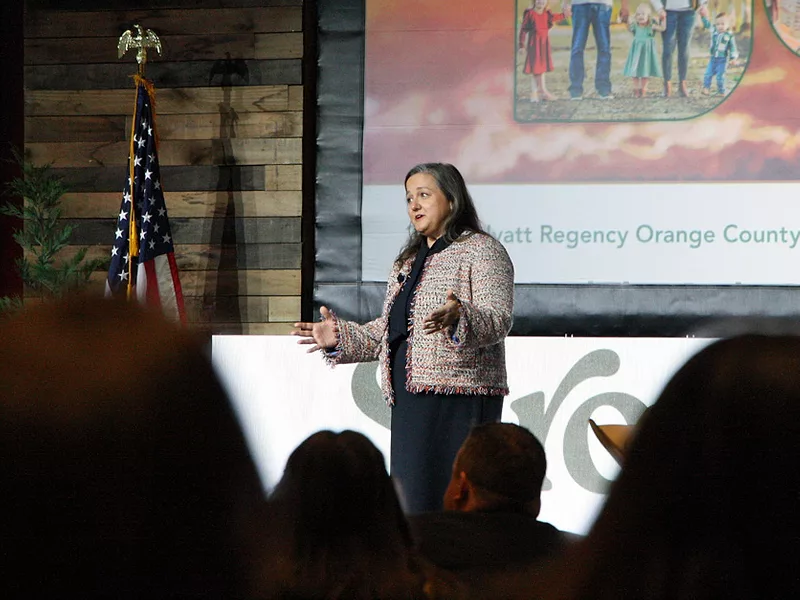
California Farm Bureau President Shannon Douglass opened the organization’s annual meeting in Anaheim Monday with a message blending celebration and caution, pointing to membership growth and advocacy gains while warning that regulatory pressure, ballot fights and labor challenges will continue to define the state’s agricultural landscape.
Under Douglass’ leadership over the last two years, the California Farm Bureau has shifted more of its attention to elevating visibility and resources for its county farm bureaus. At the meeting she applauded them for stepping up to grow their memberships, noting that several posted significant year-over-year gains — namely Lake, Nevada, Napa, Plumas-Sierra, San Francisco, Santa Cruz and Solano counties.
Internal restructuring was another focal point. Douglass said the organization’s strategic plan — “which we pulled off the shelf, dusted off, and incorporated into everything we do” — is now integrated into board decisions, staff meetings and long-term planning.
Douglass credited COO Dan Durheim and the organization’s finance team for stabilizing its fiscal outlook after difficult decisions on programs deemed no longer necessary.
Policy battles on water, labor and wildlife
Douglass focused mainly on advocacy, reflecting a year marked by aggressive legislative defense and high-profile ballot engagement.
She pointed to work by farm bureau staff on energy costs, predator management and climate policy — including efforts to block large-scale solar developers from relaxing the Williamson Act, which she described as “our farm bureau bible.”
Interested in more news on farm programs, trade and rural issues? Sign up for a four-week free trial to Agri-Pulse. You’ll receive our content - absolutely free - during the trial period.
Douglass called the debate over predator control a win after state regulators paused efforts to protect coyotes. She credited members and county sheriffs for shifting the outcome: “We got the point across, because of you all showing up to those meetings, sending in those emails, sending in the letters and making the calls.”
She also pointed to a composting bill aimed at helping livestock producers who lack rendering access, calling it “the most common-sense thing to move through the Legislature this year.”
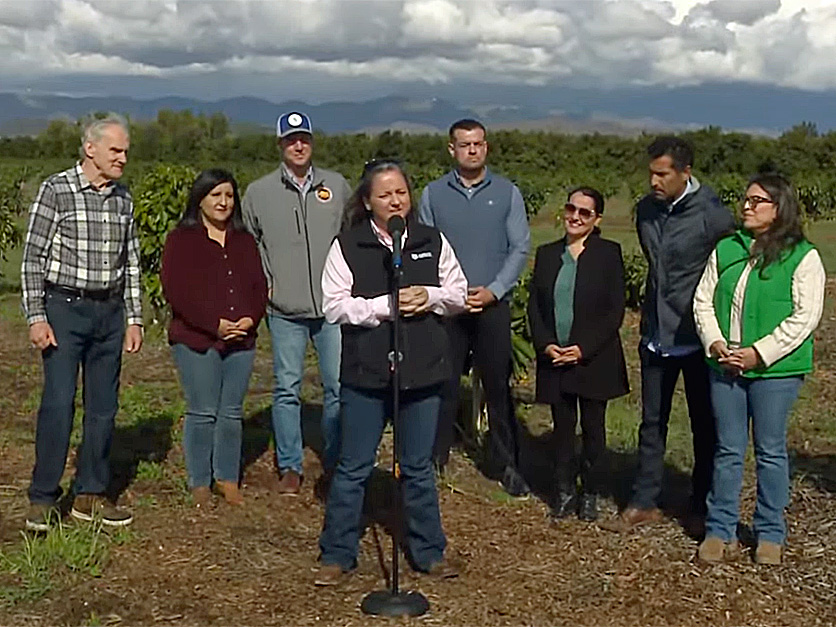
Lawmakers gather at a Ventura County avocado farm. (YouTube image)
On labor, Douglass noted the organization’s unusual decision to coauthor a New York Times opinion piece with Assembly Speaker Robert Rivas, arguing it helped reset the tone of the debate.
“We simply talked about why this issue is important — not only on our farms and businesses from a business perspective — but why it's important from a people perspective and how we value and appreciate the people that work on our farms and are involved in our communities and families,” she said.
The most contentious fight of the year, she said, was Proposition 50 — a ballot measure strongly opposed by the farm bureau. Despite losing "by a lot,” Douglass said the farm bureau’s clear and early stance preserved its credibility and political connections. Within two weeks of election night, she said, legislative leaders were back on farm tours.
Looking ahead: County-level engagement and next-generation leadership
Douglass emphasized expanding county-level policy engagement and leadership development. The organization has doubled the participation in its commodity advisory committees after shifting meetings from Sacramento to host counties — a format she said will continue next year.
She also highlighted youth efforts, noting that young farmers, FFA members and the next generation remain central to the farm bureau’s long-term mission.
“We've got over a hundred years of history, a whole century of work that's been laid out before us, a tremendous foundation that we’ve built,” she said. “Because of all that work, because of all that investment, that allows us to look ahead at a really bright future.”

