
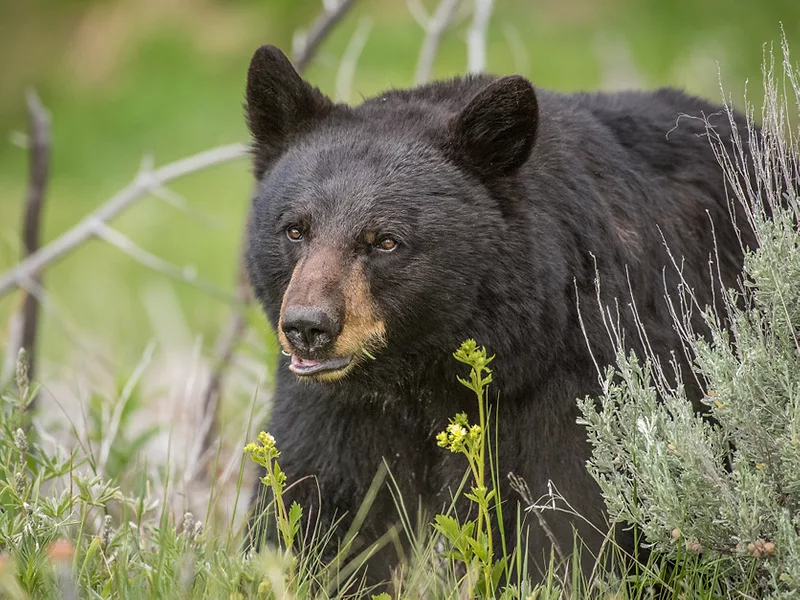
The Legislature and state agencies have been racing to assess the impacts and the options available as bears, coyotes, mountain lions and wolves increasingly invade neighborhoods, kill livestock and in some cases threaten human lives.
Ranchers and pet owners secured a small victory this month with the state walking back an effort to protect coyotes. In another glimmer of hope for agriculture, the increasing wolf population — and its reliance on cattle — has propelled wildlife officials to rethink its long-term strategy for the endangered species.
Yet Democratic lawmakers are reluctant to endorse more aggressive measures to protect communities from mountain lions, after the state experienced its first fatal attack in 20 years. And for the first time in California history, a black bear may have killed a resident, raising alarms over the increasing prevalence of the opportunistic omnivores in regions like Lake Tahoe.
At the center of the entrenched and adversarial debates over protecting both predators and the public is the California Department of Fish and Wildlife.
“The department — for better or worse, at a lot of levels — often feels like it's become the state's animal control service,” said CDFW Director Chuck Bonham, in an update last month to the California Fish and Game Commission, which oversees the department. “It's an untenable assignment: 58 counties. Every county is different. All our communities have their own variety, their own perspectives. Then you add to it things that are back in California, and the challenge gets even more intense.”
Coyotes expand in every county
Those long-simmering tensions can quickly hit a boiling point when policymakers consider changes, as the commission discovered in February. Removing coyotes as a nongame animal appeared clearcut to commissioners at the start of the year and did not seem to require prior notice to stakeholders or time for debate. A lower committee had recommended the commission approve the removal “in concert with a future rulemaking to maintain hunting opportunities.”
It’s easy to be “in the know” about what’s happening in Washington, D.C. Sign up for a FREE month of Agri-Pulse news! Simply click here
Yet the sudden decision immediately raised red flags for several agricultural associations. In a letter to the commission, Kirk Wilbur, vice president of the California Cattlemen’s Association, claimed the move to enact a new regulation “risks significant harm to California’s livestock producers.” Wilbur explained that coyotes disrupt calving patterns and kill calves, requiring ranchers to put down problem predators while proactively managing populations to prevent further harm.
 CDFW Director Chuck Bonham (photo: Department of Water Resources)
The commission relented and kicked the proposal back to the committee for further discussion. That teed up a four-hour discussion this month, along with hundreds of comment letters from farmers, ranchers, conservation advocates and residents living in fear of coyotes. At the outset of the hearing, commissioners sought to temper the debate by conceding that the recommendation is no longer moving forward and assuring stakeholders the committee will dedicate more time to discuss the issues at its September meeting.
While the focus of the conversation was coyotes, the debate centered on the role of CDFW in protecting the public.
“When we start putting predators above human beings and their livelihood, we create an imbalance that needs to be looked at thoroughly and in an honest way,” said Lassen County Sheriff John McGarva.
Michael Fisher, sheriff for Sierra County, argued the coyote proposal was not rooted in biological necessity but ideology and political pressure.
“They ignore the lived reality of rural California and predator control,” said Fisher.
Several commenters from agriculture detailed to the commission the damaging behavior of coyotes, from chewing on irrigation lines to the loss of calves and sheep.
“For coyotes, it's like a quick stop at In-N-Out [Burger] for us,” said San Diego County cattle rancher Alli Fender. “Each calf loss, especially right now, is worth anywhere between $1,600 to $2,000.”
Others worried of losing $10,000 show-quality sheep and shared accounts of coyotes luring guardian dogs away for others to go in for the kill. Pet owners, meanwhile, have been horrified to see coyotes enter dog doors and leap six-foot fences to steal off with family cats and dogs.
To many, controlling coyote populations was the only reliable solution, particularly for Duane Martin, a livestock producer based in Ione who often grazes his herds on county park lands.
“We can't trap them. We can't kill them,” said Martin. “We can't do anything. They want us to shoot them with paintball guns. That doesn't even work.”
Martin has been active in CDFA discussions on wolf management and worried the state would once again be “jamming [regulations] down our throat.”
Requiring permits to take coyotes, as CDFA requires for game animals, would be nearly impossible to implement, argued several ranchers, who stressed that coyotes look alike, move around quickly and would cause thousands of dollars in damage before the permits come through.
The commissioners leaned into the concerns with a sympathetic ear.
“It would not be feasible for the department — or for many of you who are working on farms and ranches — to require evidence of depredation prior to taking a coyote or to require permits for depredation,” said Commission President Erika Zavaleta, who co-chairs the committee. “We can take those off the table.”
Zavaleta added that only the Legislature has the authority to reclassify coyotes as game animals, since it would require a change in statute.
Agricultural associations celebrated Zavaleta’s decision as a win for ranchers.
“Overall, while I believe it was a good day for livestock producers, I know our battle with predators rages on,” said Rick Roberti, president of the California Cattlemen’s Association.
Pleas from conservation groups and animal rights advocates to enact new protections for coyotes went unheeded by the committee that day, though Zavaleta recognized “there's still questions about how we sustain lethal take.”
The looming wolf threat to livestock
Despite the lengthy hearing on coyotes, Bonham believes gray wolves “might be the most argued about wildlife species in North America” and that the state — a decade after confirming the first pack in a century — has crossed a significant threshold. At the end of 2024, CDFW tracked seven packs, with five meeting the definition of a breeding pair. That triggered the department to shift to the second phase of its 2016 management plan and initiate a status review of the species.
The initial development of that management plan involved more than 40 meetings over the course of a year and a half and “countless organizations and agencies.” Bonham anticipates more opportunities ahead for public input and scholarly feedback through independent peer review.
Under the plan, CDFW must now evaluate legal pathways under both the California Endangered Species Act and its federal counterpart to potentially issue permits authorizing more aggressive forms of hazing, such as rubber bullets, drones and ATVs, Bonham explained to the commission.
“We now have somewhere between 50 and 70 animals back. That's an amazing ecological success story,” he said, when describing the “duality” the department is grappling to contain. “Simultaneously, some of these animals and packs are primarily eating cows, and that is a big, legitimate concern in our rural landscapes.”
To support ranchers, the state has already been piloting “the nation's most comprehensive compensation program” to address both direct and indirect losses and the steep costs for nonlethal deterrents. CDFW has performed 79 investigations into losses, while its law enforcement division has pursued eight cases when locals allegedly killed wolves.
Bears are moving into rural communities
The success with wolves, however, has inspired calls to take more action to restore other lost species. A conservation alliance is urging CDFW to return grizzly bears to California a century after their disappearance. Under the leadership of the Center for Biological Diversity, the alliance commissioned a feasibility study. It found “no insurmountable biological, ecological, economic, legal or policy obstacles” for the state’s leaders and wildlife managers to overcome.
“The grizzly is our official state animal. It's on our flag,” Brendan Cummings, conservation director at the environmental organization, told the commission. “Many years ago the federal government successfully recovered the bald eagle, our national symbol. California can do the same with the grizzly.”
 Fish and Game Commissioner Erika Zavaleta (commission photo)
Bonham, immersed on the department’s many competing priorities, responded that CDFW would “have a hard time prioritizing this, given we have scarce resources.” He pointed out that it is losing 190 vacant positions as the administration drastically cuts spending amid a $12 billion state budget deficit.
“We already have a very large challenge managing human wildlife conflict with mountain lions, coyotes, bears and wolves,” he added.
Earlier in the hearing Bonham celebrated the department’s first update to its black bear conservation and management plan since 1998. Deploying cameras, DNA work, GPS collars and other modern tools to track the bears, CDFW was able to pin the statewide population at nearly 60,000, more than double earlier estimates.
The population — and the related damages to property, losses to agriculture and conflicts with communities — means the bears must relearn their natural fear of humans, according to Assemblymember Heather Hadwick, R-Alturas.
“Predators and bears are out of control in California,” said Hadwick, during a recent policy hearing for the Assembly Water, Parks and Wildlife Committee. “From the Oregon border to the Tahoe Basin, families, farmers and ranchers in my district are coming into contact with more and more bears, as they break into dumpsters, cars and even homes. Almost daily I get a call or text from a rancher who lost another calf or cow.”
Tahoe, she noted, has the highest density of black bears in the world. Hadwick also pointed to the death of a Sierra County woman likely from a bear mauling. She proposed, through Assembly Bill 1038, to reduce the number of conflicts by authorizing CDFW to allow the use of dogs to chase away bears. In 2012 California banned hunters from the practice, known as hounding, deeming it animal cruelty.
The bill drew support from the California Farm Bureau, along with Sheriff Fisher and several hunting groups. Hadwick, however, struggled to gain support from across the aisle. Asm. Steve Bennett, D-Ventura, argued AB 1038 confuses the issue by focusing on hunts and avoiding nonlethal deterrents. Asm. Chris Rogers, D-Santa Rosa, advocated for restoring the $3 million wolf compensation fund and expanding it to address losses from bears and mountain lions. Hadwick shared that Republicans have put in a $50 million request for that fund.
The arguments led the committee to block the bill from advancing.
Mountain lions go from threatened to thriving
A similar bill to allow hounds to haze mountain lions received a similar fate.
“This bill is not about hunting lions,” said Senator Marie Alvarado-Gil, R-Jackson, during an emotional committee debate last month over Senate Bill 818. “This is about finding a middle ground of coexistence with wildlife and with human life.”
Alvarado-Gil named the bill after two brothers attacked by a mountain lion last year in El Dorado County, with one critically injured and the other pronounced dead at the scene. The family testified in support of the bill, along with CAFB, which viewed it as a pragmatic step in protecting the public and agricultural operations.
But the measure conflicted with Proposition 117, which voters approved in 1990 to grant a special protected status to mountain lions. Committee Chair Monique Limón, D-Santa Barbara, assured Alvarado-Gil she did all she could to make SB 818 work. But the committee decided to convert SB 818 to a low-impact study bill, handicapping it until the Appropriations Committee delivered the final blow last week by holding it for the year.
“There is not one member of this committee that has come to me and expressed anything but a willingness to support this issue and to find a way to build consensus — that's where the bill has gotten stuck,” said Limón.
For more news, go to Agri-Pulse.com.

