
When the Cordi family lost nearly 70% of its almond orchards in a 2008 windstorm, they decided to pursue a long-held dream: owning and operating a winery. They began replanting with grapes.
Today, Cordi Winery in Live Oak, Calif., is a family-run, 15-acre vineyard that grows, produces and markets single-varietal wines.
While the business has thrived, the Cordis faced periods of uncertainty, particularly during the COVID-19 pandemic in 2020. With the wine industry declining and the family nearing an economic crisis, they applied for a USDA Value-Added Producer Grant (VAPG) to expand their marketing efforts.
“Without the grant, I don’t think we would have survived,” said Reece Cordi, founder, owner and Cordi Winery head winemaker.
The family used the grant to expand marketing and reach customers at a time when few people were leaving their homes. With the funding, they launched a website and online shop, and advertised through radio, newspapers, magazines and social media.
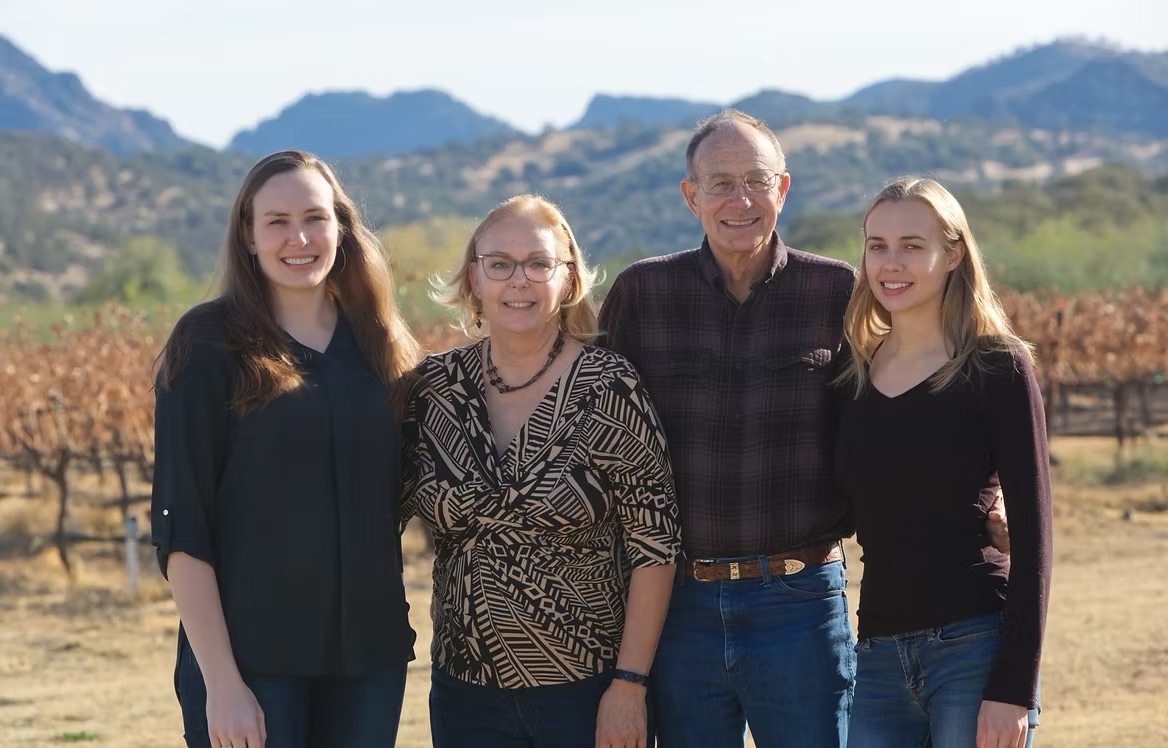 The Cordi family (Cordi Winery photo)
Funding under scrutiny
The VAPG program helps agricultural producers develop new products, expand marketing opportunities and increase farm income. Administered by USDA Rural Development, the grants support farmers and ranchers who add value to raw agricultural commodities. An Agri-Pulse analysis of USDA Rural Development documents found that from 2015 to 2025, USDA awarded more than $331.3 million in VAPG grants.
Ferd Hoefner, former policy director and senior strategic advisor at the National Sustainable Agriculture Coalition, said that when the VAPG program was first created, it heavily supported energy and ethanol production.
However, once the industry majorly expanded after the passage of the Energy Independence and Security Act of 2007, the VAPG program pivoted its focus towards other industries.
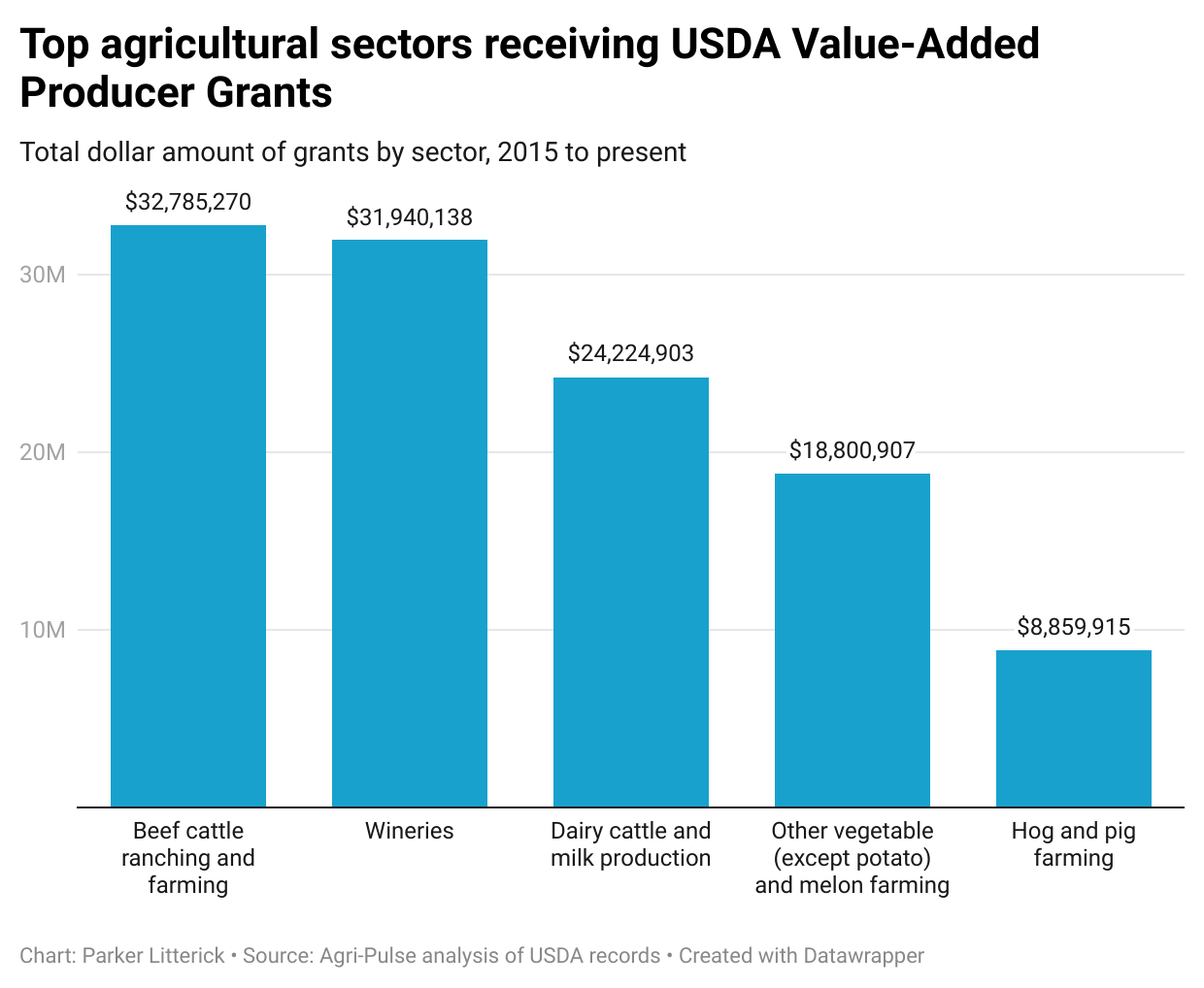
The sectors receiving the most funding over the last ten years included beef cattle ranching and farming at $32.8 million, wineries at $31.9 million, and dairy cattle and milk production at $24.2 million.
While topping other industries, overall funding for both dairy operations and wineries have decreased since 2015, with the dairy sector dropping by nearly 80% and wineries by 30%. Funding for beef, however, has surged by over 140%.
Cut through the clutter! We deliver the news you need to stay informed about farm, food and rural issues. Sign up for a FREE month of Agri-Pulse here.
States receiving the most money in grants were Virginia with $21.6 million, California with $20.2 million and South Carolina with $20 million. That’s a marked contrast to farm bill commodity programs, where the top recipients are Iowa, Texas and Illinois, according to a tabulation of payments from 1995-2004 by the Environmental Working Group. California ranks No. 10 in commodity program payments. Virginia and South Carolina are No. 30 and No. 32 respectively.
In terms of the number of VAPGs awarded, California led with 136, followed by Virginia with 134 and Washington state with 125.
Brandon Hoffman, who directs business and cooperative programs for USDA Rural Development in Washington state, said the largest number of applications there come from meat producers and processors, small scale vegetable and fruit growers, dairy product manufacturers and winemakers.
Based on USDA’s latest codes for designating counties as rural or urban, Agri-Pulse found that rural and urban counties received a similar number of grants, but urban counties received more money. From 2015 to 2025, counties designated as urban received $192.4 million in grants, while rural counties received $135.2 million.
Hoefner added that the VAPG program was intentionally designed to fund more urban areas, as many other programs under the Rural Development Act already support rural regions. “VAPG is one of the programs that has a carved-out exception for that,” said Hoefner.
VAPG was authorized under the Agriculture Risk Protection Act of 2000 and updated in the 2018 farm bill, which folded it into the Local Agriculture Market Program. The 2018 farm bill provides permanent funding, allocating $17.5 million annually for VAPG within LAMP’s $50 million statutory baseline.
A study released in 2018 by USDA’s Economic Research Service while that farm bill was making its way through Congress found that businesses that received the grants were 89% less likely to fail that similar businesses. Two years after receiving a grant only 0.23 of 1,000 VAPG recipients would be expected to fail after receiving a grant, versus 2.04 of every 1,000 non-recipients, although the impact of the grants tended to drop in ensuing years, the study found.
The study also found that a grant recipient employed five to six more people than non-recipients in the years after getting the money.
The study was based on VAPG grants issued from 2001 to 2015.
Farmers face obstacles in securing grants
The USDA VAPG program is competitive and available only to independent producers, beginning farmers and ranchers, socially disadvantaged producers, small and medium-sized farms, cooperatives and producer groups.
While efforts have been made to reach disadvantaged groups, many argue that the program’s 100% matching fund requirement and complex application process still pose significant barriers.
Janna Feldman, owner of Doe’s and Diva’s Dairy in Honey Creek, Iowa, faced challenges similar to those of the Cordis family during the pandemic. Despite receiving a VAPG in 2015, she had to close the dairy portion of her business.
Feldman used the grant to produce and market goat milk cheese and lotions, build a website and purchase cheese-making equipment. However, she struggled to meet the matching fund requirement.
“If I wanted to spend $5,000 on marketing, I couldn’t come up with another $5,000,” Feldman said. “The best year we had, we probably made $5,000. I just didn’t have the cash.”
Rep. Chellie Pingree, a Maine Democrat who serves on the House Agriculture Committee and House Agriculture Appropriations Subcommittee, said the 100% match has excluded many farmers from the program.
 Rep. Chellie Pingree (Office photo)
“The match requirement has taken a lot of farmers out of the opportunity,” Pingree said. “Reducing the match has been discussed, but right now, we’re just trying to hold onto the funding that’s available.”
In addition to the match requirement, some producers and organizations are calling for a simpler application process and more assistance. Many VAPG recipients, especially small farms and startups, must hire grant writers to navigate the complex application, adding another financial burden.
Lisa Dorn, an accountant for Hickory Hill Dairy, a fourth-generation family operation in Edgefield County, S.C., received a $240,000 VAPG in 2015 to expand its milk processing facility. Dorn had to hire a grant writer to complete the application, as the process was unfamiliar to the farm.
“We didn’t know much about the process,” Dorn said. “I’d advise others to hire someone who knows how to write a grant.”
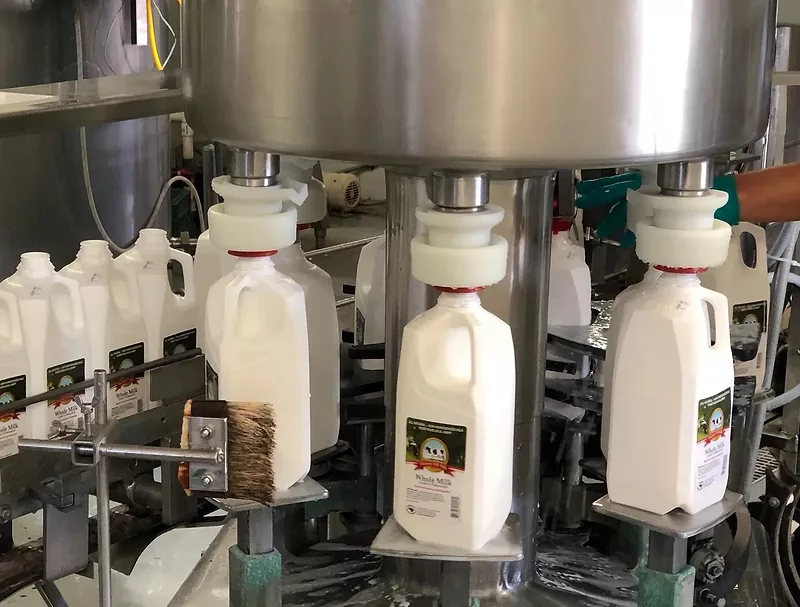
The 2015 grant helped Hickory Hill start bottling its milk. A second grant, Dorn said, allowed the company to start selling to university dining halls around the state by distributing the milk in five-gallon bags.
"We sell to the universities. We didn't have this product before. We didn't have the universities as a customer,” she said.
The USDA provides a toolkit to help producers navigate the application, but concerns remain.
Vanessa Garcia Polanco, government relations director for the National Young Farmers Coalition, is worried that applications from farmers will drop, in part because of a lack of communication from USDA. The widespread USDA staff reductions due to the deferred resignation program, combined with the extended government shutdown this fall, also have contributed to her concern.
“If the USDA doesn’t improve its customer service, we’re afraid fewer farmers will apply,” Garcia Polanco said.
Rural Development's staff was reduced by about one-third through the deferred resignation program, according to Office of Personnel Management data obtained by Agri-Pulse this spring.
Without changes, some farms could be left behind
As small and beginning farmers navigate an increasingly uncertain future, the VAPG program remains a vital lifeline for many.
However, with funding levels falling short of the program’s baseline and barriers like the 100% match requirement and difficult application process, its effectiveness may be limited.
For the Cordi family and others like them, these grants can mean the difference between survival and closure. But without addressing the program's funding and accessibility issues, many producers may find themselves left behind.

