
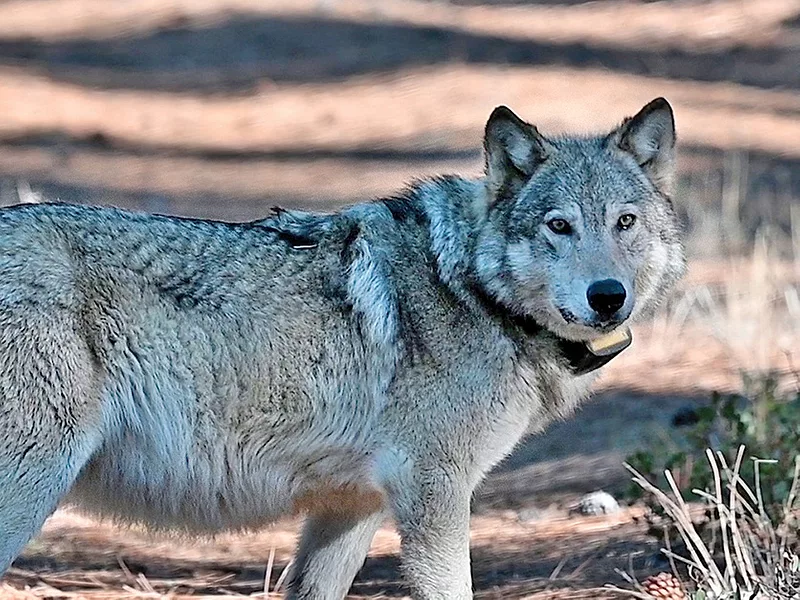
California’s approach to managing apex predators has drifted far from the realities ranchers and rural residents face on the ground, driving economic losses, fraying public trust and forcing local governments into conflicts they say Sacramento is not equipped to solve.
Rural sheriffs and supervisors are now speaking out about the state’s response to an escalating crisis over attacks on livestock and residents.
Speaking at the California Farm Bureau’s annual meeting in Anaheim, rural leaders argued that state wildlife policy often prioritizes process over outcomes, especially when local officials are trying to respond quickly to livestock depredations and public safety threats.
Their comments landed as California debates how to respond to rising conflicts involving mountain lions, wolves and bears. Mountain lions have been a specially protected species in California since voters passed Proposition 117 in 1990, which allows limited take exemptions tied to public safety and protection of private property and livestock. Wolves, meanwhile, have expanded in the state under a conservation plan that has shifted to Phase 2 this year after meeting the threshold for breeding pairs.
A fatal attack, then a political fight
El Dorado County Sheriff Jeff Leikauf described in vivid detail the mountain lion attack last year in El Dorado County that killed Taylen Brooks and severely injured his brother, Wyatt Brooks. The incident became the emotional and political backdrop for Senate Bill 818, a state proposal framed by Leikauf and other supporters as a targeted pilot to “tree and free” mountain lions in the county, hazing them away from populated areas using permitted houndsmen.
He was frustrated lawmakers watered down the measure after hearing from wildlife advocates, claiming that the Mountain Lion Foundation had revised the proposal “to remove everything out of it that had the word ‘dog’ in it.”
 El Dorado County Sheriff Jeff Leikauf (Brad Hooker/ Agri-Pulse)
Repeated depredations on goats and other domestic animals continued after the bill stalled in the Appropriations Committee.
The warning for foothill counties was just as dire for California’s rapidly growing wolf population.
“I can guarantee you that two years ago, I never considered the fact that we would have a wolf problem,” said Sierra County Supervisor Paul Roen.
The valley went from no kills a few years ago to 94 confirmed kills this summer, with most attributed to a single pack. Shasta and Siskiyou counties declared emergencies and pushed the Newsom administration for action, after feeling like they were “getting absolutely nowhere” with deterring the predators, explained Roen.
Then in June the California Department of Fish and Wildlife launched a special strike force to combat depredations. But the state officials arrived unprepared, even lacking telemetry readers that local ranchers and officials viewed as essential, according to Roen. Wolf attacks continued to escalate.
Cut through the clutter! We deliver the news you need to stay informed about farm, food and rural issues. Sign up for a FREE month of Agri-Pulse here.
Local leaders had documented the attacks, maintained their own records, and collected DNA samples to avoid losing evidence in disputes over verification and reimbursement, explained Sierra County Sheriff Mike Fisher.
“We built and categorized our own DNA database and CDFW was really upset over that,” said Fisher, adding that the county ultimately shared samples back with the department when it had contaminated its own samples.
Roen argued that documentation was the lever for change. “He realized we were going to bury him with facts,” he said, referring to disputes with CDFW Director Chuck Bonham. A map created by Tracy Schohr, a research and extension adviser at University of California Agriculture and Natural Resources, played a pivotal role in confronting CDFW.
In October CDFW took action, euthanizing four wolves in the Sierra Valley responsible for 60% of the livestock losses statewide over the spring and summer. According to the department, the decision followed months of efforts to deter the pack’s escalating livestock depredations, including drones, diversionary feeding, 24/7 field presence and other nonlethal methods. Roen attributed the takes to pressure from the U.S. Fish and Wildlife Service.
The pack had become habituated to cattle as a primary food source and posed a long-term threat to both ranching interests and statewide wolf recovery efforts.
Yet the looming wolf threat continues to haunt the community, with Fisher framing it as both a physical and psychological public safety issue.
“You have the mental health side of it, the terror, the stress,” he said, describing ranchers sleeping in trucks and responding to every cattle disturbance throughout the night.
 Sierra County Supervisor Paul Roen (Brad Hooker/ Agri-Pulse)
California’s wolf plan anticipates expansion into additional suitable habitats as recovery progresses. The second of the state’s three-phase plan describes a shift from growth driven by immigration into California to growth sustained by in-state reproduction and range expansion.
Coexistence vs. on-the-ground realities
On mountain lions, Leikauf questioned how landowners are supposed to deploy deterrence systems across large acreages.
“I don’t know how you put blinking lights on a T-post when you have 800 acres,” he said.
On wolves, the valley tried a range of tools — drones and telemetry were potentially helpful when deployed correctly — but the state did not install some deterrence it claimed in public statements, charged Roen.
“When we told them to put up all the fladry they wanted, guess how much they put up,” he said, describing the use of flags on electrified rope. “Not one piece of fladry in the Sierra Valley this summer.”
The county leaders felt CDFW treated them as bystanders when conflicts escalated.
“The three of us are local county elected officials,” said Fisher. “We’re directly accountable to our constituents.”
Roen suggested his community’s relationship with the department was severely damaged and would take decades to repair. That dynamic with Sacramento has become more fluid, with Bonham, the longest-serving CDFW director, leaving the department next month to join The Nature Conservancy as its California executive director.
The panel touched politics directly when asked whether the candidates running for governor next year were addressing the wildlife conflicts. Fisher said he had spoken with Riverside County Sheriff Chad Bianco, the Republican frontrunner, and suggested all the candidates will likely be reluctant to weigh in on predator management because it is politically toxic. He worries more influential moderate Democrats will avoid the issue entirely.
Steven Fenaroli, who directs policy advocacy at the farm bureau, reframed the learning lessons over the summer as a catalyst for building a broader coalition, uniting law enforcement, University of California researchers and livestock producers. He highlighted a new predator working group and a push to “speak louder with one voice.”
Roen said local leaders were working on an after-action packet that other counties and county farm bureaus could use to prepare before wolves arrive.
Wolf policy debate carries into Fish and Game Commission as Bonham prepares to depart
The concerns raised by the sheriffs and supervisor echoed days later at a California Fish and Game Commission hearing, when environmental advocates blasted CDFW for the wolf takes and urged the commission to revise the wolf plan to add further priority to nonlethal strategies and to increase funding for the state’s compensation program, after the Legislature approved $2 million in July.
“This happened because of just a few narratives that were taken to the media, that were portrayed to the general public,” said Anjali Ranadive, president of Women for Wolves. “All the coexistence, all of the science, all of the collaboration that you guys and that all of us have been working for has been overshadowed.”
Rural residents, on the other hand, framed their concerns around public safety.
“I am concerned for my safety while on my daily walks in rural Lassen County,” said Anne Meyer, noting that two 650-pound calves were killed 30 feet from a home where young children live and that the popular Pacific Crest Trail runs just a mile from three confirmed kills. “[Hikers] need to be issued a warning.”
Bonham defended the department’s actions, telling commissioners that from spring through early fall, CDFW deployed about 20 staff, logged roughly 18,000 hours of nonlethal hazing and monitoring, and worked with ranchers on site-specific deterrence plans before concluding the pack had become too habituated to livestock to break the cycle.
“The department made a gut-wrenching decision — and it's on my shoulders. I will have to live with it for the rest of my life,” said Bonham, while acknowledging the depredation rate in the Sierra Valley was “statistically the highest rate of loss associated with any gray wolf pack in any Western state since around the 1990s.”
Bonham also acknowledged the 2016 conservation plan was written when California’s wolf population was far smaller and stressed that the department has begun updating it to reflect the permanent presence of wolves in California.
“Coexistence is our collective future,” he said.

