
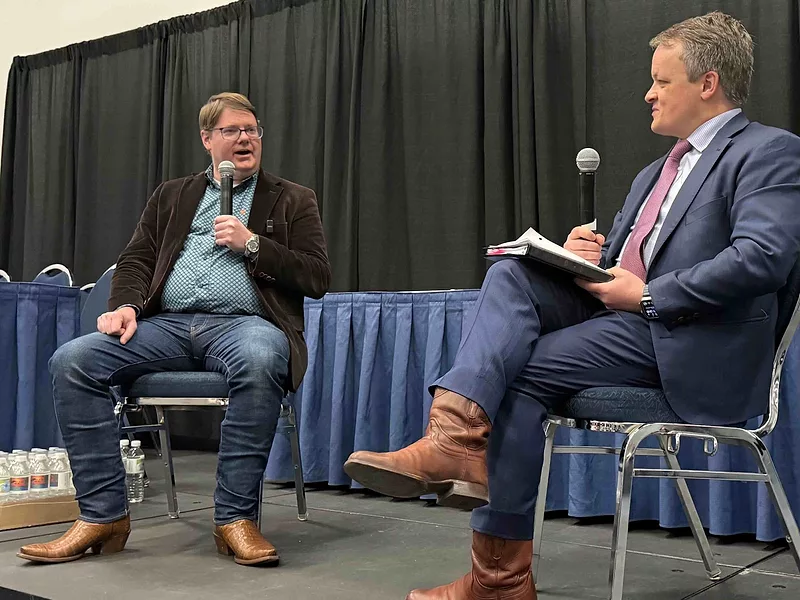
U.S. agricultural interests are “missing the ball” with so much focus on China and should instead be looking more closely at Brazil as a competitor and culprit for low U.S. commodity prices, Deputy Agriculture Secretary Stephen Vaden said Sunday.
“So much of the growth, of their productivity, has been because they are literally burning down the Amazon rainforest in order to create new cropland and new pastureland,” Vaden said during a session at the American Farm Bureau Federation’s annual meeting in Anaheim, California.
“That is not something we would ever do here in the United States, and it is an unfair form of competition.”
Vaden said he was happy that U.S. Trade Representative Jamieson Greer is investigating those Brazilian practices under Section 301 of the Trade Act, noting that U.S. farmers and ranchers are “being asked to compete against a country that's going out and burning down one of the world's great ecological resources in order to take our market share.”
Vaden also highlighted USTR’s efforts to break down more barriers around the globe after four years of inaction on the international trade front under the previous administration.
Vaden insisted the Trump administration wants to do more trade deals, but he said they have to be beneficial for U.S. agriculture.
Vaden said USTR has been battling the European Union’s efforts to enforce geographical indicators that prohibit the use of common names for certain food products in places like Southeast Asia and Argentina.
“We got the Argentinians to agree to forget the agreement they had made with the European Union and allow our American farmers to compete without these impediments,” Vaden said, while emphasizing “this is real and lasting change which is going to start adding up.
“That's why, when I talk about trade, I don't focus so much on China. I focus on all the other deals that whether it be Japan, Southeast Asia, the Western Hemisphere, the things we're doing with certain European countries, because all of that represents new demand.”
Vaden also addressed several other topics in a discussion with AFBF Executive Vice President Joby Young, including:
The Farmer Bridge Assistance program: For the $11 billion in payments to row crop producers, “Our team is hard at work getting the computer programs ready, so that when you show up, all you have to do is review a form that's already been filled out, confirm that the information there is correct, sign your name at the bottom, and by the end of February, you'll get your money.”
With regard to the $1 billion for specialty crops, USDA is in the process of designing that program and Vaden anticipates USDA will be making policy decisions and payments in the first quarter of this calendar year.
Farmers’ cost-price squeeze: Vaden said there are “legitimate questions to be asked” about what can be done to sell more both domestically and in the international marketplace. On the cost side of the equation, “we have had record consolidation when it comes to large agribusinesses, particularly when we look at areas of farm equipment and fertilizer.” He noted President Donald Trump’s executive orders asking USDA to join the Department of Justice in looking at anti-competitive behavior.
Section 32 program: Section 32 is a U.S. law providing the USDA with 30% of customs receipts (tariffs) to support agriculture. In fiscal year 2025, USDA purchased nearly a billion dollars in agricultural commodities to distribute “everything from citrus to catfish, Vaden said, while noting that Section 32 monies are roughly 12 to 18 months behind receipt of the actual imports. As those dollars add up, Vaden said USDA will have more to spend under Section 32 to help remove more surpluses.
Drone usage: Vaden supports what the Federal Communications Commission has proposed to “put a pause on” the purchase of new foreign-made drones, while noting that farmers can still fly drones they currently own.
“By the time existing drones are obsolete, the expectation is that, thanks to this new FCC policy, American drones will have caught up, and the drone you buy will have been made here in the U.S.”
He said he reads classified information on a weekly basis about “what our foreign adversaries are up to and what an important role agriculture plays in their plans,” underscoring the importance of protecting agricultural data.
“The new battlefield is data and whoever has the best data wins,” he said.
Forest management: Vaden emphasized that national forest lands are working lands and that USDA intends to actively harvest and properly manage them. “They are not museum pieces. They're not a national park. That's why they're at USDA,” he said. He also called for using more public lands for grazing and said he was working with the Interior Department to make it easier for cattlemen to move herds between Bureau of Land Management and Forest Service properties. “We need to make that transition as seamless as possible if we're going to grow our cattle herd.”
He also lamented that “you can't cut a tree, even a dead tree, without getting sued. I'm not a tree hugger myself, but I can understand that people like natural beauty. … I don't understand liking dead trees.”
For more news, go to: www.Agri-Pulse.com

