

|
As much as President Donald Trump would like to bring down the cost of beef, historical beef prices have played a key role in keeping dairy farms afloat as milk prices have collapsed over the past year.
Dairy producers have been supplementing their income for several years by breading their less-productive cows for beef calves rather than replacement heifers. Sales of beef calves became especially important last year as the all-milk price fell from over $24 per hundredweight a year ago to under $19 last month.
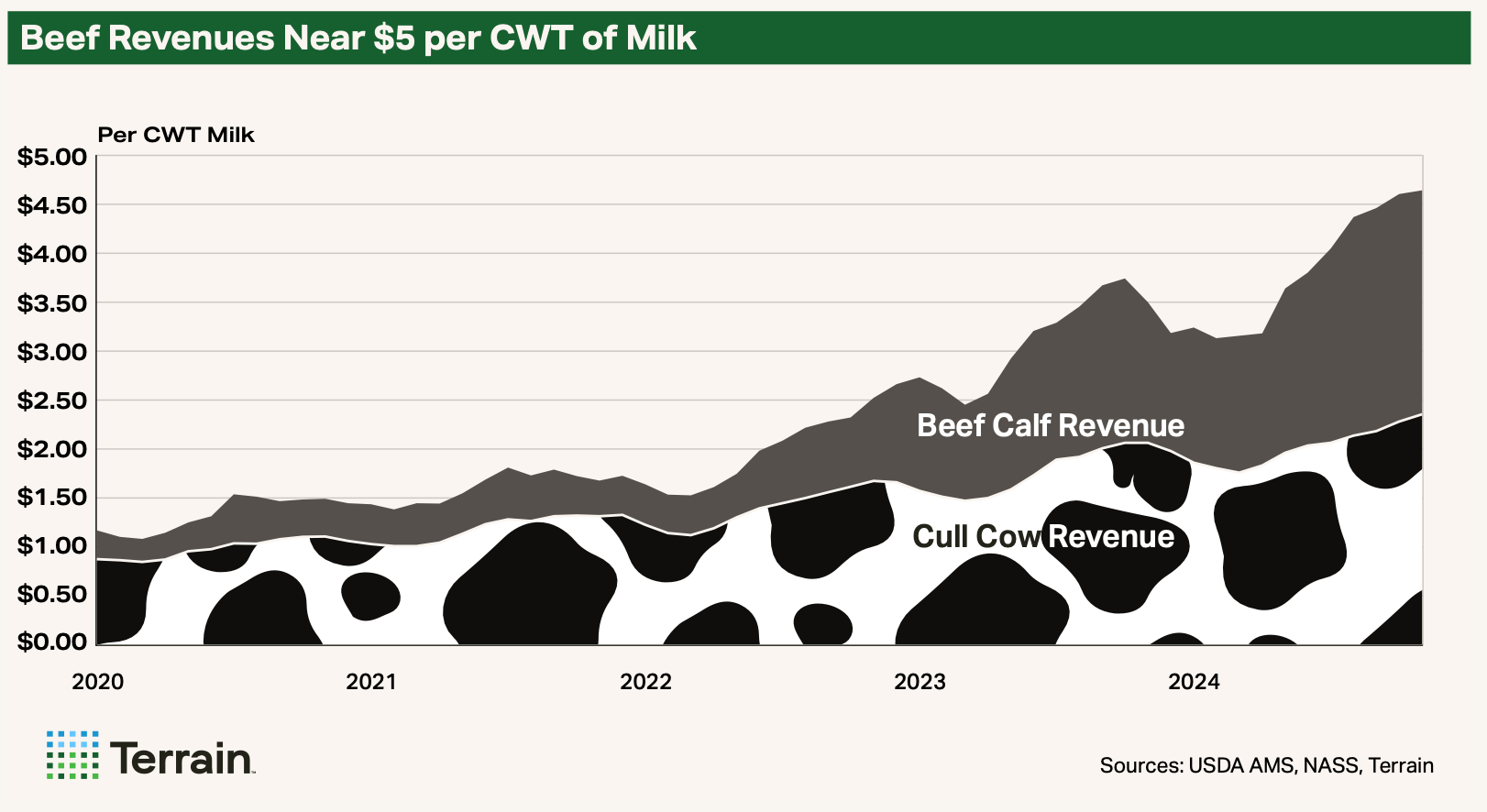
Ben Laine, an economist for Terrain, estimates that selling beef calves and culled cows accounted for $4 to $5 per hundredweight in dairy farm revenue last year, more than double what they got in 2022. The beef revenue lowers the break-even point for dairy farms by a similar amount, he said.
Beef calf sales have been “pretty lucrative” for dairy producers, Laine said. “It's been really kind of a lifeline to the dairy industry, as we've started to see [milk] prices turn a little bit here.”
Dairy farms are typically using about 30% of their less-productive cows for beef calf breeding, he said.
“We've certainly seen what we call a beef on dairy market using crossbred calves that has really taken off and been a critical lifeline for U.S. dairy farmers here over the last several years,” said Will Loux, senior vice president of global economic affairs for the National Milk Producers Federation.
“It's allowed U.S. dairy farmers to be hyper-efficient, more sustainable, both financially as well as also allowing dairy farmers to kind of help supply what is a real need for beef in the United States.”
Strong beef prices became a sharp focus of the Trump administration last year, which introduced several measures to try to induce an increase in cattle production. Retail beef prices continue to climb, however, rising 1% in December, according to the Consumer Price Index.
The administration is also rumored to be considering a buyout of dairy herds, an issue that arose at American Farm Bureau Federation’s annual meeting this week. AFBF delegates adopted a resolution opposing the idea. A USDA spokesman on Wednesday flatly denied a buyout is being considered. “This is unequivocally false. USDA is not considering such a buyout full stop," he said.
Heidi Fischer, a dairy producer near Hatley, Wisconsin, is among the dairy farmers who have used beef revenue to help manage income as a national oversupply of milk pushed milk pices down.
Her 2,800-acre farm, which she runs with her husband and in-laws, has about 1,000 cows, which have been producing about 95 to 100 calves a month, with about two-thirds being sold for beef. She stressed that the operation is also mindful of the number of heifers that will be needed to maintain its milk production.
“Having the additional beef was kind of a byproduct of what our breeding protocol and goals were. … We're really dialed in on who do we want heifer calves out of,” she said.
Fischer, who is president of Edge Dairy Farmer Cooperative, said her operation has also taken advantage of USDA’s risk-management tools, including the Dairy Margin Coverage (DMC) program and dairy revenue protection insurance.
DMC triggers payments when the margin between the all-milk price and feed costs falls below a selected coverage level in any given month. Producers are expected to get a payment for December, when the margin fell to an estimated $8.83 per hundredweight, down from $13.85 in January 2025. The maximum coverage level is $9.50.
DMC enrollment for 2026 started Monday. Changes included in the One Big Beautiful Act allows producers to update production and increases the maximum coverage level under Tier 1 from 5 million to 6 million pounds.
 Fischer’s operation has also reduced its feed costs by incorporating high-oleic soybeans, a Corteva variety known as Plenish, that substitute for canola and other additives. By introducing soybeans into the farm’s crop rotation, they’ve also saved on fertilizer for the following corn crop.
Danny Munch, an economist for the American Farm Bureau Federation, says that beef revenues have encouraged farmers to retain cows longer than they would have, contributing to a price-depressing oversupply of milk. The U.S. dairy herd is at its highest level since the early 1990s.
“When dairy farmers are starting to focus on the beef market, well they're not really focusing on the milk market. So, we got a lot of dairy farmers that are holding on to cows longer, they're breeding them longer,” Munch said at AFBF’s annual meeting this week in Anaheim, California.
“What does that mean? They're still milking them. That means there's more and more milk in the market. … We have record milk production in this country, and the market is not sending signals that we need more milk.”
Munch said a market correction is coming, because the number of replacement heifers has dropped to its lowest level since 1978 even as the overall number of cows has grown.
Eventually, the cows now being used for breeding beef animals will be too old to continue calving. “They’ll be culled, but you won't have those replacement calves to bring back the milk supply,” Munch said.
 Danny Munch (LinkedIn photo)
Trump’s trade policy hasn’t been the problem for dairy producers that it has been for soybean farmers and other crop producers. “Up to this point, I'd say dairy has weathered the retaliatory tariffs fairly well,” said NMPF’s Loux. “A lot of this has to do with dairy has been fairly diversified away from China.”
But dairy producers haven’t been entirely unscathed by tariffs.
Fischer had to pay an extra $70,000 in duties last year on equipment the operation imported from Europe to better manage its use of sand for bedding. The equipment will allow the farm to recycle the sand rather than having to constantly truck in fresh sand after the used sand is spread on fields to dispose of it.
“I'm trying to be a good community member, so there's less traffic [from sand trucks, and] not putting sand in my fields. And then I turn around and I get hit with this tariff,” said Fischer. “I feel like I'm getting punished for doing something good.”

