
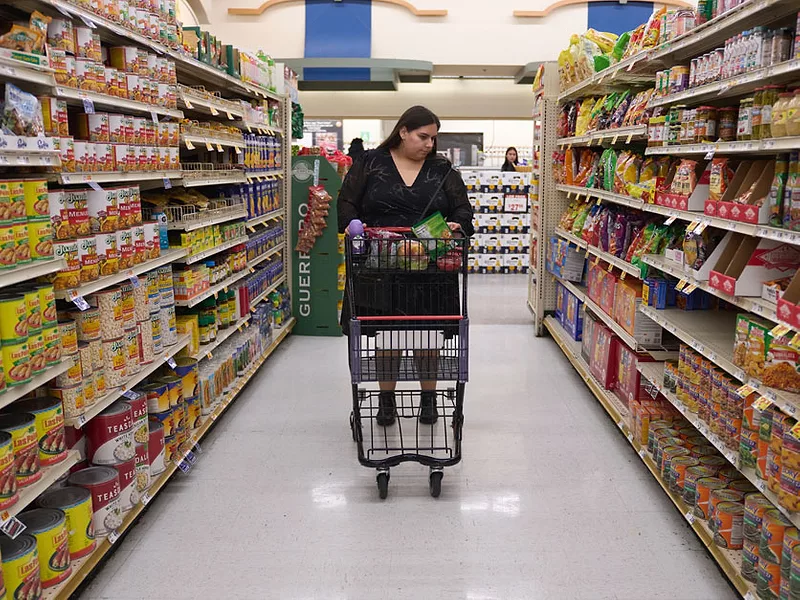
Six Republican senators want Attorney General Pam Bondi and Federal Trade Commission Chair Andrew Ferguson to investigate the food retail industry for violating an antitrust law intended to protect small retailers.
In a letter, Chuck Grassley and Joni Ernst of Iowa, Mike Rounds of South Dakota, Thom Tillis of North Carolina, Roger Marshall of Kansas, and Tim Sheehy of Montana say they’ve heard about a lack of competition forcing small and medium-sized grocers to "accept increasingly discriminatory terms and conditions for their products, including less favorable pricing, price terms, supply terms, and retail packaging.”
The senators say those retailers "allege that sometimes they are unable to access products that are in short supply, while their larger competitors are able to obtain those same products.” They add that “industries, such as the grocery business, experience high turnover and low margins, which allow firms with market leverage — whether sellers, purchasers or intermediaries — to engage in discriminatory practices that disproportionately harm independent competitors.”
Trump walks back European tariff threat
President Donald Trump is dropping his plans to impose new tariffs on European partners for opposing his effort to take control of Greenland.
In a post to Truth Social Wednesday, the president says he spoke to NATO Secretary General Mark Rutte and hashed out “the framework of a future deal” for Greenland’s security.
“Further information will be made available as discussions progress,” Trump wrote.
Take note: Trump’s post came just hours after the European Parliament formally suspended the approval of a U.S.-European Union trade pact agreed last year.
During a press conference Wednesday, the Parliament’s international trade committee chair Bernd Lange told reporters the body wouldn’t sign off on the deal until there is “clarity” on Trump’s Greenland plans.
Craig, local officials assail SNAP cuts
Angie Craig, the top Democrat on the House Agriculture Committee, linked the One Big Beautiful Bill Act’s shifting of SNAP administrative costs to the states to higher property taxes in Minnesota.
Cut through the clutter! We deliver the news you need to stay informed about farm, food and rural issues. Sign up for a FREE month of Agri-Pulse here.
Led by Craig on Wednesday, Democratic lawmakers held a roundtable to highlight the impacts of the OBBBA, which cuts the SNAP program by $287 billion over 10 years, according to the Congressional Budget Office. Craig said cuts in federal social safety net programs such as Medicaid and SNAP were forcing county officials in her state to raise property taxes.
Two examples: Dakota County, the largest in her congressional district, has okayed a 9.9% increase, and St Louis County has approved a 12.4% hike.
Officials from Connecticut, Ohio and New Jersey told the roundtable that they were struggling to implement new SNAP work requirements without clear guidance from USDA. Daniel Giacomi, the division director for the Connecticut Department of Social Services, said states need more time to implement changes before they have to shoulder more of the financial burden of running SNAP.
Some details: The OBBBA requires states to pick up 75% of SNAP’s administrative tab. They currently pay 50%. One study has concluded that will increase state costs by $15 billion annually.
The officials also derided the OBBBA’s use of the SNAP error rate to determine admin costs, saying it’s not reflective of how well programs are operated.
“I will just say it out loud here today: The payment error rate is a fundamentally flawed metric,” said Larry Braasch, deputy division director for the New Jersey Department of Human Services.
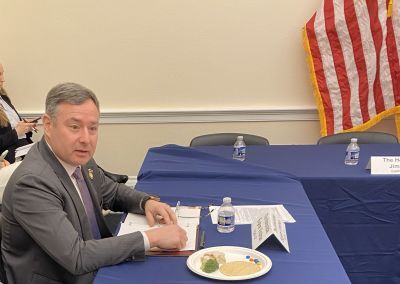 House Ag Committee member Rep. Eugene Vindman, D-Va., brought a plate of chicken, a tortilla, broccoli and some M&Ms to the Democrats' roundtable on SNAP. Agriculture Secretary Brooke Rollins has suggested that for $3, the meal is an inexpensive way to eat in accord with the new dietary guidelines. (Agri-Pulse photo)
Mosaic extends phosphate production freeze at Brazil plants
Mosaic says that two of its Brazil facilities will stay idle for at least another 30 days due to a spike in sulfur prices.
In a statement published Wednesday, the company says its Fospar and Araxa single sulfur phosphate facilities, which were idled in mid-December, will remain offline.
“This move removes phosphate units from an already tightly supplied market,” StoneX’s Vice President of Fertilizer Josh Linville tells Agri-Pulse. He notes that the continued idling could result in higher prices.
Chinese phosphate exports are expected to remain depressed until at least August, Linville said. “The world can ill afford to lose more production.”
EU Mercosur deal faces setback
The European Parliament has voted to send the bloc’s Mercosur trade deal for a judicial review. That could delay full ratification by up to two years.
Farmers in countries including Ireland, France and Poland had been concerned over the deal’s agriculture provisions.
German Chancellor Friedrich Merz called the vote “regrettable” and argued it “misjudges the geopolitical situation.” He called on the commission to provisionally implement the pact while the European Court of Justice weighs the legality.
“We are convinced of the agreement's legality. No more delays,” he posted on X.
Study touts need for nationwide E15
Ag groups put out a study saying that expanding higher corn-based biofuel blends nationwide would give farmers and fuel producers the time needed to develop robust new markets for renewable marine and aviation fuels.
With bigger yields sending production to record highs, the U.S. Corn Belt urgently needs new drivers of demand. The massive 2025 corn crop is seen as reducing planted acres, weakening rural areas dependent on the flurry of economic activity around corn production. That’s according to the study from the Iowa Corn Growers Association and Iowa Renewable Fuels Association (IRFA).
Farm-state federal lawmakers pushed this week to get language into "must pass" funding legislation that would allow year-round U.S. sales of ethanol blends of 15% with motor gasoline, up from the current 10%. The attempt to broaden availability of E15 has been a top goal of the ag industry for years. Corn is the biggest U.S. crop and more than a third of each year's harvest goes into making ethanol.
IRFA Executive Director Monte Shaw says if E15 isn't passed as part of congressional attempts to avoid a government shutdown on Jan. 31, there likely won’t be another chance for years to get E15 enshrined into law.
"The outcome of this will have a lot to do with how agriculture feels the next five years," Shaw told Agri-Pulse Wednesday at the Clean Fuels Alliance America conference in Orlando, Florida.
Take note: President Trump is expected to travel to Iowa next Tuesday. The Iowa congressional delegation is expected to have more details on his visit as soon as today.
Smithfield Foods to acquire ‘Nathan's Famous’ hot dog brand
Nathan’s Famous hot dogs will be part of Smithfield Foods. The Virginia-based pork giant announced on Wednesday that it had entered into a merger agreement with Nathan’s Famous, a brand known for hot dogs, sausages, and other meat products.
As part of the agreement, Smithfield agreed to acquire all of Nathan’s Famous’ issued and outstanding shares for $102 per share, with an enterprise value of around $450 million, according to a press release. The deal is expected to close in the first half of this year.
Sid Miller opponent gets key endorsement
Texas Ag Commissioner Sid Miller’s primary opponent has won the endorsement of Gov. Greg Abbott.
“Nate Sheets is the true conservative champion for the job and is the leader we need to keep Texas the global powerhouse in agriculture,” Abbott said in a statement released by the Sheets campaign. Sheets founded a popular brand of honey that goes under his name and now owns a 10,000-acre ranch in west Texas.
The primary is March 3.
Final Word
“It’s do or die right now. We’ve asked our champions in Congress to do whatever it takes because if we don’t get it now, we don’t think E15 is coming for years and there isn’t another identifiable demand driver on the horizon.” – Iowa Renewable Fuels Association Executive Director Monte Shaw talking to Agri-Pulse about the push to get E15 legislation through Congress by Jan. 30.
Kim Chipman, Steve Davies, Philip Brasher and Oliver Ward contributed to today’s Daybreak.

.webp?t=1762183428)


