

President Donald Trump delivers his State of the Union message days after the Supreme Court struck down a cornerstone of his trade policy, and his controversial pick for U.S. surgeon general will get her long-delayed Senate confirmation hearing.
The House Agriculture Committee was scheduled to begin debating a GOP farm bill on Monday, but due to weather the start of the markup was delayed a week.
The 6-3 ruling against Trump’s use of tariffs on Friday came as Democrats were preparing to hammer House Ag Chairman Glenn “GT” Thompson, R-Pa., and other Republicans for not rolling back the levies in their draft farm bill.
Trump’s plan to temporarily replace some of the tariffs is poised to keep the topic alive. The White House has said certain fertilizers and some farm products will be exempt.
Trump speaks to a joint session of Congress on Tuesday evening. He could pitch a message to farmers on how his trade deals will be a boon for U.S. agriculture, as well as tout his administration’s Make America Healthy Again initiatives. Virginia Gov. Abigail Spanberger, a former House Ag Committee member, delivers the Democratic response following the president’s address.
The speeches could provide a glimpse into how key trade, and farm and food, issues might play out on the campaign trail in this year’s midterm elections.
Also in focus this week, as the House and Senate return to Capitol Hill after a week-long recess, is whether lawmakers can come up with a compromise deal to pass a bill allowing year-round sales of higher ethanol blends, known as E15. The issue will dominate talks this week at the National Ethanol Conference in Florida.
Down in Texas, members of the nation’s grain and oilseed groups and representatives of ag equipment manufacturers will gather for the annual Commodity Classic. Agriculture Secretary Brooke Rollins speaks to the conference in San Antonio on Thursday afternoon.
Pesticide critic gets confirmation hearing
Casey Means, Trump's pick to be surgeon general, was one of the most prominent members of the MAHA movement before it helped power Trump to a second term. Her Senate HELP hearing is scheduled for Wednesday.
 Casey Means (Caseymeans.com photo)
The hearing was originally scheduled for October but was postponed due to her pregnancy. She was nominated for the position last May.
She has linked pesticides to cancer and other human health problems, once writing in her online newsletter that “the single most effective strategy that I believe can solve the pressing human health and environmental issues facing our globe” is “restoring sustainable agriculture practices that contribute to biodiverse soil and nutrient-rich food, and moving away from industrial agriculture that uses toxic synthetic pesticides.”
She is credited with helping jump-start the MAHA movement with her book, “Good Energy” on metabolic health, which became a New York Times bestseller. She also is chief medical officer and co-founder of Levels, a company that sells continuous glucose monitors.
Means co-wrote the book with her brother, Calley Means, an ally of Health and Human Services Secretary Robert F. Kennedy Jr., who is now a health adviser in the White House.
Tariff fallout to continue
The Supreme Court’s landmark ruling Friday will limit how a future administration wields tariffs, but it could also shape lawmakers’ approach to trade legislation in the coming months and years, a former economic official in the Trump administration, told Agri-Pulse.
“It will be interesting to see how Congress reacts,” Everett Eissenstat, also a former Senate Finance Committee chief trade counsel, said in an interview. “I always thought this would end up in the Congress at some point.”
The episode, he said, could spur renewed interest in clarifying congressional oversight over tariffs. Sens. Chuck Grassley, R-Iowa, and Maria Cantwell, D-Wash., have a bipartisan bill to give Congress a vote on new tariffs, for example.
With the Supreme Court ruling taking some of the uncertainty out of U.S. trade policy, there could also be increased appetite for codifying some of the trade deals.
“I think you are going to see more legislation built around some of the concepts that have been put in place by these frameworks,” Eissenstat said.
Rep. Adrian Smith, a Nebraska Republican who chairs the House Ways and Means Committee’s subcommittee on trade policy, has been a proponent of putting some of the pacts to congressional votes to make them more durable.
But lawmakers’ responses to the high court ruling on Friday highlighted deep differences between GOP lawmakers when it comes to trade policy, exposing the challenges of wrangling the conference behind a single approach.
Some, like Washington Rep. Dan Newhouse and Kentucky Sens. Rand Paul and Mitch McConnell, who all backed congressional efforts to overturn some of Trump’s tariffs, welcomed the court’s reinforcement of congressional tariffing powers.
But Sen. Bernie Moreno, R-Ohio, called for Republicans to pass legislation to reinstate Trump’s tariffs. Others, like Ways and Means Chairman Jason Smith, R-Mo., and Sen. Roger Marshall, R-Kan., expressed disappointment at the Supreme Court’s decision.
For right now though, the president is signaling that he doesn’t need anything from Congress. Asked whether he would work with Congress on tariff legislation Friday, Trump said he doesn’t have to.
“I have the right to do tariffs. I've always had the right to do tariffs,” he said. Without emergency powers it will just be “a little bit more complicated.”
Farm bill debate certain to be contentious
House votes were cancelled for Monday, leading House Ag leaders to postpone for until the week of March 3 the planned farm bill debate.
Pesticides, animal welfare and nutrition programs are among the contentious issues up for debate and expected to be among the subject of proposed amendments to the draft farm bill when the debate does begin.
Among the amendments the committee could consider during the debate is one filed by Rep. Nikki Budzinski, D-Ill., that would require a mandatory update of commodity program base acres, a move that would likely cut spending and result in some growers losing lucrative base.
The panel’s top-ranking Democrat, Rep. Angie Craig, has decried the bill for “ignoring” Democratic priorities and including “poison pills” that could derail a bill’s passage.
Laura Wood, president of LWP consulting, told Agri-Pulse Newsmakers she thinks the “poison pill” provisions “can be worked through.”
Thompson’s draft legislation includes updates of various ag programs that weren’t dealt with in last year’s One Big Beautiful Act, which included $66 billion in new spending on ag programs. The piecemeal approach is Congress’s answer to getting around a stalemate in passing a full, five year farm bill.
There are 179 pieces of legislation included in Thompson’s farm bill, including 148 bills with bipartisan support. Just 13 of the marker bills have exclusive support from Democrats, and 18 have exclusive support from Republicans.
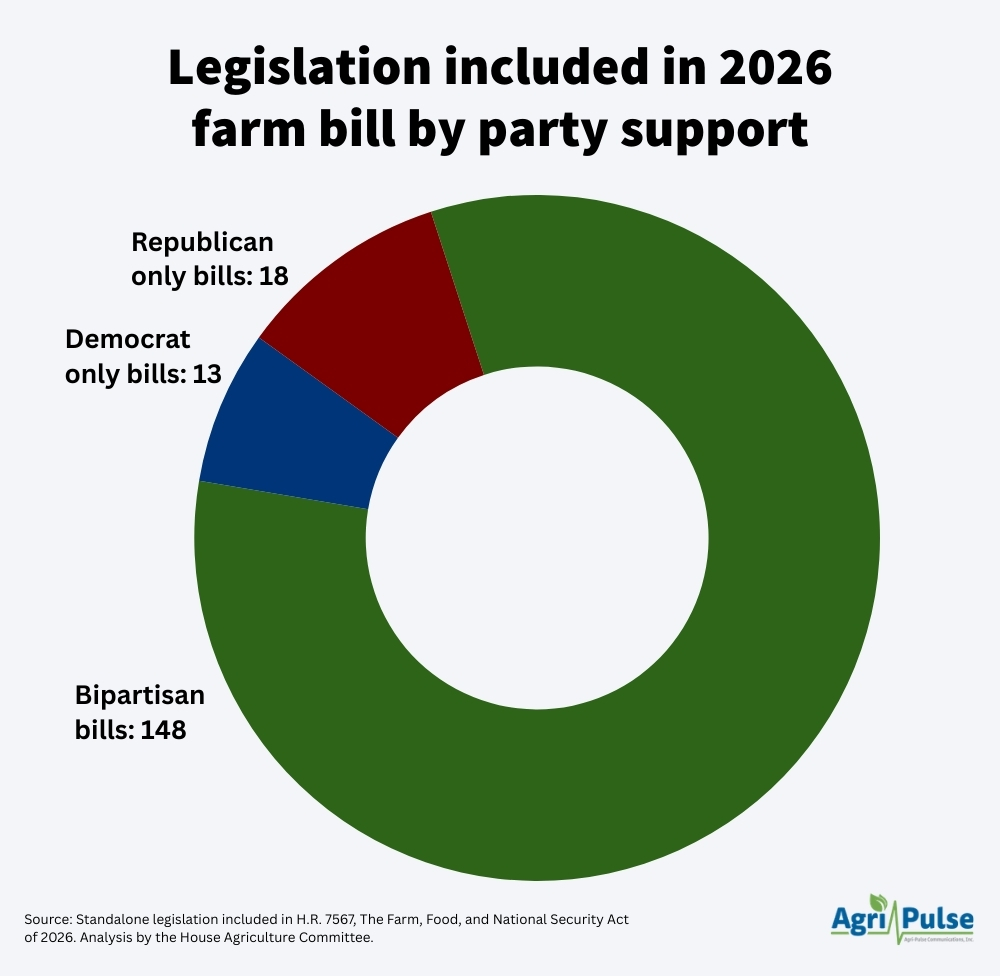
Those marker bills divided by title can be viewed in an analysis by the House Agriculture Committee.
One of the provisions in the GOP bill would prohibit consumers from bringing lawsuits that claim pesticide manufacturers failed to warn them of health risks, if a label approved by the Environmental Protection Agency doesn’t contain such a warning.
Specifically, the bill seeks to achieve national uniformity in pesticide labeling by barring states or courts from penalizing or holding liable “any entity for failing to comply with requirements that would require labeling or packaging that is in addition to or different from the labeling or packaging approved by [EPA] administrator.”
The measure also seeks to hold “bad actors” responsible by allowing states to make label changes for pesticides made by entities that have violated certain provisions of the Federal Insecticide, Fungicide, and Rodenticide Act, such as by submitting false data.
Rep. Chellie Pingree, D-Maine, said she plans to introduce an amendment to strike that language.
“This farm bill is a gift to Big Chemical, plain and simple. It delivers exactly what giants like Bayer have spent years lobbying for: blanket immunity from lawsuits and the power to gut the state warning label laws that protect families, farmers, and children,” Pingree said.
She said the provision “would slam the courthouse doors on people who’ve been poisoned and harmed.”
The GOP farm bill also aims to prohibit states from imposing “a condition or standard” for raising covered livestock located outside of its state.
The Supreme Court upheld California’s Proposition 12 in 2023. That law doesn’t allow the sale in the state of any eggs or pork derived from animals not raised according to California’s animal housing standards. The National Pork Producers Council and other farm groups have been pushing for the provision, claiming that many small producers cannot afford to make the necessary changes to their operations.
Here is a list of agriculture or rural-related events scheduled for this week in Washington and elsewhere (all times EST):
Monday, Feb. 23
Washington International Trade Association hosts annual international trade conference, through Tuesday, in person in Washington or online.
AFFI-CON frozen ingredients show, through Tuesday, in San Diego.
National Association of Counties conference through Tuesday, in Washington.
International Sweetener Colloquium, through Wednesday, Championsgate, Florida.
Tuesday, Feb. 24
Commodity Classic, through Friday, San Antonio.
Renewable Fuels Association’s National Ethanol Conference through Thursday, Orlando.
9:30 a.m. – Center for Strategic and International Studies webinar, “What Comes Next for U.S. Trade Policy After the Supreme Court’s IEEPA Ruling?”
10 a.m. – Senate Environment and Public Works Committee hearing on reauthorization of the Water Resources Development Act, with focus on Army Corps of Engineers projects and programs, 562 Dirksen.
11 a.m. – Peterson Institute for International Economics will host a virtual event on “tariffs in America and the Supreme Court case.”
1 p.m. – Farmers for Free Trade roundtable, “USMCA Renewal and North American Agricultural Trade.”
3 p.m. – The Atlantic Council will host an event on “unlocking new opportunities in US-Guatemala trade and investment.”
9:30 p.m. – President Trump delivers his State of the Union address to Congress; Virginia Gov. Abigail Spanberger gives the Democratic response.
Wednesday, Feb. 25
9:30 a.m. – Senate Energy and Natural Resources Committee hearing on the nominations of Stevan Pearce to be director of the Bureau of Land Management, Kyle Haustveit to be an undersecretary of energy, and David LaCerte to be a member of the Federal Energy Regulatory Commission, 366 Dirksen.
10 a.m. – Senate Health, Education, Labor and Pensions Committee hearing to consider the nomination of Casey Means to be U.S. surgeon general, 430 Dirksen.
11 a.m. – USDA releases Food Price Outlook
3 p.m. – USDA releases Broiler Hatchery report.
Thursday, Feb. 26
8:30 a.m. – USDA releases Weekly Export Sales report
9 a.m. – Ag Innovation Forum 2026, in Kansas City, Missouri
4:30 p.m. – Agriculture Secretary Brooke Rollins speaks at Commodity Classic in San Antonio
Friday, Feb. 27
3 p.m. – USDA releases annual reports on cold storage and poultry slaughter
For more news, go to Agri-Pulse.com.
.webp?t=1762183428)


