
|
This is the final installment in a three-part series examining Brazil's growing agricultural competitiveness and its potential for additional expansion, "Brazil's Ag Powerhouse: Any Limits?"
Simone Botan, 52, runs her family’s 7,660-acre farm near Lucas do Rio Verde in Brazil’s Mato Grosso. Botan, a trained psychologist who worked on the farm from the age of five. now grows corn and soybeans on almost 4,450 acres with the rest preserved as natural forest.
“We try to put a strong focus on sustainability,” she told a group of reporters, including Agri-Pulse, earlier this month.
Brazilian farmers have long been cast as global villains in the fight against climate change, accused of tearing up the rainforest for commercial agriculture.
But the industry in Mato Grosso – Brazil’s agricultural heartland that straddles the Amazon’s rainforest biome and the tropical savannah, known as “cerrado” – says the reputation as a climate menace is unjust, at best, and at worst, part of an effort from the global north to protect domestic industries.
They point to the use of no-till farming and vast tracts of untouched land set aside by farmers as evidence of the effectiveness of existing climate laws in preserving Brazil’s forest ecosystems.
In fact, they say that if the carbon footprint of their agricultural products were accurately accounted for, they would be among the more sustainable options in international markets. Rather than an albatross around their necks, sustainability can be a competitive advantage for Brazilian soybeans, they argue.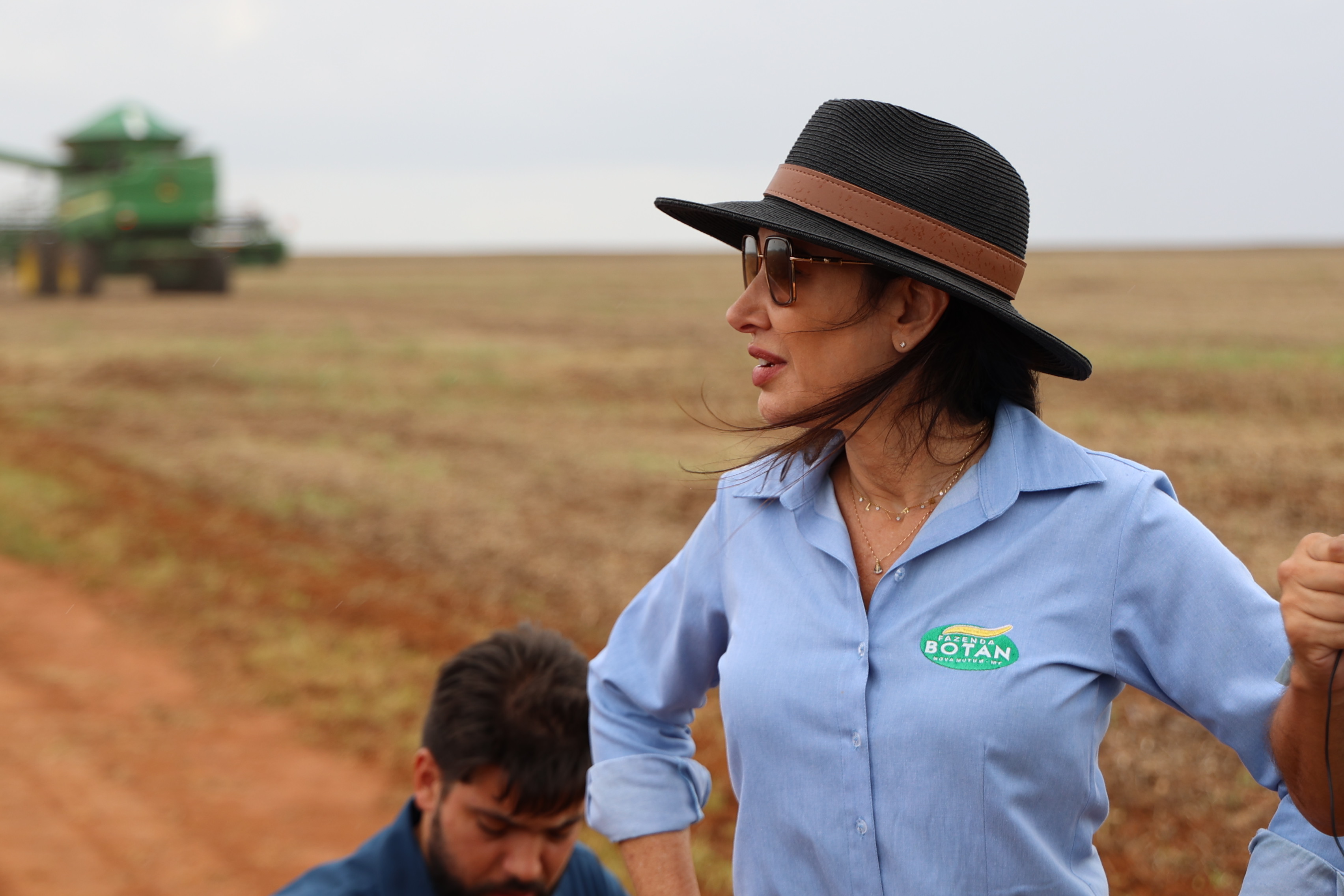 Simone Botan on her farm near Lucas do Rio Verde. (Agri-Pulse photo)
Mato Grosso is one of the most established soybean producing regions in the country. Many producers, like Botan, are second-generation growers, working farms established in the 1980s after the bulk of deforestation several decades ago.
Although the region has made substantial progress in curbing deforestation for soybeans, it has a long way to go to eliminate it entirely, analysts say. Enforcement of laws is patchy, they note, and a key driver of recent progress – a soy moratorium – was recently dealt a blow when major trading companies withdrew from the deal.
The industry itself will need to take steps to prevent backsliding and make further advances if it wants to be seen as a true sustainability leader, they argue.
A patchwork of green
Earlier this month, Aprosoja-MT, a trade association representing Mato Grosso’s soybean and corn producers, hosted a group of European and North American reporters. A sizeable portion of the week was dedicated to demonstrating efforts to mitigate climate impacts of agriculture and progress by the sector in tackling deforestation.
Daniel Vargas, a professor at the economics school at São Paulo’s Fundação Getulio and an economic and environmental regulation specialist, sees a “mismatch” between the international perceptions of Brazilian soy production and the reality on the ground.
Members of the trade association and their grower members repeatedly suggested that the industry in Mato Grosso has been a poor communicator of sustainability bona fides and needs to deepen global understanding of efforts underway to preserve swaths of rainforest and savannah in its natural state.
For starters, producers in Mato Grosso face strict limits on the share of private land that can be converted to agricultural uses under the latest iteration of the country’s Forest Code, signed into law in 2012. Planters located in the Amazon biome in the north of the state can only farm on 20% of their land and must keep 80% preserved as natural forest. Those elsewhere have to preserve between 20% and 35% of their acreage.
If producers deforested land before 2008, they have the option of regrowing forests or buying offsets elsewhere in the same biome.
Areas around rivers must be left untouched to prevent chemical runoff and to act as a natural buffer. Depending on the width of the river, producers are required to leave 30-500 meters of untouched vegetation.
The scale of the preservation efforts is most visible from the air. A flight over the region during the early February soybean harvest reveals a patchwork of green and brown fields, punctuated by a sprawling web of forests that often connect to neighbors’ preserves to form corridors that allow wildlife to roam.
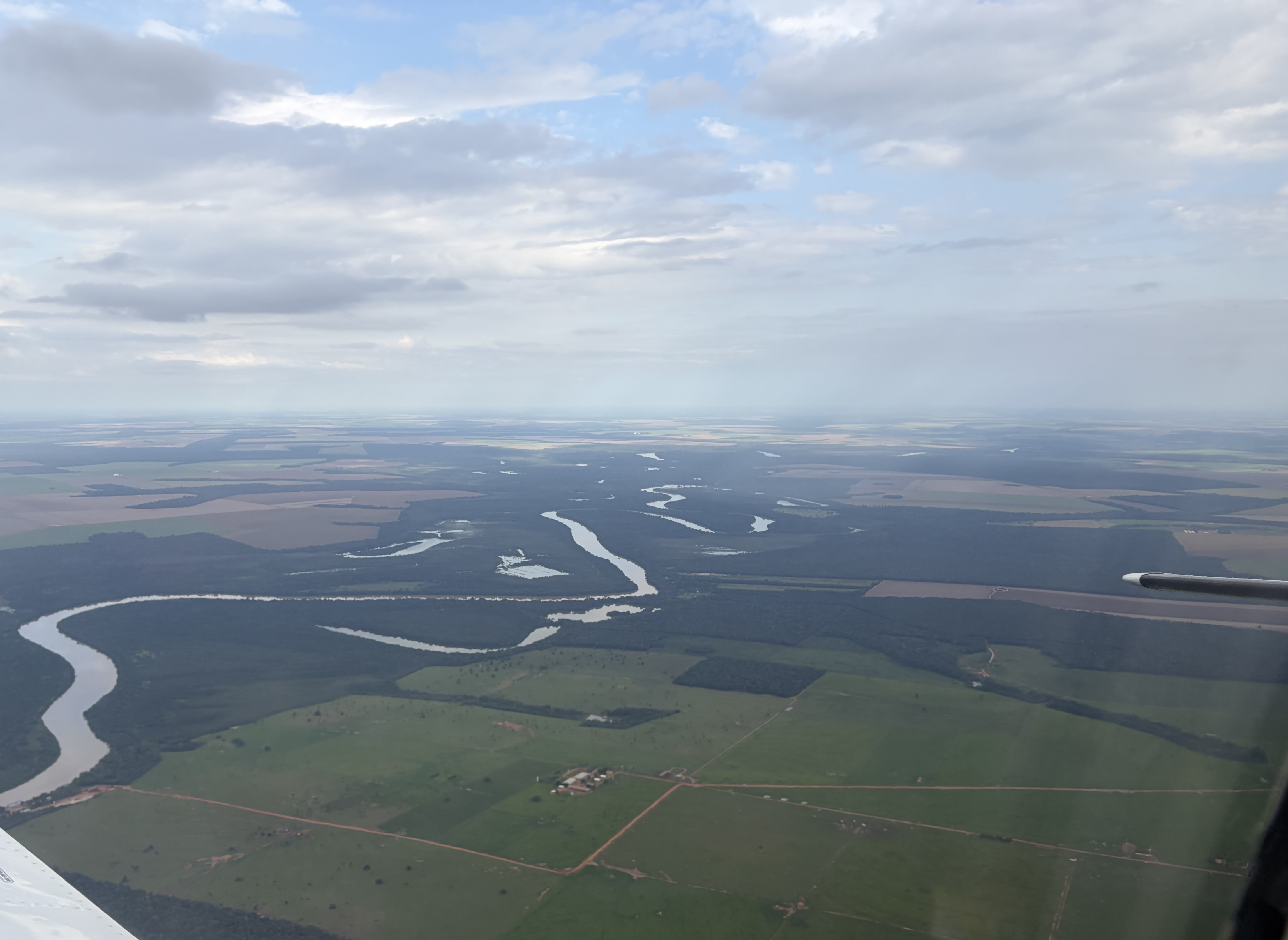 A river in Mato Grosso (Agri-Pulse photo)
Producers also have to apply for licenses before they can deforest additional acres, even if they are already farming under their legal limits, like Botan. Licenses can take more than a year to get, Aprosoja-MT President Lucas Costa Beber tells Agri-Pulse.
The federal environmental agency (IBAMA) monitors satellite imagery to ensure compliance and works with state environmental agencies to go after illegal and unlicensed, irregular, deforestation.
Penalties for breaching the Forest Code can be severe. Producers face fines, embargoes on their lands, seizures of livestock or machinery and, in severe cases, imprisonment.
A voluntary soy moratorium adopted in 2006 which, until recently, saw the major commodity traders agree to avoid purchasing soybeans from deforested areas also contributed significantly to declines in deforestation. A 2017 study led by University of Kansas researchers found that deforestation in Mato Grosso was five times lower from 2007 to 2014 than it had been in the previous seven years, and the rate of forest to soy conversion fell from 9.4% to 3.9%.
Brazilian President Luiz Inácio Lula da Silva has said he wants to go even further and end deforestation in the Amazon by 2030.
“To be frank, I would say in a lot of ways, the Brazilian environmental policy is stricter than what we have here in the U.S.,” Justin Kirchoff, CEO of Summit Agricultural Group, an investment company, told Agri-Pulse in an interview.
“We're farming to the edge of the stream,” he added. “They also have extremely strict, and I would say harsh, penalties for deforestation.”
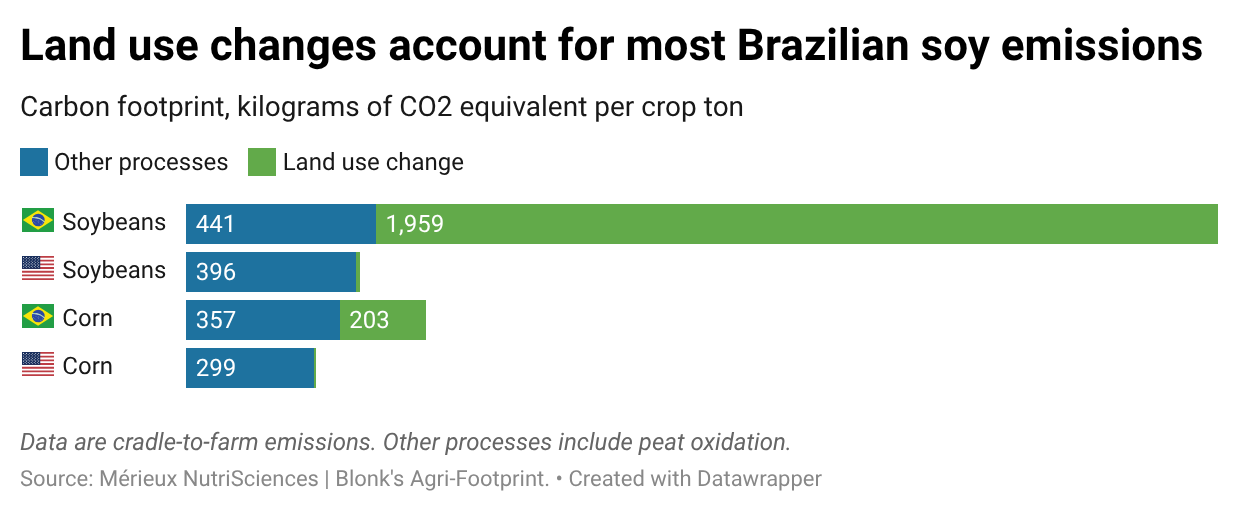
Brazilian soybeans have an average carbon footprint more than five times larger than U.S. beans, according to data from Agri-Footprint, a sustainability intelligence platform from Mérieux NutriSciences-Blonk. But the bulk of the emissions come from assumptions around land use changes.
Mérieux’s methodology accounts for land use changes occurring in the last 20 years, according to Janjoris van Diepen, Blonk’s footprint director for North America. Once these land use changes are omitted, Brazilian beans show a carbon footprint comparable to that of the U.S. Some methodologies even have Brazilian soybeans as the cleaner product once deforestation is excluded.
Demonstrating progress on deforestation could also highlight the sustainability of downstream agricultural products, including soybean and corn derivatives, say industry representatives.
As Brazil ramps up production of corn ethanol, the sector believes that it will be the preferred choice of industries looking to maximize reductions in greenhouse gas emissions.
The industry believes strict domestic traceability requirements put it in a strong position in international markets for corn derivative products like dried distillers’ grains with solubles, Natiela Nicolodi, a regulatory affairs manager at Inpasa, an ethanol production company, told reporters. Brazil’s domestic biofuel incentive program, known as RenovaBio, traces feedstocks back to the farm level, requiring more precision than the U.S. Renewable Fuel Standard, which often relies on aggregate compliance.
Future progress is under threat
Compounding Brazil’s challenge in swaying international opinion on sustainability of agricultural products is that, while the country has made strides in recent decades to reduce deforestation, analysts say it was in large part due to the soy moratorium that is now under threat. They believe that Forest Code enforcement is not enough to assure the desired protection.
Holly Gibbs, director of the Global Land Use and Environmental (GLUE) lab at the University of Wisconsin, told Agri-Pulse that the moratorium succeeded in pulling soybean farmers out of the market for land deforested after 2008.
“The soy sector has done something amazing by devaluing deforestation," she said, but farmers have been “remarkably bad” at following the Forest Code.
Her research suggests that almost a quarter of soy farms larger than 62 acres in the Amazon have been deforested illegally since 2008. Further, around a third of all soy grown in the region comes from properties that are not fully implementing the code, she said.
Part of the challenge, said Lisa Rausch, lead scientist at the GLUE lab, is that the agency responsible for enforcing the Forest Code was decimated under former President Jair Bolsonaro. Between 2019 and 2022, the agency faced budget cuts of 30%, and the number of fines for illegal deforestation fell 42%, according to the agency’s own data, even as deforestation ticked up.
“I don't think they've ever recovered,” Rausch said.
Since Lula entered office, the agency’s budget has increased and deforestation has fallen dramatically. Deforestation in the Brazilian Amazon is now at its lowest level since 2014.
In an interview with Mongabay earlier this year, IBAMA head Rodrigo Agostinho admitted the agency’s shortcomings.
“We don’t have enough people,” he said, adding that the agency had defined priority areas with the highest rates of deforestation and is allocating resources accordingly.
The agency has begun using remote enforcement techniques, relying on satellite imagery and reducing the manpower needed to enforce the law, as well as incorporating artificial intelligence into its enforcement practices. But still, many offenders operate with impunity, Rausch said.
In cases where embargoes and fines have been applied, Rausch said that farmers have reported products as coming from other properties under their portfolio or used neighbors' farms to launder their products. Farmers also challenge fines in the courts, which can be “slow and inefficient,” Rausch argued.
“They're in this place where they're contesting it, and so they sort of go about their business while it's being contested,” she added.
Mato Grosso has done more than many states to implement the Forest Code, according to analysis from Climate Policy Initiative, a nonprofit research organization. But issues persist.
Where does Brazil go next?
With enforcement of the Forest Code still patchy, Rausch and Gibbs are particularly concerned that the future of the soybean moratorium is in doubt.
In January, the Brazilian Association of Vegetable Oil Industries (ABIOVE), which represents the largest soy traders including ADM, Bunge, Amaggi, Cargill, Cofco, JBS and Louis Dreyfus Co., said it would withdraw from the agreement. The announcement came after the state of Mato Grosso ended a tax incentive for participants.
A preliminary study from the Brazilian Amazon Environmental Research Institute (IPAM) estimates the move could lead to a 30% increase in deforestation by 2045. ABIOVE has suggested that its members will monitor their supply chains for deforestation individually.
“That won't have the same effect that the moratorium did,” Rausch said. She argued that it sends a “messier signal” to the sector.
Even if companies agree to enforce the same standards on paper, they may accept differing levels of proof and documentation. Companies run the risk of diluting the commitment, she said, “to the point that it would have probably virtually no effect.”
Ultimately though, economic incentives may compel companies to take a firm stance.
The European Union’s forthcoming deforestation regulations, set to go into effect for large operators at the end of the year, have stringent traceability requirements for soy, coffee, beef and other commodity imports.
While Brazil’s soybean exports to the EU are minor – around 15% of its total exports – the bloc is a major buyer of soybean meal. More than 50% of Brazil’s soybean meal exports went to Europe in 2025, according to S&P Global.
The EU deforestation regulation (EUDR) is a “very concerning topic for some of the Brazilian producers,” Raphael Bulascoschi, StoneX Brazil market analyst, told Agri-Pulse, and may be “something that they fear for the long-term.”
Daniel Veloso and Jayme Costa Pinto provided translation.
Some of the reporting for this story was completed during a nine-day reporting trip to Brazil’s state of Mato Grosso. Seven of those days were undertaken at the invitation of Aprosoja-MT, a trade group representing soybean and corn producers in the region, with the group funding flights, accommodation, transportation and food for a group of reporters during the visit.
Logo produced with Google.ai.

