
|
This is the second part in a three-part series examining Brazil's growing agricultural competitiveness and its potential for additional expansion, "Brazil's Ag Powerhouse: Any Limits?"
Wagner Silva swerves to dodge a pothole several inches deep and feels a tug on the wheel as the rear of the 30-seater bus drifts off course. The 38-year-old drive r from the Brazilian city of Caceres deftly corrects course barely easing up on the accelerator.
It has not rained in this part of Brazil’s Mato Grosso state in more than two days. But water still clings to the roads wherever it can find refuge from 90-degree heat, and the red clay mud still feels damp in places. Traction isn’t forthcoming – particularly at the speeds Silva likes to drive.
Silva has been shuttling visitors to farms on these dirt roads for around five years, and although his passengers on this day in early February 2026 are out of the ordinary – a group of six journalists from Europe and North America – the roads are not. In fact, the roads at this point in Mato Grosso’s rainy season are often much more treacherous.
A translator quips to the reporters that Brazilians eat a lot of red meat to keep their strength up in case they have to get out and push vehicles free.
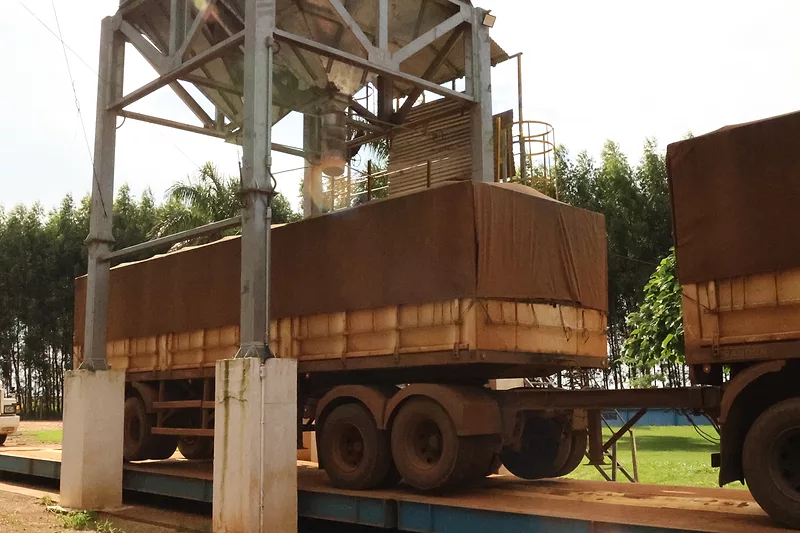
All over Brazil’s agricultural heartland of Mato Grosso drivers like Wagner are locked in their own battles with the pockmarked roads. The region’s soybeans, which were planted in September, are ready for harvest. And with a dearth of storage options, farmers are pulling them off the land and loading them straight into covered trucks destined for the country’s ports.
Every unanticipated pothole risks soybeans spilling into the road or causing a mechanical failure that leads to unanticipated delay.
 Silva on his bus (Agri-Pulse photo)
Mato Grosso occupies more than 900,000 square kilometers in the Brazil’s center west. The state is about the size of France and Germany combined and a third of that area is devoted to commercial agriculture. More than a quarter of the country’s soybeans – and 11% of the world’s total supply – is grown in the state as is around 40% of the country’s corn.
But while France and Germany boast a rail network of almost 40,000 miles, according to the Commerce Department’s International Trade Agency, the Brazilian government says Matto Grosso has around 650 miles of track.
Without a vast rail or barge network to service the country’s growing regions, an army of trucks transports Brazil's harvest in batches of 40-50 tons for hundreds of miles to the nearest rail terminal, or almost a thousand miles to the nearest port, battling underdeveloped roads and long waits of five or six hours near port and rail terminals.
Soybean and corn producers in Matto Grosso face transportation costs well above competitors in the U.S. and Argentina. Exporters pay around $113 per ton to get their product to China, compared to around $85 per ton for Argentinian and U.S. exporters, according to data from the Mato Grosso Institute of Agricultural Economics (IMEA).
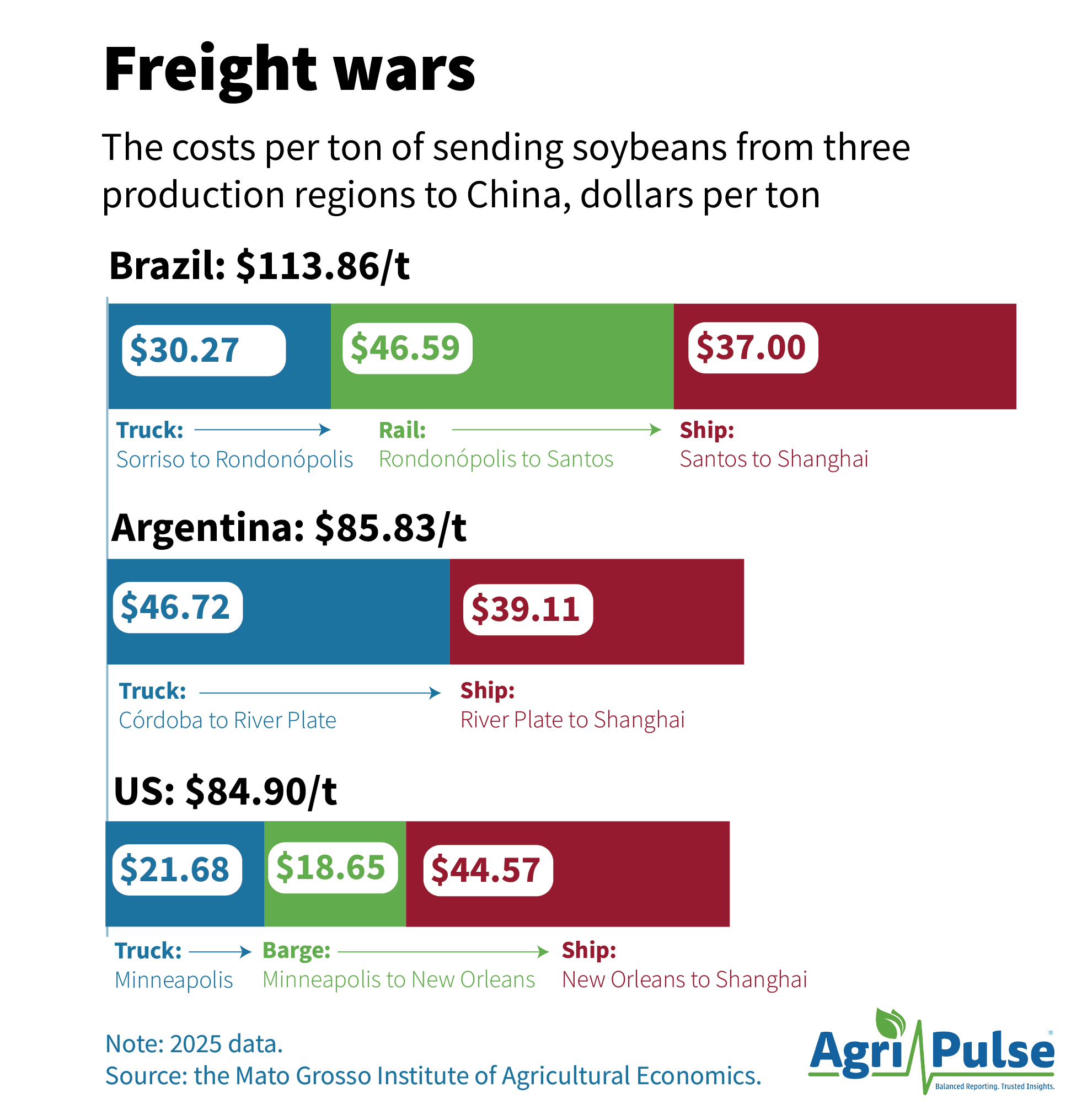
Those high costs eat into farmers’ bottom lines and hamper competitiveness. Brazilian commodities are already highly competitive in global markets, thanks to cheap land and labor and the ability to plant two, or even three, crops a year. But if the country could resolve its longstanding infrastructure issues, its competitiveness could surge, analysts and industry representatives say.
Brazil’s logistical challenges are only set to grow. The country’s soybean exports are on course to expand further in coming years. Matto Grosso has seen planting explode from 7.7 million acres in the 2000-01 marketing year to 32.1 million acres in 2024-25, according to data from the country’s National Supply Company (Conab), IMEA and USDA. By 2033-34, IMEA estimates planting will reach 41 million acres, another 27% increase from today.
Multiple efforts are underway to expand the country’s railways and take some trucks off the region’s roads, but the most ambitious remain in early planning stages. Environmental groups have mounted a fierce opposition campaign to the most promising rail development opportunity and gummed the project up in Brazil’s legal system. But Mato Grosso’s soybean producers believe that could soon change.
Mile by mile
Around 40 minutes after Silva and his passengers leave the soybean farm near Campo Novo do Parecis in the state’s center West, the dirt road gives way to asphalt. Nobody has had to get out and push on this occasion, and the reporters have kept their hands clean, but the bus has not emerged from the ordeal unscathed.
Silva steers the vehicle off the single-lane highway into a pulloff to assess the damage.
The fairing around the front left wheel has snapped and is hanging off. Silva uses two plastic bags to tie the panel in place. They will hold for three days until he drops the reporters at an airfield for their return to Cuiaba. Everyone will make do.
There have been similar piecemeal efforts to address Mato Grosso’s infrastructure challenges.
Infrastructure upgrades at the country’s northern ports allowed them to increase their corn and soybean exports by 57% from 2020 and 2024, easing some of the pressure on southern ports. The region now accommodates around 40% of the country’s exports of both commodities.
The Brazilian government has also announced $920 million in investments in waterways to help move agricultural products to the north of the country.
Private companies like Bunge, Cargill, Cofco, Amaggi and Louis Dreyfus have all invested in port terminal infrastructure in recent decades.
The local government in Mato Grosso is also building another lane onto its single-lane highway, known as BR-163, in the north of the state. The project is supposed to be completed before the end of 2026.
All of these efforts have somewhat eased the logistical challenges exporters face, but addressing the high costs of moving product from the interior to the ports has proven an ongoing challenge.
The latest effort to slash costs comes from a three-stage project from Rumo, the largest railway operator in the country. The project aims to extend an existing railway line from Rondonópolis in Mato Grosso’s south to Santos port further north, in the heart of Matto Grosso’s growing region.
The first stage of the project, a 99-mile stretch of railway from Rondonópolis to the city of Primavera, is set to open this summer. The full extension to Lucas do Rio Verde isn’t expected to be completed until 2031, however.
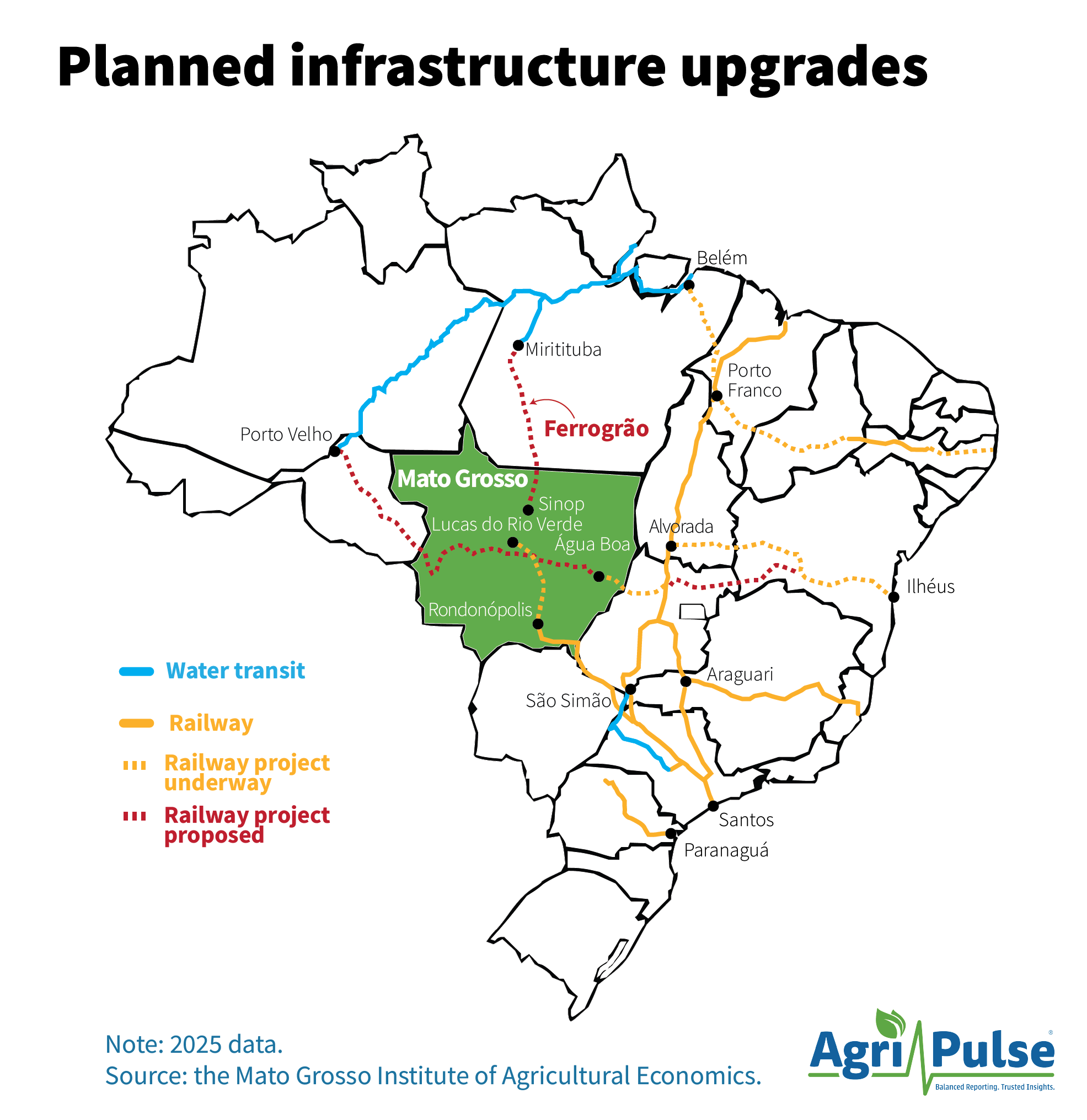
Diogo Velloso, a director at Rumo who manages the transportation of grains to Santos port, tells Agri-Pulse that, once completed, the project should cut the distances Mato Grosso’s corn and soybean producers have to rely on trucks for their transportation by around 180 miles, shaving between $3 and $5 per metric ton off existing freight costs and 10-15 hours off transportation times.
Ethanol producer Inpasa is also courting investment for a future pipeline project to connect its facility in Sinop, Mato Grosso, to the port of Santos, near São Paulo. Bruno Maier, a corporate and sustainability advocacy manager at the company told Agri-Pulse that the project could ease congestion by taking trucks carrying ethanol off the roads.
But with the U.S. and Argentina enjoying logistics costs almost $20 per metric ton cheaper than Brazil’s when shipping to the Chinese market, even with the rail extension, Mato Grosso’s producers are still going to be at a price disadvantage compared to other countries’ transportation costs.
Put simply, Brazil’s agriculture export capabilities are growing faster than its ability to upgrade its infrastructure. As long as this imbalance persists, Velloso said, freight costs are likely to remain high for Brazilian exporters.
The white whale-way
The real infrastructure prize for Mato Grosso’s soybean producers is a proposed rail line in the north of the state, known as Ferrogrão – or the “grain train.” The $3.8 billion project would connect the city of Sinop, which straddles the edge of the Amazon biome, to the port at Miritituba in Itaituba, a city more than 600 miles north. The port has a waterway connection to the port of Belém, a major export hub, via a tributary to the Amazon river.
If completed, this project could cut transportation costs for Mato Grosso producers by around 30%, Lucas Costa Beber, president of Aprosoja-MT, a trade association, told Agri-Pulse. He estimates that more than half of the state’s soybeans would end up on the rail artery.
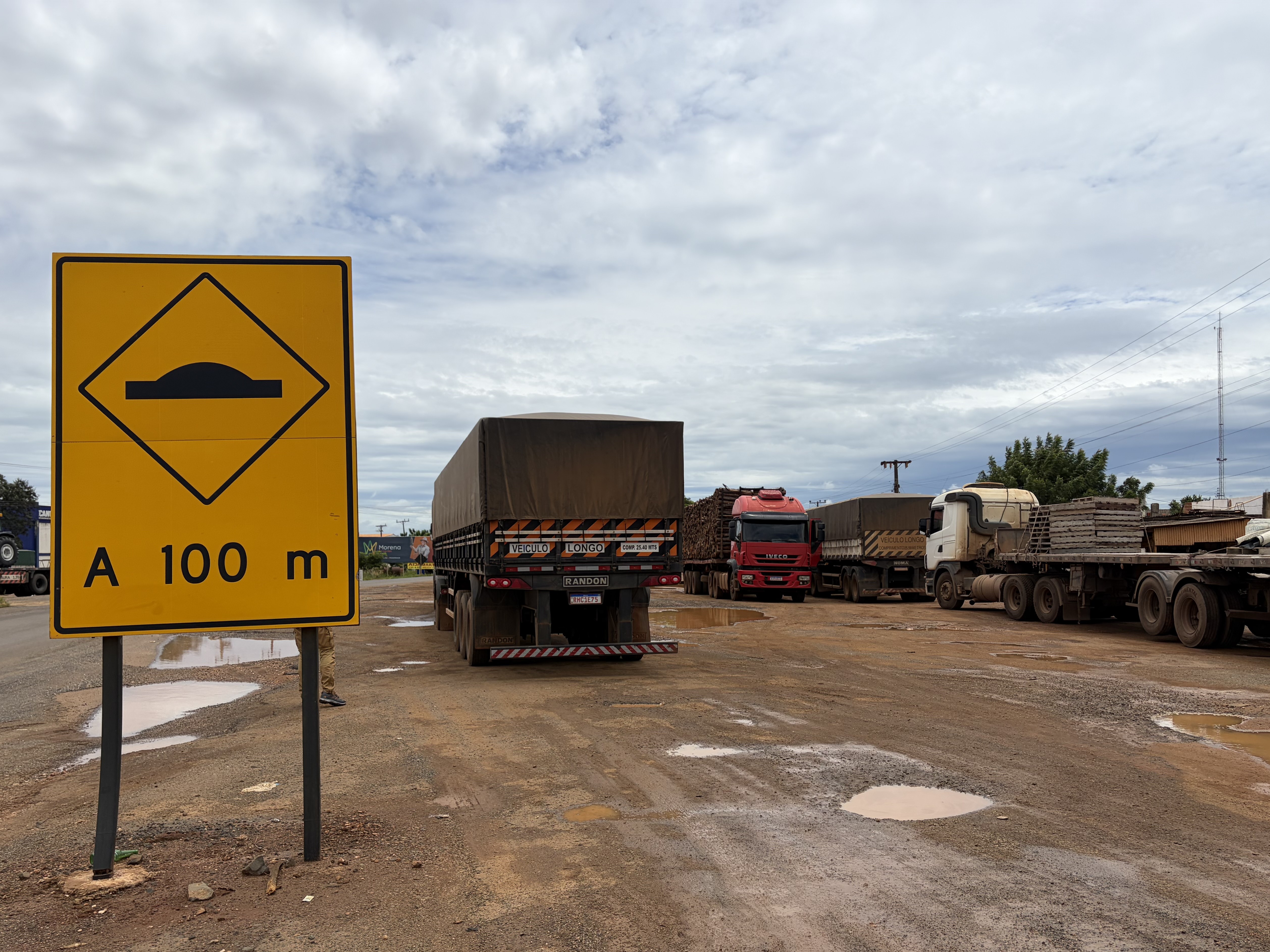 Trucks on a pull off on BR-163 (Agri-Pulse photo)
Whether the line will come to fruition, however, is an open question. Agri-Pulse wrote about the opportunities the Ferrogrão railway could offer Brazilian exporters in 2018, but eight years later, the plans are still being scrutinized by the country’s supreme court.
The project requires redrawing of the Jamanxim National Park boundaries, a federally protected area, to accommodate the rail. It would also abut indigenous communities in the Tapajós-Xingu corridor.
Environmental groups are concerned.
Pedro Charbel, a campaigns coordinator at Amazon Watch based in Rio de Janeiro, told Agri-Pulse that the group has several concerns. In addition to deforestation to make way for the railway, the group is concerned that the increased volume of barges on the Tapajós River could hurt river ecosystems and reduce indigenous communities’ access to fishing stocks. Charbel also worries that it could worsen illegal land grabs around the Amazon.
The impacts will be “cumulative,” he said in an interview. “It will increase sevenfold the number the exports through the river. So, this means seven times more barges in the Tapajós River. This means more dredging.”
Proponents of the project argue that there have already been efforts to mitigate the environmental impact of the project. They say that building the railway near the existing highway will keep deforestation to a minimum. There have also been proposals to expand protected areas to more than offset any vegetation lost to construction.
Further, backers note that moving soybeans off trucks and onto rail could lead to a 40% reduction in greenhouse gas emissions associated with soybean exports.
Accordingly, former Brazilian Agriculture Minister Antônio Cabrera said the Ferrogrão project is among “the largest decarbonization projects in the world.”
The supreme court heard the beginning of oral arguments in a case weighing the legality of redrawing the national park’s boundaries in October, but arguments have been put on hold. Beber said, however, that he has been encouraged by early signals from the court.
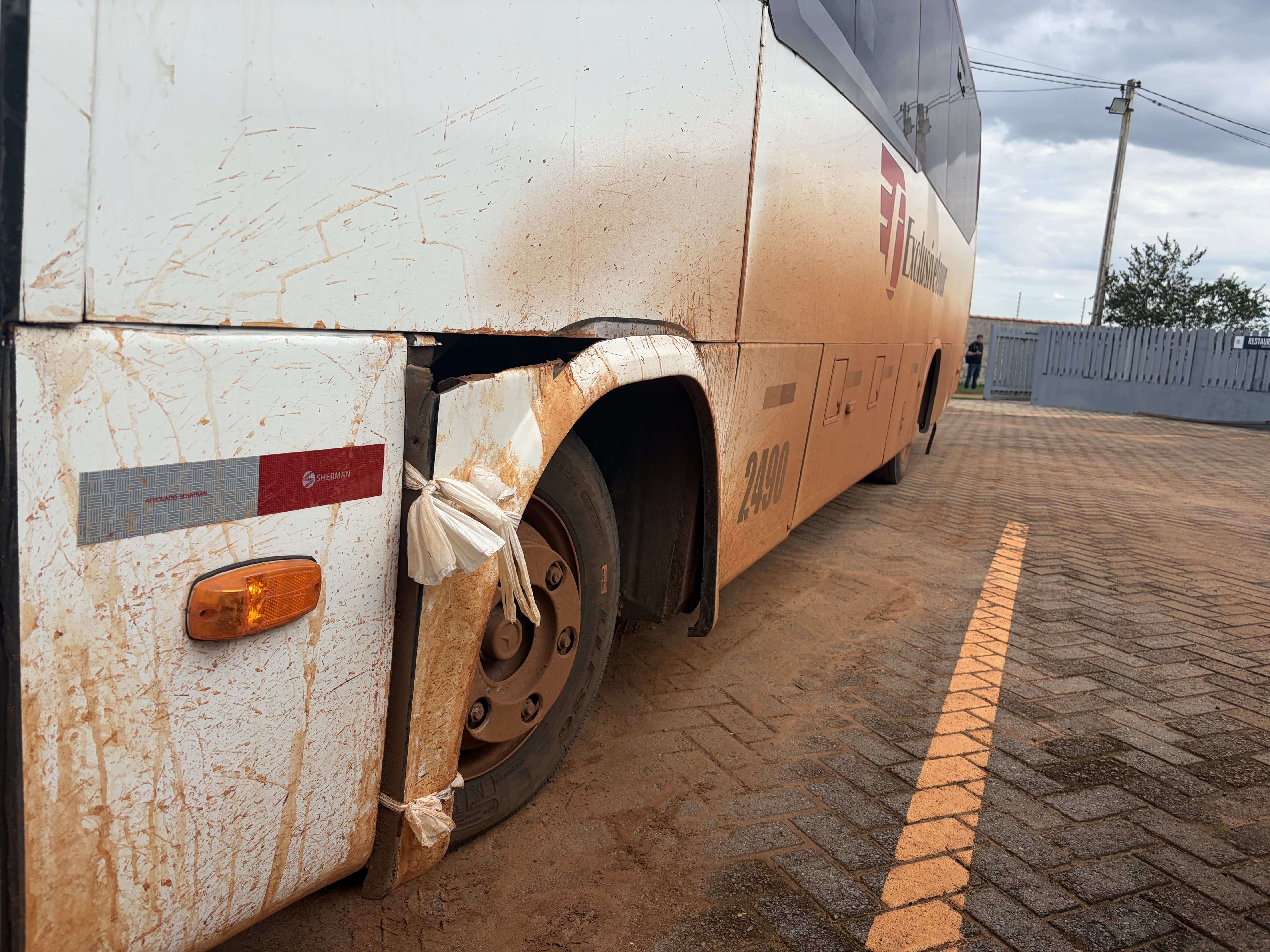 Silva's efforts to reattach fairing after a visit to a soybean farm (Agri-Pulse photo)
 Justice Alexandre de Moraes, the case’s rapporteur, has already voted in favor of allowing the project to continue, even as others want more time to digest the case.
Brazil’s Ministry of Transportation is already planning to hold an auction for the project in 2026, and is presenting the railway to Chinese investors this month, according to reporting by Valor International, a Brazilian media outlet.
But Charbel warns that the legal opposition is just one strand of environmentalists’ effort to halt the project.
“We are showing the environmental and social costs of this project. We hope to show potential investors that they should not put their money into this,” he said.
Marcela Marini, a São Paulo-based senior grains and oilseed analyst at Rabobank, said that even if the supreme court greenlights the project, attracting investors will take time and there is a myriad of other potential pitfalls that could materialize in the interim.
“Those investments, they take years to be approved,” she said. “I prefer to be on the conservative side of it. We should not count on [Ferrogrão.]”
Storage sorrows
Instead of waiting for infrastructure projects that may never come, Marini pointed out that farmers could ease costs by investing in grain storage options. Storage capacity is very limited across Brazil. Conab estimates that on-farm storage was only 35.6 million tons in 2025, with total storage, including central facilities, was around 210 million tons.
Meanwhile, Brazil produced 171 million tons of soybeans and 141 million tons of corn in 2025, according to Conab.
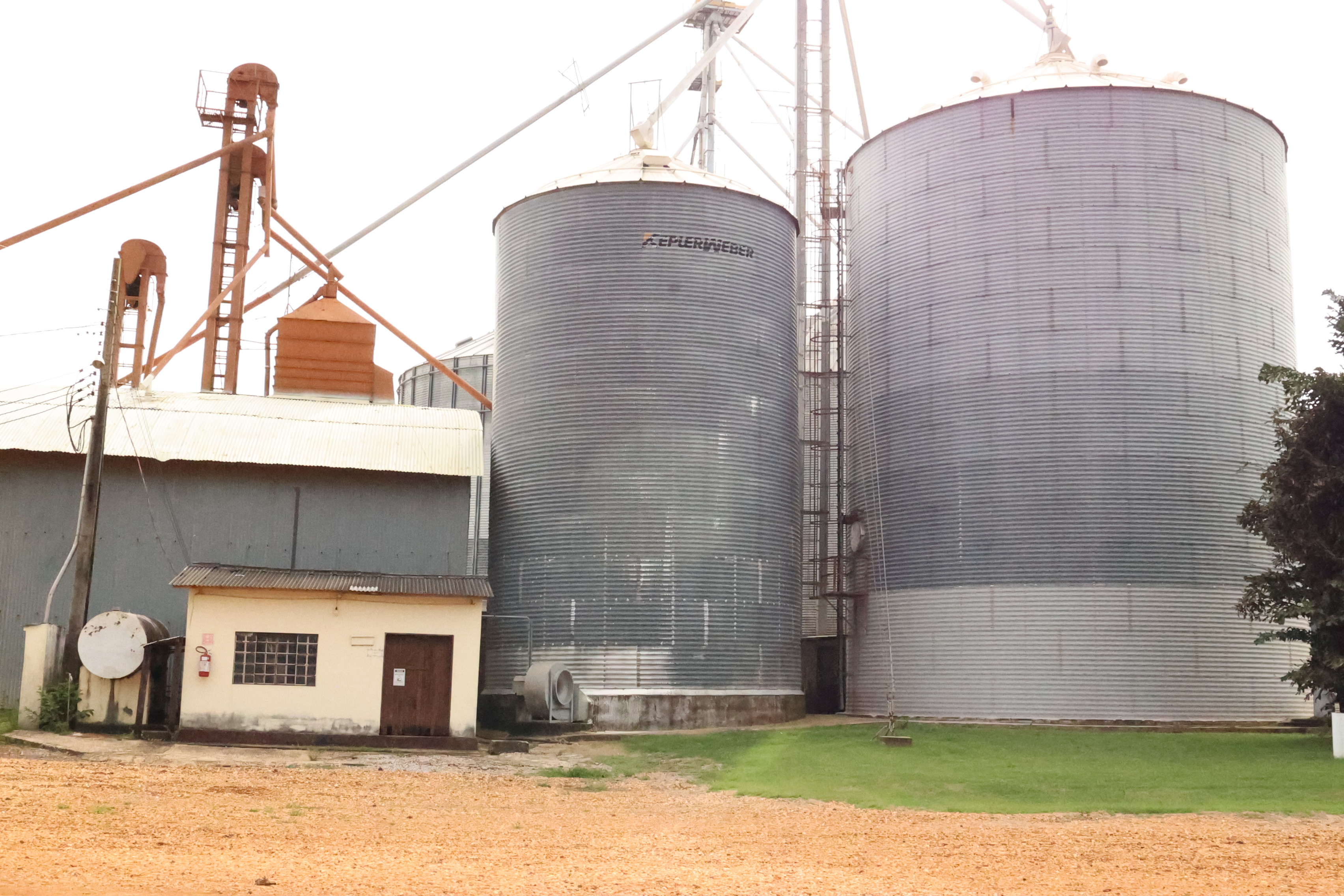 Grain storage on Botan family farm in Mato Grosso (Agri-Pulse photo)
 Without storage, farmers, in many cases, send their crops straight to the ports for export, leaving them at the mercy of transportation and trading companies which adjust prices during peak demand.
During harvest, 15,000 trucks a day will arrive at Santos port, a fivefold increase on the usual vehicle traffic.
But scaling up storage capabilities will mean addressing yet another of Brazil’s bottlenecks: access to credit.
Interest rates are high in Brazil – around 15%. When farmers approach private lenders, they often end up paying interest rates that are even higher, sometime reaching 18%-19%, according to Joana Colussi, a professor in agricultural economics at Purdue University in Indiana.
“That's a very high cost in terms of credit,” she said.
Last year, the Brazilian government also cut its spending on a program to subsidize interest rates for farmers. Medium-sized producers now face rates on working capital loans of 10%, according to Valor International. Other operators pay as much as 14% through the subsidy program.
For investment loans, the rates are between 8.5% and 13.5%.
Borrowing at these rates is a challenge, and with low global commodity prices, delinquencies and bankruptcies have been rising, and lending among financial institutions has been falling.
Loans were down 13% in the first seven months of the 2025-26 crop season, according to Valor’s reporting.
Producers also lack access to affordable crop insurance programs, Colussi said. When they have good years and margins are high, they often feel the need to save money to protect them from a future weather event or downturn, rather than investing in expanded storage capacity.
No place for complacency
Infrastructure challenges are likely to be a persistent drag on Brazil’s competitive potential for years – or decades – to come. Even projects to incrementally reduce transportation costs will take years , and limited access to credit will be an ongoing thorn in the sides of producers and companies that want to improve their competitiveness.
Despite these headwinds in Brazil, U.S. exporters are looking at the country's efforts with growing alarm.
“There is no question that there are significant investments happening in Brazil,” Alejandra Castillo, president and CEO of the North American Export Grain Association, said. “The size and breadth of the infrastructure is certainly going to rival the U.S.,” she added.
Whether the U.S. is investing at the pace needed to keep its competitive edge on infrastructure in the long term is also a concern for Danny Munch, an economist at the American Farm Bureau Federation.
Although inland transportation remains well behind the U.S., Munch pointed out that Brazil’s port infrastructure is highly competitive, and in some cases, may already be superior.
The World Bank, for example, ranks global container ports based on efficiency. Philadelphia ranked the highest of any Brazilian or American port in 2024, in 26th position. It was the only port from either country in the top 50. The next highest ranked ports, however, are both Brazilian, with Imbituba and Itapoa at 60 and 65, respectively.
“They already have certain pieces of their infrastructure that are ranked ahead of the U.S. on some of these metrics,” Munch told Agri-Pulse.
Fierce resistance from dockworkers and unions in the U.S. to the types of port automation that could streamline operations but would cut jobs could also limit the ability of U.S. ports to modernize, Munch added.
Castillo warned that the U.S. is at risk of falling behind unless it makes a concerned push to boost its domestic infrastructure investments.
“As a system, the U.S. government hasn't really built or maintained” its infrastructure, she said, including rail and barge projects. “All of that is what feeds the U.S. farm industry,” Castillo added.
Moving forward, Castillo warned, the race to preserve, or develop, an infrastructure edge will be “where truly the competition comes into play.”
Daniel Veloso and Jayme Costa Pinto helped with translation.
Some of the reporting for this story was completed during a nine-day reporting trip to Brazil’s state of Mato Grosso. Seven of those days were undertaken at the invitation of Aprosoja-MT, a trade group representing soybean and corn producers in the region, with the group funding flights, accommodation, transportation and food for a group of reporters during the visit.
Logo produced with Google.ai.

