
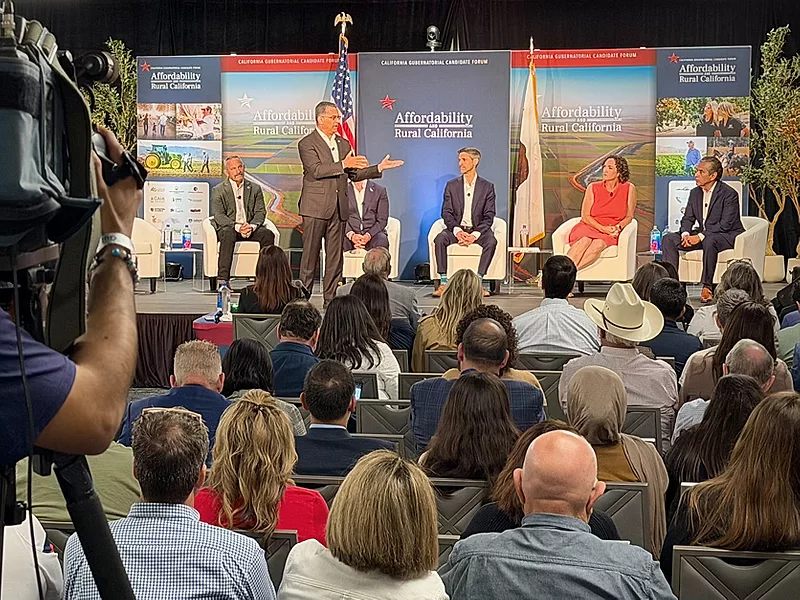
Six of the top gubernatorial candidates converged at California State University, Fresno on Wednesday for an agriculture-focused forum that underscored a striking dynamic in the race: broad agreement that state policies are driving up costs for farmers, even as candidates diverge on how to fix them.
The Maddy Institute and more than 30 agricultural groups hosted the forum, which centered on affordability, water and regulatory burdens in rural California.
Across party lines, candidates identified housing, energy and regulation as key contributors to the state’s high cost of living. But several Democrats joined Republicans in criticizing Sacramento’s regulatory framework — a notable shift in tone for a state long defined by aggressive environmental and labor policies.
“Cost of living is predominantly because of regulations and taxes — end of story,” said Riverside County Sheriff Chad Bianco, who pledged to eliminate those regulations imposed by state agencies.
Businessman Steve Hilton similarly called for sweeping rollbacks, including capping vehicle registration fees and expanding in-state oil production.
“We do need to get rid of all the things that have made this the most expensive state in the country to live, to work, to run a business,” he said.
Democratic candidates struck a more nuanced tone but still acknowledged the burden on agriculture. San Jose Mayor Matt Mahan said that the ag and rural communities “for far too long” have been second tier, “if they've even been on the agenda in Sacramento.” He called for major reforms to the California Environmental Quality Act and other laws that slow infrastructure and water projects.
Former Rep. Katie Porter emphasized housing affordability as the largest pressure on families.
“There’s no bigger piece of your budget than housing,” she said, while also calling for regulatory reforms that target bad actors rather than imposing broad compliance costs.
Former Los Angeles Mayor Antonio Villaraigosa warned that energy policy is compounding costs, cautioning that continued refinery closures could send gas prices above $8 per gallon.
Former U.S. Health and Human Services Secretary Xavier Becerra proposed more aggressive executive actions, stressing that he would declare a state of emergency to tackle affordability and that he would freeze certain household costs.
Interested in more news on farm programs, trade and rural issues? Sign up for a four-week free trial to Agri-Pulse. You’ll receive our content - absolutely free - during the trial period.
Water policy emerged as a central issue alongside affordability, with considerable overlap across most candidates for expanding storage, raising dam capacity and increasing water recycling to stabilize supplies in the Central Valley.
Growers’ concerns over rising compliance costs also drew bipartisan acknowledgment. Several candidates cited dramatic increases in regulatory burdens over the past two decades and pledged to streamline permitting for water, housing and energy projects.
Despite ideological differences, candidates repeatedly emphasized the need to better represent the Central Valley in Sacramento, with many highlighting personal ties to agriculture or rural communities.
The forum marked the first major in-person clashes in the race following the cancellation of a separate debate at the University of Southern California, and it underscored how affordability — particularly as it intersects with agriculture, water and energy — is emerging as the defining issue in the campaign.
Tom Steyer and Rep. Eric Swalwell did not participate.
For more news, go to Agri-Pulse.com.

