
|
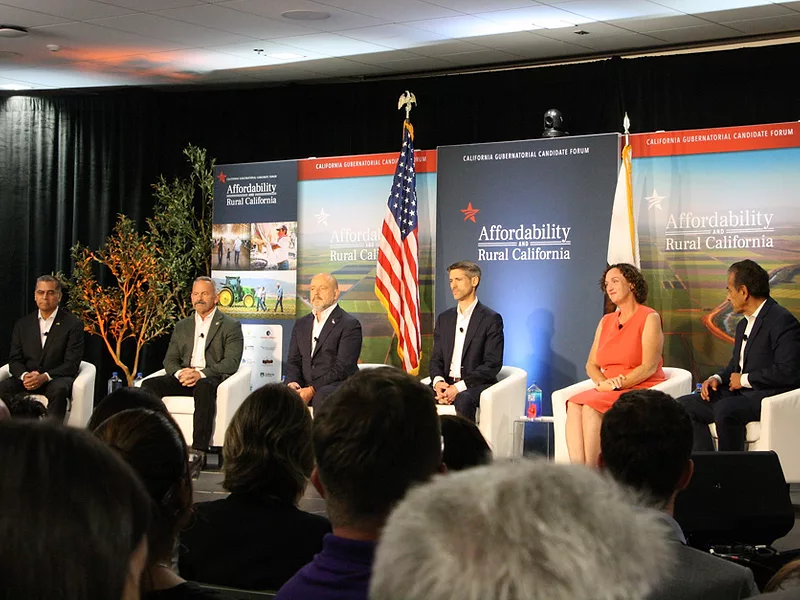
Gubernatorial candidates delivered a pointed, often combative debate in the heart of California agriculture last week. Water, regulation and energy costs dominated a forum that exposed both growing consensus — and deep ideological divides — over the future of the state’s farm economy.
The Maddy Institute and more than 30 agriculture groups hosted the forum to press the candidates on their perspectives on affordability, along with rural and agricultural issues.
Across nearly two hours on stage at California State University, Fresno, the candidates repeatedly returned to one shared premise: The system governing agriculture is not working. But what to do about it drew starkly different answers, from sweeping deregulation to targeted reforms and new investment — with nearly every position grounded in direct appeals to growers, farmworkers and rural communities.
A ‘break-glass moment’ for agriculture
Former U.S. Health and Human Services Secretary Xavier Becerra opened with a stark warning tailored to the Central Valley audience, framing affordability as a crisis touching every part of the agricultural economy.
“This is a crisis. This is a break-glass moment,” said Becerra, a Democrat. “The very people who pick the crops that feed us can’t afford to go to the grocery store and buy what they need.”
Becerra leaned heavily on executive authority, saying he would declare a state of emergency to fast-track housing development and freeze utility and insurance rates while the state investigates price drivers.
In a postdebate interview, Becerra extended that approach to one of agriculture’s most contentious issues: water conflicts between state and federal officials.
“Rather than file lawsuits or do antagonistic things, sit down and resolve them,” he said, striking a conciliatory tone. “With something like water, we cannot be engaged in a federal-state fight — when you’ve got farmers who have to every day worry about where they’re going to get their water to plant their crops.”
That stance signals a shift from his tenure as California’s attorney general, when he sued the first Trump administration more than 100 times. Becerra suggested that, as governor, he would prioritize negotiation — particularly on water infrastructure and operations — to avoid leaving agriculture caught between competing governments.
Republicans target regulation as root cause
Republican candidates framed the affordability crisis — and agriculture’s challenges — as the direct result of state policy.
Riverside County Sheriff Chad Bianco offered the most sweeping critique.
“Cost of living is predominantly because of regulations and taxes — end of story,” said Bianco.
He promised to eliminate regulations “on Day 1 through 10,” arguing they were “meant to control you and put you out of business.”
In a follow-up interview, Bianco expanded that argument to nearly every sector affecting agriculture.
“Every single regulation on the oil industry is being removed,” he said. “They're being controlled by environmental activism.”
He also rejected the premise of working with the Democratic leadership in the Capitol.
“The California Legislature has broken California. Why would I work with them?” he said. “They better figure out how to work with me, because I'm going to expose what they've been doing for the last 20 years.”
Former Fox News host Steve Hilton echoed that message on stage, delivering one of the forum’s sharpest partisan attacks.
“Every single Democrat on this stage today should start with an apology for what their party has done to this area and this industry,” said Hilton. “Stealing your water, piling on the regulations with a thousand percent increase in the last decade or so, cutting the pay of agricultural workers — on and on.”
He proposed replacing vehicle registration fees, which can exceed $1,000 for a new car, with a $71 flat fee. He also called for rolling back regulations he said are driving up grocery prices and pushing farms out of California.
His campaign has since gained momentum with an endorsement from President Donald Trump, a development likely to consolidate Republican voters in the top-two primary, avoiding a Republican-only showdown.
Democrats acknowledge regulatory strain
If Republicans dominated the rhetoric on deregulation, Democrats on stage showed a notable willingness to meet them partway — repeatedly acknowledging that California’s regulatory framework is straining agriculture.
San Jose Mayor Matt Mahan, a moderate, delivered one of the clearest critiques of the California Environmental Quality Act, saying recent reforms have not been enough.
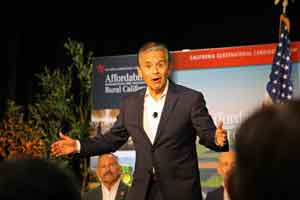 Antonio Villaraigosa (Brad Hooker/Agri-Pulse)
“We poked a lot of holes in it, but it still leaves open far too much litigation, too much process, hundreds of pages of paperwork, years to comply,” said Mahan. “We're not serving ourselves by having overly onerous compliance rules that force people to study everything, and then you get sued anyway because you missed one thing.”
Interested in more news on farm programs, trade and rural issues? Sign up for a four-week free trial to Agri-Pulse. You’ll receive our content - absolutely free - during the trial period.
He called for strict limits on litigation and faster timelines for infrastructure projects.
Mahan tied those reforms directly to water and agricultural infrastructure.
“The only way to move forward — with high-speed rail, large-scale infrastructure for water storage and conveyance, energy grid upgrades — is to fundamentally reform CEQA and other regulatory frameworks in California,” he said, warning that current laws have made it “difficult for us to do anything in the state.”
Former Rep. Katie Porter similarly acknowledged that the regulatory environment has become unsustainable for growers, but she emphasized accountability over wholesale rollback.
“The touchstone ought to be getting paid what you’re promised and being safe in the workplace,” said Porter. “If we can't show that a law is doing one of those two things, it should be up on the chopping block potentially.”
Porter also struck a personal note when discussing her agricultural background, recalling her experience in FFA — and drawing an audible reaction from the audience.
“I wore that horrible navy blue corduroy jacket, which is an abomination that we do to people who are in FFA,” she said.
Former Los Angeles Mayor Antonio Villaraigosa echoed concerns about regulatory overreach while emphasizing the need for investment and collaboration.
“We’re got to put a moratorium on farming regulations,” he told Agri-Pulse, adding that he would do the same for California Air Resources Board regulations. “This is an existential election for these communities, because they're dying on the vine in no small part because of that overregulated environment they have to operate in.”
Water agreement
Water policy dominated the forum, with candidates largely agreeing that California must increase supply — but sharply divided on how.
Bianco called for aggressive infrastructure expansion and a “need to build massive dams.”
Hilton argued that environmental policy itself is the main barrier.
“We're never going to reduce the cost of groceries or anything else until we abandon the climate dogma that has got us to this point,” he said, while pledging to “delete the biological assessments” at the State Water Resources Control Board.
Democrats emphasized a mix of building more infrastructure, improving project efficiencies and coordinating better with farmers. They generally agreed on streamlining permits for water projects, building on Gov. Gavin Newsom’s legislative package that accelerated the Sites Reservoir project.
“We need to give you predictability on water,” said Becerra. “We may not know how much rain is going to fall in a particular year, but we can still give you predictability based on the amount of water we currently only have.”
Porter highlighted the limits of supply expansion, noting agriculture has already adapted through efficiency measures.
“For too long, our water conversation in California has been about pitting different Californians against each other,” she said, noting how farmers have adapted by investing in drip and micro irrigation systems. “They've done what we've asked them to do.”
Mahan similarly said that farmers are “already embracing innovation” and argued the state needs to repair canals that lose water to subsidence damage.
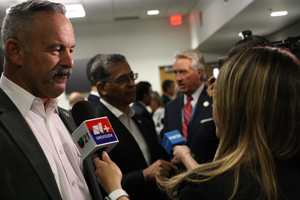 Chad Bianco, left, and Xavier Becerra, center (Brad Hooker/Agri-Pulse)
“We absolutely need to expand storage,” he said. “It is a crime that it has taken this long to move forward these reservoir projects.”
Villaraigosa pushed an all-of-the-above strategy — storage, conveyance and groundwater recharge — while emphasizing the need for bipartisan cooperation. He said that as Assembly speaker in the late 1990s he worked with Republican Gov. Pete Wilson on a water bond, lamenting that despite the push, “the two dams never got built.”
“Screaming at each other and calling each other names doesn't work,” he said. “At the end of the day, we have to work together.”
Delta tunnel divides candidates
The proposed Delta Conveyance Project —Newsom’s plan to build a tunnel to move water through the Sacramento-San Joaquin Delta — drew skepticism across the stage.
Bianco dismissed the project outright.
“The Delta conveyance thing is a completely ridiculous project,” he said, drawing chuckles as he compared it to high-speed rail.
Hilton similarly opposed the project, while advocating for expanded surface storage and conveyance infrastructure.
Porter took a more nuanced position.
“We can't spend 20 years talking about the Delta tunnel and not doing the 100 shuffle-ready water projects that could have improved the situation already,” she said.
Mahan said the project “is not something I'm for today,” after backing it earlier in his career.
PAGA and ag overtime
Candidates also weighed in on the Private Attorneys General Act, a major concern for agricultural employers due to litigation costs.
Porter pointed to ongoing reforms but said more evaluation is needed. She said the next governor should examine whether recent changes are “cracking down on abuse” while still allowing legitimate claims and determine “if we need to go back” and revise the law further.
More broadly, candidates across the spectrum acknowledged that enforcement mechanisms — not just regulations themselves — are contributing to costs.
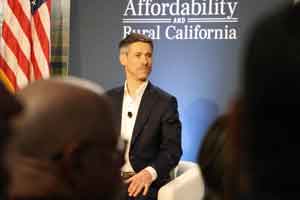 Matt Mahan (Brad Hooker/Agri-Pulse)
Mahan described a system of “layer after layer” of compliance, with monitoring, reporting and permits, that has increased costs 13 times over for farms over the past two decades.
“As governor, the most powerful tool you have is the power of appointment,” he said. “We appoint the 3,000 people who run every state agency. I will get them out from behind their desks in Sacramento, down here on the ground level to reform our regulatory environment to make it work.”
Labor policy also drew scrutiny, particularly California’s agricultural overtime law.
Porter acknowledged it is failing to achieve its intended goal and cited a University of California, Berkeley, study indicating farmworkers are earning less since the regulation took effect.
“That's a regulation that — however well intended it may or may not have been — does not work,” she said, later adding: “We are seeing farm activity move to Arizona, move across the border, because of the overtime law.”
She declined to endorse a proposal to enact tax credits to compensate farmers for overtime costs.
“I will tell you that generally tax credits favor big operators over small ones,” she said. “They favor those who can go through the complexity of all of that process.”
Steyer and Swalwell skip forum
Billionaire climate investor Tom Steyer and Rep. Eric Swalwell did not participate in the forum. Steyer instead stopped in Fresno on Tuesday for a brief a town hall discussion.
Steyer is among California’s top political donors and both he and his wife, Kat Taylor, have close ties to Newsom and lobby heavily on climate-smart agriculture funding, particularly with healthy soils and farm-to-school spending. In 2020 the governor selected Steyer to lead an economic recovery taskforce, which critics argued lacked transparency and delivered few policy recommendations.
In 2006 Taylor and Steyer purchased an 1,800-acre cattle ranch to develop into a learning laboratory for studying and promoting sustainable and regenerative practices. Dubbed TomKat Ranch, the operation in 2019 served as the backdrop for a campaign video announcing Steyer’s presidential candidacy. Despite heavy spending, he struggled to gain traction in early voting states.
Swalwell has centered his campaign on “affordability over red tape.” According to his campaign website, he would stabilize the property insurance market “by shifting climate-disaster costs from homeowners to corporate polluters” and he pledges to end utility rate hikes.

