
|
Highly pathogenic avian influenza is hitting fewer birds this year than last, helping keep egg prices down during a significant time of year for virus activity.
HPAI had been confirmed in 62 U.S. flocks in the last 30 days, affecting a total of 5 million birds as of Tuesday, according to USDA figures. Thirty-nine of these flocks are commercial, while 23 are backyard flocks.
In the first three months of 2026, the U.S. saw around 20.8 million birds affected by the virus, a roughly 45% decrease in cases from the same period the year prior, according to USDA data. Egg layers in particular saw a notable drop in cases over that period, going from around 32.8 million during that period in 2025 to 17.6 million in 2026.
USDA's National Agricultural Statistics Service estimated U.S. egg production at 8.36 billion in February of this year, a 5% increase from the same month last year. Table egg production rose to 7.17 billion in February, a 7.5% increase from 6.67 billion a year earlier.
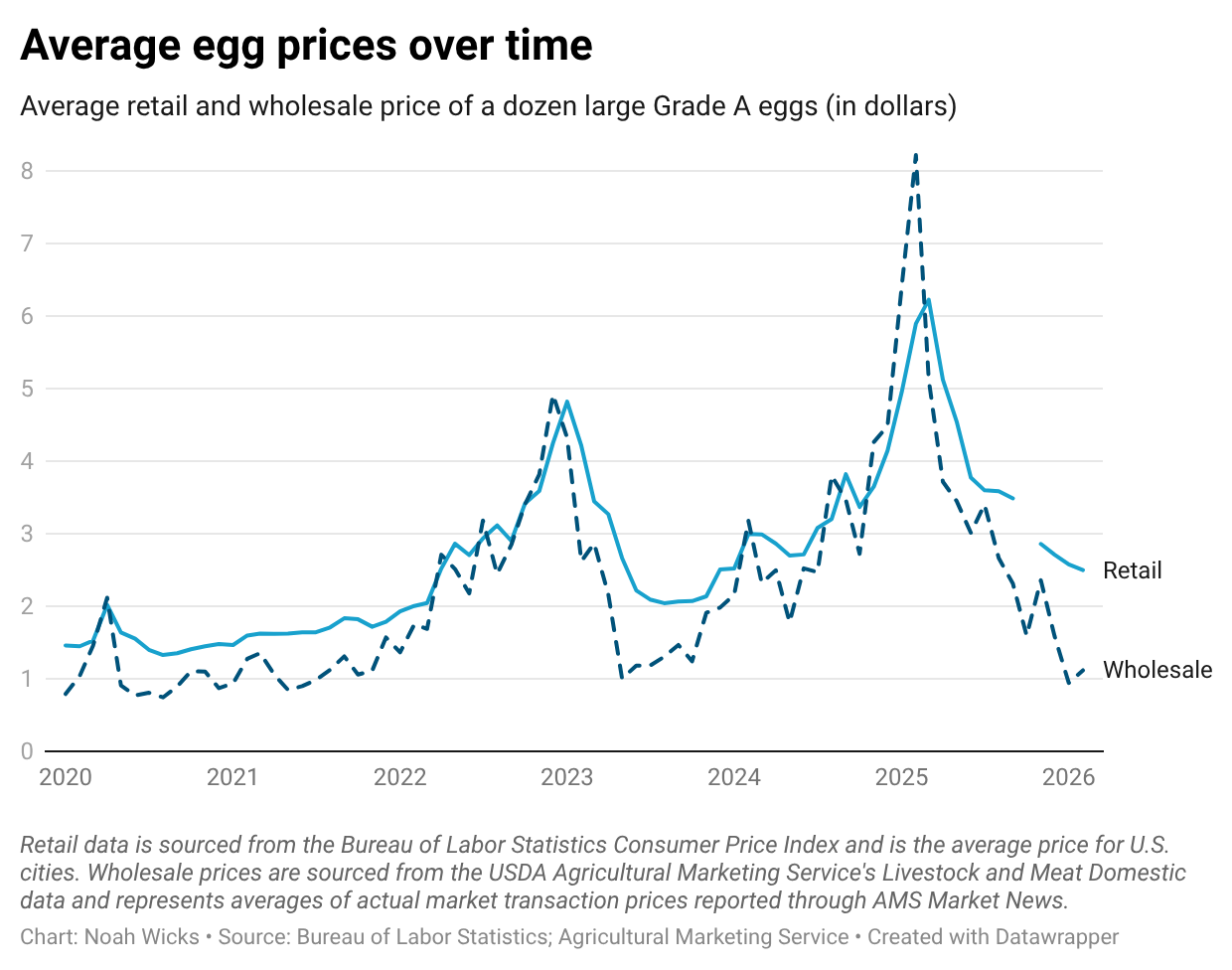
Prices have fallen since last year, when consumers saw significant increases largely due to the virus’s impacts. According to the Bureau of Labor Statistics’ Consumer Price Inde Jada Thompson (University of Arkansas photo)x, the average price of a dozen large Grade A eggs in U.S. cities was $2.50 in February, the latest month for which data is available. During the same month last year, the average price was $5.90.
Meanwhile, wholesale price data from the Economic Research Service pegged the combined regional average price of large Grade A eggs at $1.12 per dozen this February, a roughly 86% drop from $8.22 per dozen last February.
“That drastic of a price difference is very much driven by supply,” said University of Arkansas economist Jada Thompson, referring to this year’s prices compared with last year’s. She said the drop reflects a general increase in inventory compared with past periods of disease activity.
Wesley Davis, a partner at Meridian Ag Advisors, said case counts may be falling as more producers adopt stronger biosecurity practices. A drop in wild bird populations may also be easing pressure on poultry flocks, he said.
Davis also noted that when HPAI cases ramp up, hatcheries tend to increase their production of replacement pullets to backfill expected losses, which has helped to keep prices from rising significantly during the recent outbreak. Still, he is not expecting that trend to last.
“What I would suspect is going to happen is, at some point, those pullet numbers will start to come back into line,” he said.
The national layer flock stood at 378.6 million hens in February, up 5% from a year earlier, according to data from NASS’s monthly Chicken and Eggs Survey. Meanwhile, replacement pullet inventory — young hens being raised to enter both egg-laying and breeding flocks — reached 144.9 million, a sign of industry investment in rebuilding capacity. That number is a 7.3% increase from last February, when pullet inventories stood at 135.1 million head.
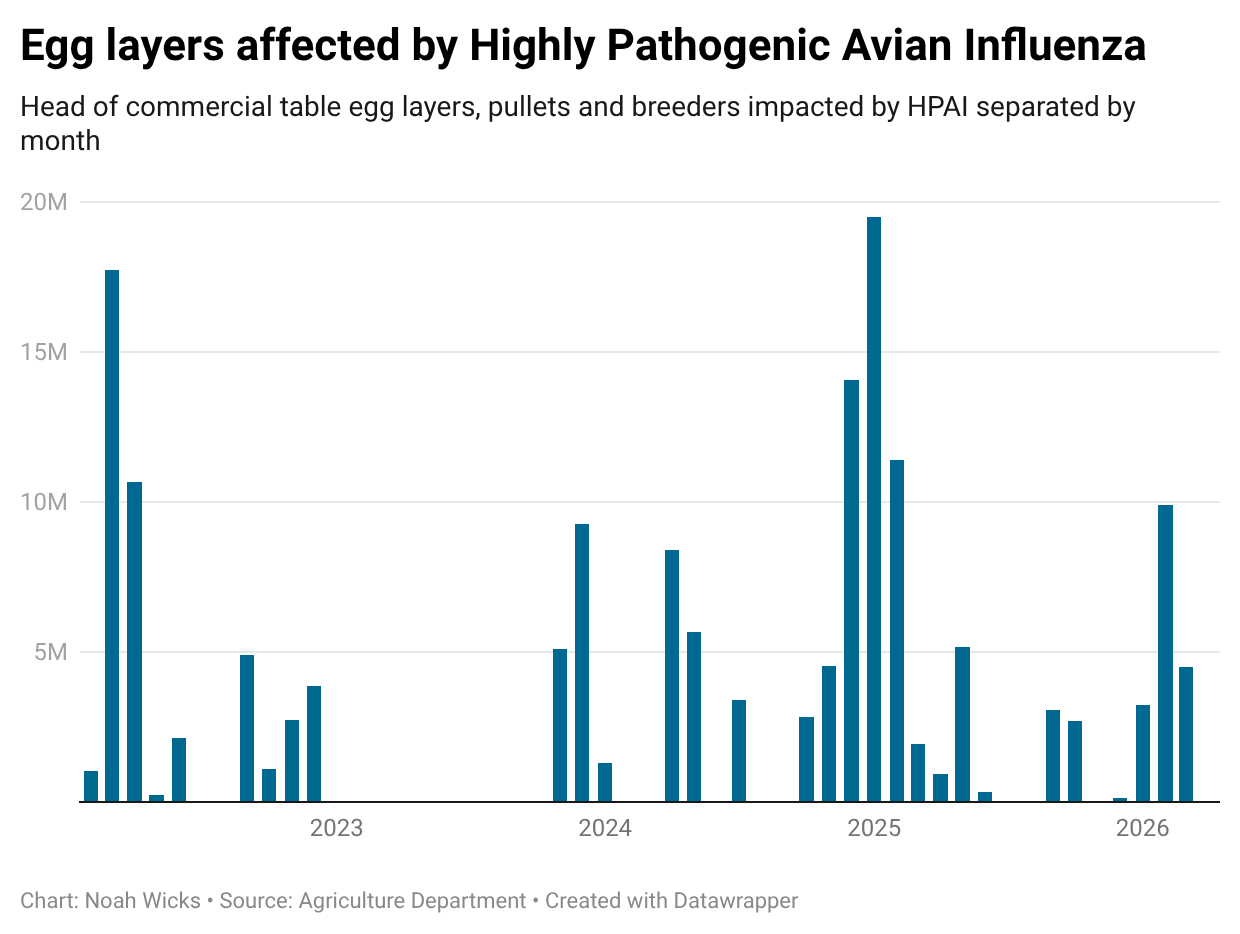
Thompson said egg hatcheries increased egg sets and pullets last fall in preparation for spring HPAI cases, which have kept prices down. Typically, it takes around six months for new layers to come into the system, she said.
“Because we had such a bad deal last year,” she said, referring to high HPAI case counts in 2025, “I think there was this readjustment.”
Davis also said there's been an uptick in smaller egg producers and hobbyists, which may be contributing to overall supplies.
Michigan State University Economist David Ortega said wholesale demand for eggs in the U.S. has shifted away from shell eggs and toward liquid eggs, which still appears to be the case at the “institutional, food service level,” he said.
Interested in more news on farm programs, trade and rural issues? Sign up for a four-week free trial to Agri-Pulse. You’ll receive our content - absolutely free - during the trial period.
Greg Tyler, the president and CEO of the USA Poultry and Egg Export Council, said egg industry leaders are exploring export opportunities amid a current surplus.
“I think we’re seeing a much larger supply of eggs on the market,” Tyler said.
The U.S. exported 7.6 million dozen table eggs to other countries in January and February of this year, a 54% drop from the same period last year, according to data from the U.S. Poultry and Egg Export Council. In particular, the volume of exports to North American countries — the most significant market for U.S. eggs — fell by 69% between the first two months of 2025 and 2026. Meanwhile, exports to the Caribbean fell from 3 million metric tons to 2.1 million metric tons during the same period both years, a 30% decrease.
The U.S. also saw table egg export volumes to the European Union fall but saw gains in shipments to the Middle East and East Asia, though all account for a smaller share of U.S. exports than North America and the Caribbean.
Shipments of egg products, on the other hand, increased 38% between January and February of 2025 and 2026, rising from 3,057 metric tons to 4,223 metric tons. While export volumes to North America fell 46% to 892 metric tons, exports to East Asia grew to 1,500 metric tons and export volumes to the European Union grew 135% to 1,272 metric tons.
Brian Earnest,  Brian Earnest (CoBank photo)the lead animal protein economist at CoBank, noted that cage-free egg production in the U.S. reached a new high of 146.4 million head in March. That’s an increase of 16% from 125.8 million head a year earlier, according to USDA Agricultural Marketing Service data.
Earnest said California, which has a law allowing only the sale of cage-free eggs in the state, was hit particularly hard by HPAI in last year’s cycle, leading to increased on other states to meet consumption needs. He also noted that rising cage-free use is being driven by commitments from major retailers like Walmart and Kroger.
“Production has slowly kind of gravitated that way, to the point where now roughly 50% of production in the U.S. is cage-free or under cage-free production,” Earnest said.

