
Former USDA Chief Economist Joe Glauber says growers may be able to pull back on fertilizer use without significantly harming crop yields.
Amid high fertilizer prices, some growers are expecting to cut back on fertilizer to reduce costs. During a panel discussion at the North American Agricultural Journalists’ annual meeting Monday, Glauber noted that farmers may have some room for further reductions without taking a hit on production.
“People will be far more careful with higher prices,” Glauber said, but added that he doesn’t see a big swing in production.
“It's not an uncommon practice for some farms, actually, to over-apply,” he said. Some growers use the extra fertilizer as an “insurance policy” to protect against heavy rains, he added.
The markets are also reflecting strong yields, he noted, pointing out that futures markets haven’t seen big price movements.
But he did offer the caveat that it is early in the crop year, and a lot can still change.
“I'm not saying, ‘Yeah, don't worry about it.’ They’re still going to be affected by this cost squeeze, but I do think that in terms of overall production impacts, I don't foresee a big increase,” he said.
RFS changes, year-round E15 likely to be paired in legislation, Skor says
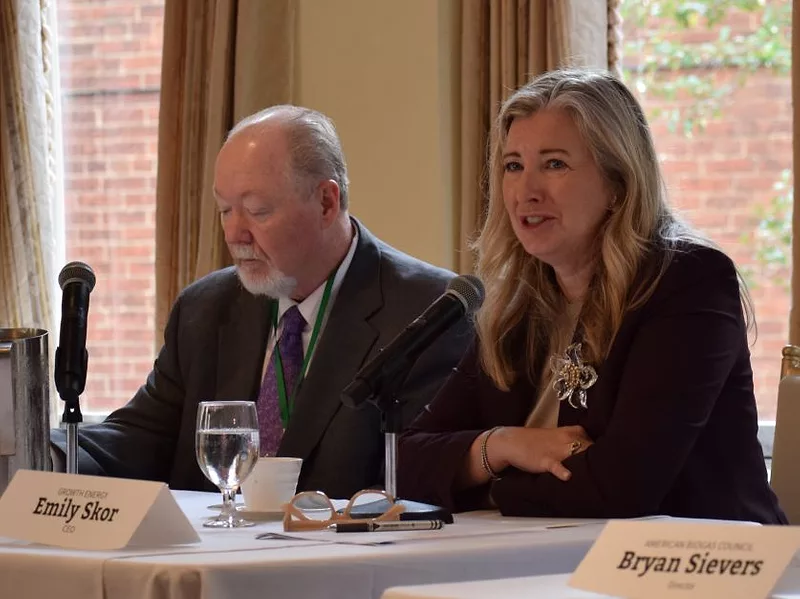
Growth Energy CEO Emily Skor expects E15 legislation to be paired with proposed changes to the Renewable Fuel Standard.
“What they’re really focusing on is that coupling of year-round E15 and RFS reform. That's the conversation that's taking place right now,” Skor said on Monday at an annual meeting of the North American Agricultural Journalists. “It's a difficult conversation. I think they're making slow progress.”
Prior to the recent two-week congressional break, speculation swirled on Capitol Hill that lawmakers may try to move a bill to allow year-round sales of higher ethanol blends, known as E15, without including any overhaul of the RFS.
Interested in more news on farm programs, trade and rural issues? Sign up for a four-week free trial to Agri-Pulse. You’ll receive our content - absolutely free - during the trial period.
The inclusion of a provision to revamp RFS exemptions derailed a House bill in January due to division among oil refiners. Skor, whose group representing ethanol companies is the largest biofuels trade organization, said pairing E15 with RFS reform is likely the best path forward. Doing so should bring more lawmakers and refining interests to the table, she said.
“In some respects, it makes the degree of difficulty higher than a clean E15 [bill], but I also like to think that it makes the stakeholders a little bit more motivated to work with Congress to get something through,” Skor said.
From Farm to Market: Moving Brazil’s Soybeans
Following his three-part (I, II, III) reporting series earlier this year, Agri-Pulse’s Oliver Ward is out with a video report highlighting the infrastructure challenges soybean producers in the agricultural heartland of Mato Grosso face and their effort to address the issues.
Watch Oliver’s video report at Agri-Pulse.com.
Firms not expecting to pass tariff refunds along to consumers
Company executives are not planning to pass along tariff refunds to consumers in the form of lower prices, according to new polling.
A survey of 25 chief financial officers by CNBC found that none of the companies are planning to pass the savings along to consumers. Seven said they were “not sure.”
Take note: Judge Richard Eaton, the Court of International Trade judge who is presiding over the tariff refund cases, has picked a new lead case after the plaintiff in the previous case filed for dismissal.
Earlier this month he lifted the stay on a case filed by Euro-Notions Florida Inc. and issued a new order for refunds matching the one from the previous case.
Eaton maintained an April 14 deadline for the administration to provide another update on how refund efforts are progressing, in an effort to keep the process on track. But the government now has longer to appeal the refund order, because the new order was issued April 7.
Farm Bureau leader believes new ad hoc assistance is likely
John Newton, vice president of public policy and economic analysis for the American Farm Bureau Federation, says he sees new economic assistance for farmers as likely.
"I don’t think it’s an if — I think it’s a when,” Newton said of the prospect of additional ad hoc assistance for farmers at the North American Agricultural Journalists annual meeting on Monday. He said “another supplemental package that includes economic relief for farmers is definitely something that I think the Hill and the White House both have their eyes on."
Newton said he wasn’t quite sure how large the aid package would be, but cited news reports suggesting it could be between $15 and $17 billion. He said American Farm Bureau Federation staff would be visiting with the White House about it sometime this week.
JBS reaches tentative deal with Greeley-based union
Meatpacking giant JBS USA has reached a tentative collective bargaining agreement with a union representing workers in its Greeley plant, ending a period of tense negotiations that had resulted in a three-week strike.
The agreement with the United Food and Commercial Workers Local 7 union runs through April 2028 and would offer a 70-cent base wage increase at ratification. Workers would see base wages increase 40 cents in July and another 40 cents next July, according to a JBS press release. It also offers a $750 one-time payment bonus at ratification and another $500 one-time payment next April.
“This tentative agreement is a testament to the incredible resolve of our members at the JBS Greeley plant,” UCFW Local 7 President Kim Cordova said in a release. “These workers stood together on the picket line for three weeks, through extreme weather, because they knew their worth and refused to be disrespected."
As SNAP limits kick in, grocers brace for challenges
Grocers say they’re under growing pressure as new SNAP waiver policies roll out nationwide, warning that strict enforcement could push some stores out of the program.
New limits took effect in April in Colorado, Florida, Texas and West Virginia. In all, 22 states now have or are considering restrictions on “non-nutritious” items such as soda and candy.
The National Grocers Association says a patchwork is emerging in which states define what’s ineligible while USDA interprets those rules. “The grocer is being evaluated on USDA’s interpretation of the state definition,” NGA Vice President Stephanie Johnson told the North American Agricultural Journalists on Monday.
At issue is USDA’s two-strike system, outlined in this Dec. 30 guidance. A failed test transaction triggers a warning and 30 days to fix the issue; a second violation during a follow-up audit means disqualification.
Johnson said there is no plan for consistent evaluation across states. Jerold Mande, CEO of Nourish Science, said confusion has been compounded by the loss of SNAP-Ed funding and experienced federal staff.
NGA is urging USDA to allow more flexibility, saying grocers are being asked to manage “hundreds of thousands” of newly ineligible items. Johnson warned the bigger risk may be declining SNAP participation due to program cuts under the One Big Beautiful Bill Act — a shift that could push some stores below profitability.
“We’re probably going to lose a few stores before we get some flexibility,” she said.
Senate Ag Republicans announce senior staff changes
Skylar Sowder has rejoined the Senate Ag Committee as policy director. She has been with Farm Credit Council as vice president of government affairs since 2021, and earlier oversaw commodity programs, crop insurance and disaster assistance issues for the Committee.
In addition, Corey Brown Weber was promoted to deputy staff director. She joined the committee in August 2025 as chief counsel and earlier was legislative director for Sen. Thom Tillis, R-N.C.
Final word
“It’s worth it because … we are last in life expectancy of any other wealthy country. … And it’s just how sick our children are. A third of children in the U.S. have a food-caused chronic disease.” — Jerold Mande, CEO of Nourish Science, discussing state SNAP waivers that restrict certain food items. He said SNAP remains the federal government’s “biggest lever” to incentivize healthier eating.
For more news, go to www.Agri-Pulse.com.
.webp?t=1762183428)


