
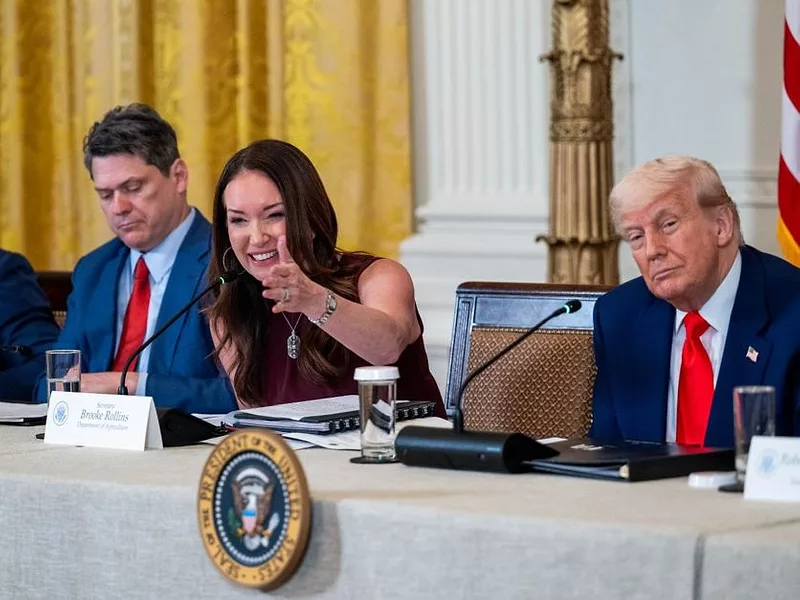
The Trump administration is poised to dip into tens of billions of dollars from tariffs and trade deal renegotiations to strengthen domestic fertilizer supplies, Agriculture Secretary Brooke Rollins told lawmakers.
"We've got to invest in more infrastructure," Rollins said during a House Appropriations subcommittee budget hearing on Thursday. "We've got to reshore fertilizer back to America."
Rollins said she hosted a 90-minute meeting on Wednesday with executives of four top fertilizer companies and Commerce Secretary Howard Lutnick, U.S. Trade Representative Jamieson Greer and National Economic Council Director Kevin Hassett.
"They flew in from all over the world to sit down with us and really talk this through," she said, adding that she's hopeful the administration will be ready to announce a full plan next week. "We're going to start deploying some of those [trade] resources to begin to build, and they won't come online for 12 to 18 months, but we've got to start moving back in that direction," Rollins said in response to a question from Rep. Ashley Hinson, R-Iowa.
Following the invalidation of President Donald Trump's emergency tariffs, the administration is preparing to pay back more than $150 billion in tariff revenue, and is planning to begin accepting refund applications Monday.
Previously, administration officials said they would dip into tariff revenues to fund the Farmer Bridge Assistance payments, but those actually ended up coming from USDA's Commodity Credit Corporation, which is not directly funded by tariff revenues.
Rollins said the USDA is focused on helping move fertilizer supplies more quickly, but cautioned it will take time for crop nutrient prices to begin falling.
"These prices will not come down anytime in the next couple of days or weeks," she said. It will "maybe take us a couple months to get them back down, but we're working on it."
Interested in more news on farm programs, trade and rural issues? Sign up for a four-week free trial to Agri-Pulse. You’ll receive our content - absolutely free - during the trial period.
Rollins also praised Illinois-based CF Industries, a leading producer of nitrogen fertilizer, for "forgoing" more lucrative exports in order to keep nitrogen available for U.S. farmers. She added that she's talking with fertilizer companies from around the country on a daily basis. Rollins also warned that high fertilizer costs – a problem made worse due to global supply constraints stemming from war in the Middle East – are only one piece of the larger problem of elevated farm input costs.
“Fertilizer is the current crisis of the day, but as soon as we're past this one, then it will be seed, or then it will be equipment," she said. "It is an overarching economic pending disaster, what has happened with these cost of inputs. And of course, if you look at the data, what has happened is you have a handful of companies that have basically taken over the market in all of the inputs, and so what comes with that is the fact that we don't have competition, and that's what we've got to really solve for."
Rep. Sanford Bishop of Georgia, the top Democrat on the House ag panel, told Rollins that producers in his state say that contrary to news reports, they didn't pre-purchase fertilizer last fall before the latest price spike. "They were busy selling off land and trying to make ends meet," he said. Farm bankruptcies are rising and more than three-fourths of ag economists say the crop sector is in a recession, he added.
Hinson criticized The Mosaic Co., a major fertilizer producer, for its plan to idle some facilities "at a time when our farmers are paying through the roof for these input prices."
For more news, go to Agri-Pulse.com.
Steve Davies and Oliver Ward contributed to this report.
.webp?t=1762183428)
