
|
If negotiators can’t find a path forward to extend the U.S.-Mexico-Canada Agreement this year, there will be other opportunities to reach a deal. But U.S. agriculture sees dangers in drawn-out negotiations, and some argue a swift extension is necessary to keep the pact at full strength.
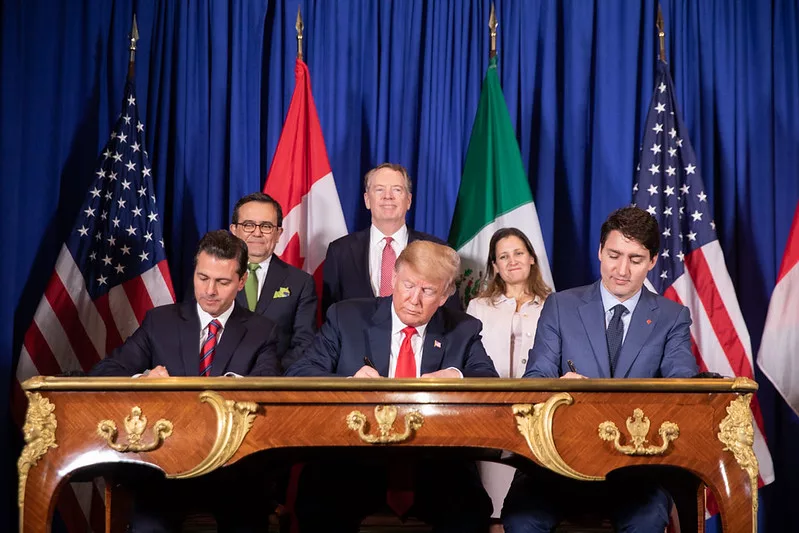
U.S. Trade Representative Jamieson Greer was in Mexico earlier this week for talks with officials to prepare for the upcoming review of the North American free trade deal President Donald Trump negotiated in his first term. Formal trilateral negotiations are set to kick off in July.
If negotiators don’t agree to extend the deal this year, they have to meet again every year until the deal’s expiration in 2036 to try to find a way forward. But U.S. agriculture industries say officials shouldn’t be complacent just because they have multiple bites at extension.
They argue that the deal needs to be extended this year to prevent the further erosion of its agriculture coverage and put the U.S. and North America on the best footing to compete with China.
Narrowing at the margins
Whatever happens during the review, the share of agricultural products afforded tariff-free trade between the three countries is unlikely to return to what it was when Trump took office last year.
The administration has already withdrawn from a tomato suspension agreement that had been in place since the 1990s that kept duties off Mexican tomatoes. There are further U.S. antidumping and countervailing duty investigations on fresh mushrooms from Canada and winter strawberries from Mexico underway that could also result in new tariffs.
Mexico has launched its own set of trade investigations into U.S. pork and apple exports in recent months in what some see as tit-for-tat maneuvering ahead of the review.
The Mexican investigation, which covers pork leg and shoulder imports, is “largely a political move” to boost the government’s leverage in upcoming USMCA talks, Maria Zieba, vice president of government affairs for the National Pork Producers Council, told Agri-Pulse last week.
It’s possible that Mexican tariffs on pork and apples may not come to pass. U.S. Apple Association President Jim Bair pointed out that the apple investigation likely wouldn’t yield a final determination before the summer or fall – after the USMCA review gets underway. Negotiators could hash out a resolution that resolves some of these cases as part of that process.
“We're working under the assumption that cooler heads will prevail,” Bair said in an interview.
 U.S. Apple's Jim Bair (LinkedIn photo)
But if tariffs on these industries are put in place and USMCA negotiations drag on for multiple years, it could become more politically difficult to remove them. Other industries may also see the success of these cases and pursue their own trade probes on ag products to secure their own import relief.
“Other fruit and veg producers in the United States are looking at the strawberry case and getting lined up,” an agriculture industry source granted anonymity to speak frankly about the situation told Agri-Pulse.
These trade remedy cases, which can lead to tariffs not covered by the agreement’s liberalizing provisions, chip away at the pact’s coverage and undermine its benefits, the source said.
“The Trump administration is really essentially renegotiating the agreement on the margins of the agreement. And the longer that has to happen, and the longer that those tariffs are in place, the more people are going to get used to them and reset a norm,” they added.
Interested in more news on farm programs, trade and rural issues? Sign up for a four-week free trial to Agri-Pulse. You’ll receive our content - absolutely free - during the trial period.
Companies making investment decisions would also benefit from the added certainty that a 16-year extension would bring, analysts said. Apple orchards cost $70,000 per acre to plant and are productive for two decades or more.
"That's a long-term investment," Bair said, "and people are wondering, 'can we, should we make those investments?"
An unrecognizable review
When the USMCA was retooled in Trump’s first term, plenty in the agricultural sector welcomed the inclusion of a six-year review. They reasoned that it would offer an opportunity to build on the deal and deepen cooperation, including by more closely aligning approaches to China.
“I was excited about it,” the agriculture industry source said. “We're really in a very challenging competition with China for the development of advanced bioproducts, and all of these cutting-edge petrol-replacing chemicals and materials made out of plant products. And they are on track to winning.”
Peter Beetham, CEO of Cibus, a seed precision breeding firm, said the timing of the deal and its review also lent itself to fostering North American regulatory alignment. Mexico, he said, is developing its regulatory framework for gene editing and genetics.
 Cibus' Peter Beetham (LinkedIn photo)
“You've got a moment,” he said, where agreements that foster collaboration and offer a “clear path” to a large North American market could deliver significant opportunities for the biotech sector.
Some in the agriculture industry had visions of the USMCA review offering a platform to make headway on some of these issues, as well as providing a venue to address issues with the deal itself. The U.S., Mexico and Canada could further align on trade measures to keep subsidized Chinese imports out of the U.S. market and coordinate investment to maximize research and development and manufacturing returns across North America.
The backdrop for the run-up to this review, however, has been quite different, with the president and senior officials downplaying the deal’s benefits, bashing the Canadian government and threatening to carve the deal up into two bilateral deals.
“The reality is that I'm spending all my time just trying to maintain the market access that we have had for the past 20 years through USMCA or NAFTA,” the industry source said, referring to the USMCA’s predecessor, the North American Free Trade Agreement.
The industry representative said they are spending “almost no time” on exploring opportunities for deeper collaboration. Instead, they are “getting sucked into not breaking what's there.”

