
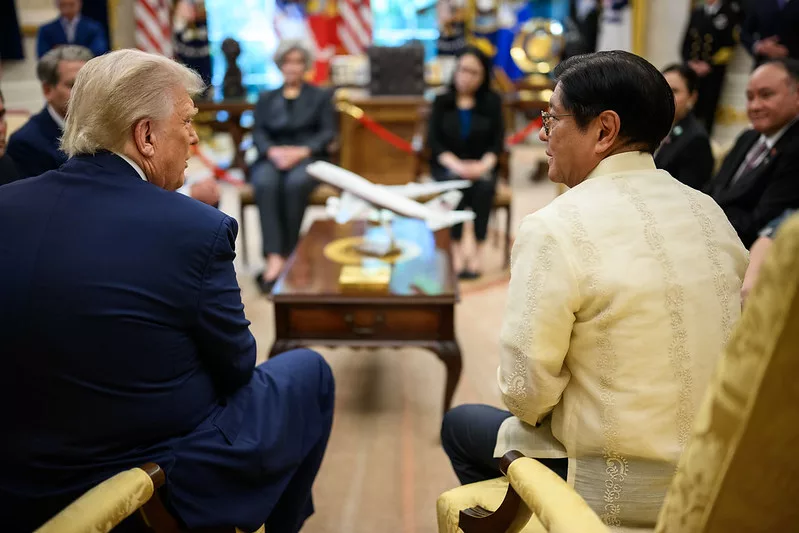
The Trump administration has announced a slate of new trade pacts, including reductions in agricultural export barriers, as countries scramble to strike deals ahead of a Friday deadline. But details of the arrangements have been scant or contested, leaving U.S. agriculture with significant questions.
On Friday, President Donald Trump is planning to implement a plan to impose sweeping country-specific tariffs on most U.S. imports. Countries have been locked in negotiations with U.S. officials to negotiate lower tariffs in exchange for concessions since Trump unveiled the proposal in April.
Some have succeeded. The U.S. says it has secured deals with the United Kingdom, Vietnam, Indonesia, Japan, the Philippines and the European Union, with potentially more coming. Others, like India, offered unilateral product-specific concessions to improve bilateral trade relations.
However, only the U.K. agreement text has been signed and publicly released so far, and some foreign governments are offering competing descriptions of the verbal deals.
These opaque deals, which industries hoped would provide tariff stability and economic certainty, are leaving companies in the dark just days out from Trump’s tariff deadline.
When Trump announced his trade pact with the EU on Sunday, he said that the bloc would buy American weapons, which is not under the European Commission’s mandate, and touted sweeping tariff reductions in the EU market.
“They're agreeing to open up their countries to trade at zero tariff,” Trump said.
European Commission President Ursula von der Leyen noted at her own press conference that the U.S. and EU had agreed to go “zero-for-zero” on certain products, including agricultural products, which was later adjusted to tariff-rate quotas in an EU explainer.
Japan’s Prime Minister Shigeru Ishiba has also diverged from Trump in his descriptions of an investment vehicle created under his country’s deal with the U.S. Vietnamese officials, meanwhile, are reportedly disputing that their negotiators agreed to the 20% baseline tariff rate that Trump announced on Truth Social when he unveiled the deal.
Vincent Smith, director of agricultural policy studies at the American Enterprise Institute, a conservative-aligned think tank, told Agri-Pulse that with tariff retaliation against U.S. ag exports at stake, the U.S. agricultural sector cannot afford to have an “unreliable trade negotiator” like the current president helming trade talks.
“Countervailing actions that limit access to markets for corn, wheat, soybeans, pork products, etcetera, remain a significant concern,” Smith said. “It's really quite distressing.”
 Vincent Smith (AEI photo)
Deals first, details later
Even when more specific details of the deals agricultural provisions have been provided, many of the finer points have been missing or left for subsequent negotiations.
The deals with both Indonesia and Japan include commitments to purchase U.S. agricultural commodities, with the former agreeing to buy $4.5 billion worth and the latter $8 billion, according to the White House. While some commodities were listed in the respective White House fact sheets, neither provided a breakdown of how much of each product either country had committed to buying.
“All we have right now are words,” Smith said.
Alex Jacquez, a former policy adviser in President Joe Biden’s National Economic Council, told reporters Tuesday that without more specifics on enforcement mechanisms, the purchase commitments amounted to little.
“What we are getting,” Jacquez said, “seems to be vague promises with large numbers attached that don't have any mechanisms for follow-through.”
“We are still waiting for China to complete its purchase agreements from the phase one deal,” added Jacquez, who is now chief of policy and advocacy at the Groundwork Collaborative, a progressive think tank.
Indonesia has also agreed to lift nearly all tariffs on U.S. exports, according to the White House, although no further details have emerged on what industries or products will see tariffs scrapped.
The White House has provided no details on the prospective Philippine and Vietnamese deals beyond the president’s initial Truth Social posts.
One of the few concrete commitments that have emerged from the deal with Japan is a pledge from the Japanese to expand market access for U.S. rice. The White House said that Ishiba’s government will increase import quotas for U.S. rice by 75%.
Peter Bachmann, president and CEO of USA Rice, welcomed the provision, but told Agri-Pulse he is still awaiting further information on how the quota will be allocated. Japan maintains a 770,000 metric ton quota for brown rice that the U.S., China, Thailand, Australia and other countries use, Bachmann said. The U.S. currently fills a little less than half the quota annually.
“It's all market-based,” Bachmann said, but U.S. officials have assured him that Japan will buy a larger share of this quota from the U.S.
Only a small share of Japan’s in-quota rice purchases come from the private sector. The government buys the rest, so it could, theoretically, direct more purchases to the U.S., he said.
“But I think a lot of details still need to be worked out on both sides,” he added. “We don't know how much of that rice will go to government stocks versus how much can go directly to importers.” Bachmann said that he is awaiting information on the timing of the quota expansion.
Trade negotiators can sometimes begin with broad outlines of a deal in principle and have multiple phases of announcements as finer details are hammered out, according to Becky Rasdall Vargas, senior vice president for trade at the International Dairy Foods Association. But she said these announcements are typically "text-based," rather than each side providing their own interpretation of what was agreed.
"A lot of it is due to the timeline with which they're trying to accomplish all of these things," Rasdall Vargas said. "It makes it really difficult to achieve even an agreement in principle, or many details on how expansive an agreement in principle could be."
The skinny announcements, coupled with competing narratives from the Trump administration and its negotiating partners have left AEI's Smith skeptical that the deals will lead to significant outcomes.
It’s easy to be “in the know” about what’s happening in Washington, D.C. Sign up for a FREE month of Agri-Pulse news! Simply click here
“Given the unfaithfulness of the Trump administration and therefore the corresponding skepticism and unfaithfulness of the other side of the coin, it's very hard to believe that in this setting, unless there is a clear statement in essentially a trade negotiation contract that is enforceable, that anything much will derive from these agreements,” Smith said.
Sophia Murphy, executive director at the Institute for Agriculture and Trade Policy, told Agri-Pulse that the truncated negotiating timelines and adversarial approach to negotiations, set against the backdrop of steep tariff threats, meant securing meaningful market access was always going to be a challenge.
“Countries are trying to find ways to appease Trump without necessarily making much difference to the existing situation,” Murphy said.
Questionable demand
Where tangible political concessions have been secured – beef and ethanol tariff-rate quotas with the U.K., for example, or the lifting of Australian beef import restrictions – questions remain over demand for U.S. imports and the ability of producers to increase sales significantly.
Australia relaxed import restrictions on U.S. beef last week, in a move the president said would herald “so much” U.S. beef products heading down under.
But analysts told Agri-Pulse that producers should temper expectations. The country is already a major beef producer, they said, and U.S. producers would likely only see demand for premium, or specialty products, rise significantly.
 Glynn Tonsor (Kansas State University photo)
“I do not expect very large volumes of U.S. beef to go to Australia,” said Glynn Tonsor, a professor in Kansas State University’s department of agricultural economics.
High domestic beef prices and low U.S. cattle production have also dampened the need for exports, said David Anderson, a livestock and food product marketing professor at Texas A&M University. Accordingly, Anderson said that the benefits of the move are likely to be more political than economic.
The Australia announcement is an issue "more of fairness than anything else,” Anderson said. “We are open to their beef, but they are not open to ours.”
“But the idea that that we ought to be at least allowed to export if we wanted to really strikes a chord with people,” he added.
U.S. meat product exports to Indonesia and Philippines are also unlikely to spike in the short term from tariff reductions the president has negotiated, both analysts said. But that does not mean the deals wouldn’t help foster export growth in the future, once incomes in the region have risen, they added.
“History tells us they're going to be looking to import more meat protein, and over time, then that announcement could be favorable for the U.S.,” Tonsor said of the Indonesia deal.
The sum total, however, is that industries that have been craving tariff certainty since Trump first took office and began issuing tariff threats, won’t find it before Aug. 1, Jacquez said.
“As we approach Aug. 1, I think we will not get clarity, as businesses and consumers are hoping for … but only more questions,” Jacquez said. “As the actual ink is drying on some of these agreements and our trading partners are working on what they actually mean, I think we're going to find that we are much farther away than it would seem at these announcements.”
For more news, go to Agri-Pulse.com.

