
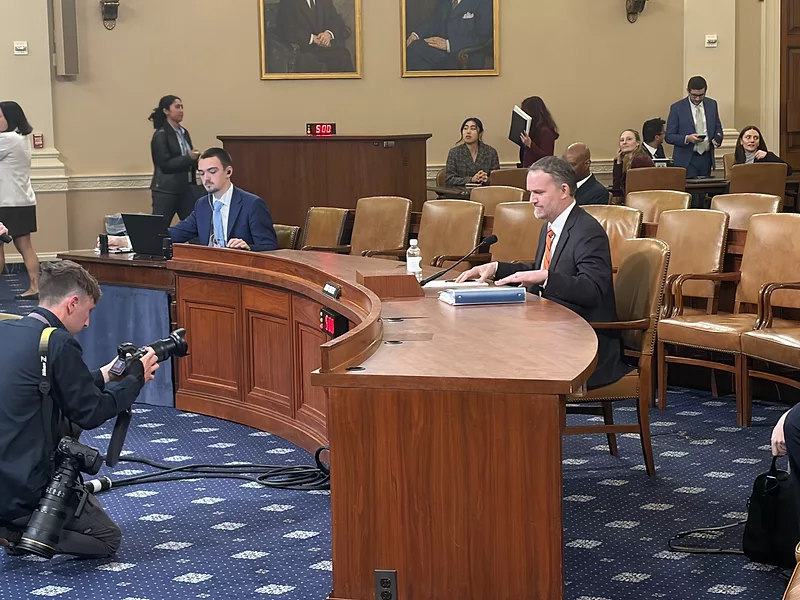
The Trump administration is hoping that it can secure commitments from China for expanding agricultural exports beyond soybeans, U.S. Trade Representative Jamieson Greer said Wednesday.
“There's been a lot a lot of talk about soybeans, and we have a very specific commitment on soybeans,” Greer told Ways and Means lawmakers during a hearing on the administration’s 2026 trade policy. “But we're also looking to get a commitment from the Chinese overall with respect to all agriculture.”
President Donald Trump is slated to head to China next month to meet with President Xi Jinping. Greer and Treasury Secretary Scott Bessent met with Chinese officials last month to prepare for the visit and discuss potential outcomes.
Greer said he hopes a broader agricultural commitment will be among the outcomes of that meeting.
The USTR and other administration trade officials are also gearing up for a review of a North American trade agreement. While early discussions with Mexico seem cordial, the U.S. and Canada are grappling with fundamentally different approaches to trade, Greer said.
The Canadians have “indicated that they want to be trading more. They want to have more trade with more countries,” U.S. Trade Representative Jamieson Greer told Ways and Means lawmakers during a hearing Wednesday.
“They're doubling down on globalization, and we're trying to correct those problems with globalization. So those are two models that don't stick together very well,” he said.
Formal talks on the U.S.-Mexico-Canada Agreement are set to kick off July 1. But while senior U.S. officials have been praising Mexico’s bilateral engagement, they have been publicly critical of the Canadian government.
“They suck,” Commerce Secretary Howard Lutnick said of Canadian officials’ approaches to negotiations, following comments from a former trade chief that suggested the country could benefit from slowing the pace of negotiations.
“That is, like, the worst strategy I’ve ever heard,” Lutnick said at a Semafor event last week.
Interested in more news on farm programs, trade and rural issues? Sign up for a four-week free trial to Agri-Pulse. You’ll receive our content - absolutely free - during the trial period.
Both Greer and Canadian Prime Minister Mark Carney said Wednesday that the two sides have exchanged issues that they plan to raise in the review. Carney stressed to reporters, however, that Canada will not allow the U.S. to set the terms of the review process.
“It’s not a case of the United States dictates the terms,” he said. “We have a negotiation. We can come to a mutually successful outcome,” he added, but warned “it will take some time.”
The Canadian embassy in Washington did not immediately respond to Agri-Pulse’s request for comment.
Among the issues that the U.S. has raised with Canada, Greer said during Wednesday’s hearing, are those affecting U.S. dairy exports and a tariff-rate quota applied on turkey.
If negotiators don’t agree on how to reform the deal and extend it this year, they have to meet every year until the deal’s expiry in 2036. But U.S. agriculture is hoping for a swift extension.
Greer appeared before the committee on the heels of a trip to Mexico earlier this week where he met with officials to discuss the impending review. As part of those discussions, Greer told lawmakers, he had raised the issue of low-cost fruit and vegetable imports from Mexico and the threat they pose to U.S. growers.
“We expect that this will be included in our USMCA negotiations,” Greer said. He also added that he would be open to using “other tools” to address the issue.
“It’s one thing to get imports of fruits and vegetables in January, February, December, things like that,” he said, but added it’s “totally different” when it comes to U.S. growing seasons.
Some in the industry have been appealing to officials to levy a seasonal tariff-rate quota to limit imports during months when U.S. growers are bringing their products to market.
During Wednesday’s hearing, Greer reiterated that the U.S. is not in a position to “rubber-stamp” the deal and said he would seek to reform the deal before backing an extension. But he also acknowledged that agricultural trade has been a “good area” of the deal and stressed that the goal is to “maintain that.”
Trade subcommittee Chair Rep. Adrian Smith, R-Neb., suggested that streamlining the deal’s dispute settlement procedure could amplify the benefits for U.S. agriculture. He pointed out that when the U.S. challenged Mexico’s ban of imports of genetically modified corn, it took years for the issue to be resolved.
“Mexico basically gave us a two-year heads up, but then also, it took two years for the actual process to be carried out,” Smith told Agri-Pulse on the sidelines of the hearing. “These are discussions we need to have.”
Several Republican lawmakers also used the hearing to try and get some sense of where U.S. tariffs are likely to go in the coming months. The administration is pivoting to alternate statutes to replicate the tariff struck down by the Supreme Court in February and has mounted two investigations under a law used to address unfair trade practices. But questions remain about rates and scope of any new tariffs.
“What can I tell [businesses] about certainty as it relates to tariffs?” Tennessee GOP Rep. David Kustoff asked.
Rep. Suzan DelBene, D-Wash., asked if goods covered under the USMCA would be exempt from any forthcoming tariffs that may may come as a result of the investigations.
Smith also pressed the USTR on whether a list of agricultural and other products not produced in the United States that had received exemptions from emergency tariffs and saw a carveout from the global tariff would receive exemptions.
Greer, however, would not commit to carrying any of the exemptions forward.
“There's investigation, so I don't want to pre-judge it,” he said.
For more news, go to Agri-Pulse.com.

