
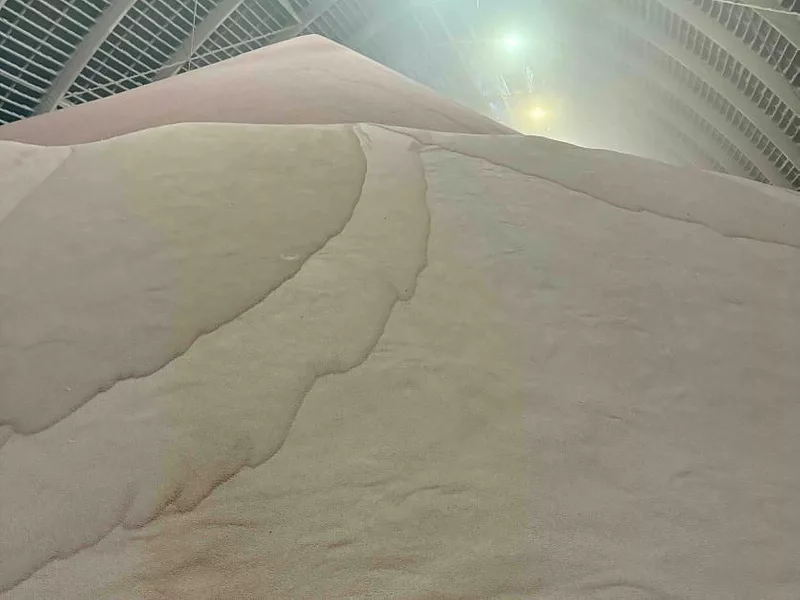
The cost and availability of fertilizer will be scrutinized at a Senate Ag Committee hearing on Tuesday. It’s the latest attempt by Washington officials to get a stronger grasp on what’s behind higher prices for crop nutrients and how to make the U.S. less reliant on foreign fertilizer markets.
The hearing comes amid calls for heightened scrutiny of the industry. Bills have been introduced in Congress to improve fertilizer price transparency. Deputy Ag Secretary Stephen Vaden last month said he’s met with officials at the Justice Department and Federal Trade Commission as part of a pricing probe of the industry.
“We know that a lot of farmers have a lot of information that might be relevant to these investigations,” Vaden said in an April 13 speech. He stressed that fertilizer pricing concerns predate war in the Middle East that has further driven up fertilizer prices.
Separately, Nutrien, the world’s largest fertilizer maker, last week posted higher-than-expected quarterly sales. CF Industries, a top producer of nitrogen fertilizer, also exceeded key estimates in the most recent quarter, fueled by higher prices, Oppenheimer analyst Kristen Owen said in a note to clients.
"The nitrogen outlook reflects the significant tightening of global supply, which CF sees remaining through 2027 on conflict-impacted volumes, limited China exports, India import demand, and healthy US corn acreage,” Owen said of CF.
Administration appeals global tariff ruling
The Trump administration will appeal a trade court ruling last week that determined a 10% global tariff imposed on most U.S. imports is unlawful, according to a filing Friday.
The Court of International Trade ruled 2-1 on Thursday that the administration had improperly used a statute used to address balance-of-payments issues to impose tariffs.
The administration is using the temporary measure to keep 10% duties in place while it pivots to alternate tariff authorities after the Supreme Court jettisoned Trump’s emergency tariffs in February.
“President Trump has lawfully used the tariff authorities granted to him by Congress to address our balance of payments crisis,” White House Spokesperson Kush Desai told Agri-Pulse in an email Friday. He added that the administration “maintains confidence in ultimately prevailing.”
Take note: Although the trade court ruled against the 10% global tariff, the ruling applies only to the plaintiffs in that case. The Liberty Justice Center’s Jeffrey Schwab, who represented two of the plaintiffs in the case, told reporters Friday that it is “not clear” what the ruling will mean for other companies.
There could soon be a slew of lawsuits, he said, as companies vie to ensure they are able to receive refunds if the CIT ruling is upheld in the higher courts.
It’s easy to be “in the know” about what’s happening in Washington, D.C. Sign up for a FREE month of Agri-Pulse news! Simply click here
Makary reportedly out at FDA
FDA Commissioner Marty Makary is apparently on his way out the door, after becoming the latest high-ranking Trump administration official to get crosswise with the president, multiple news outlets are reporting.
The Wall Street Journal, Washington Post, New York Times and other news organizations cite anonymous sources who say President Donald Trump has signed off on Makary’s firing. The reasons reportedly range from Makary’s reluctance to approve vaping products to how he has handled the issue of access to the abortion pill mifepristone.
National Institutes of Health Director Jay Bhattacharya told CNN’s Jake Tapper Sunday he could not comment on the “rumors” and defended Makary as an “absolutely amazing FDA commissioner, and a good friend of mine.”
Hyde-Smith sees support for farm assistance package
Senate Ag Committee member Cindy Hyde-Smith says she thinks there’s enough political support for more aid to farmers this year and emphasizes the importance of renewing the U.S.-Mexico-Canada Agreement, in an interview on Agri-Pulse Open Mic.
Lawmakers have floated the figure of $15 billion for an aid package to farmers battered by high input prices and low commodity prices. The Mississippi senator says, “We’re going to have to find a vehicle to get it in, but I do think we're going to be successful there.” She adds, “Certainly, the conflict in Iran has not helped that, and it's just really a struggle for the farm economy across the country.”
On USMCA, she says, “There is broad support from the members here to continue on what we're actually doing, and if we can improve it, that's a win for everybody.”
Hyde-Smith also says she’s pleased with USDA’s plans to reorganize the Agricultural Research Service, noting that ARS facilities at Stoneville and Mississippi State will receive additional funding and personnel.
“Stoneville will be designated as a national office of plant science research,” she adds. “So we're extremely happy about that, due to how important row crops are to Mississippi.”
BLM revokes grazing permit used by nonprofit for bison grazing
The Bureau of Land Management has rescinded grazing permits for 63,000 acres of public land in Montana used for grazing bison by American Prairie, a nonprofit seeking to create a nature reserve.
BLM on Friday issued a final decision revoking American Prairie’s permits for seven Montana allotments, finding that the organization manages bison as wildlife not meant for production, rather than as livestock.
American Prairie had initially protested the BLM’s proposal to revoke the permits, pointing out that its bison have been used for meat consumption, commercial purposes, breeding stock and other purposes of commercial value. However, Acting BLM Director Bill Groffy wrote in the final decision that in the case of American Prairie, “any production-oriented practices appear ancillary, and are themselves conducted chiefly to advance American Prairie’s broader conservation and restoration mission."
USDA issues rule allowing whole, 2% milk in schools
The Agriculture Department has finalized a rule to allow whole and reduced-fat milk to be offered in school nutrition programs, which currently allow low-fat and fat-free milk.
The rule is the result of the Whole Milk for Healthy Kids Act, which was signed into law in January. National Milk Producers Federation President and CEO Gregg Doud applauded the rule in a press release and said being able to offer whole and 2% milk in schools “helps students meet recommended daily values for many essential nutrients.”
"We appreciate USDA’s swift, comprehensive efforts on implementation to ensure that schools have the information they need to make purchasing decisions and whole and reduced fat milk offerings return to school menus,” Doud said.
Final word
“Despite the disruptions linked to the crisis in the Strait of Hormuz, global agrifood systems continue to show resilience. Cereal prices have increased only moderately so far, supported by relatively strong stocks and adequate supplies from previous seasons. Vegetable oils, however, are experiencing stronger price increases, driven largely by higher oil prices, which are increasing demand for biofuels and putting additional pressure on vegetable oil markets.” – UN Food and Agriculture Organization Chief Economist Máximo Torero, commenting on the FAO Food Price Index Friday. The benchmark of world food commodity prices rose for a third straight month in April “amid elevated energy costs and disruptions,” according to FAO.
For more news, go to www.Agri-Pulse.com.
.webp?t=1762183428)


