
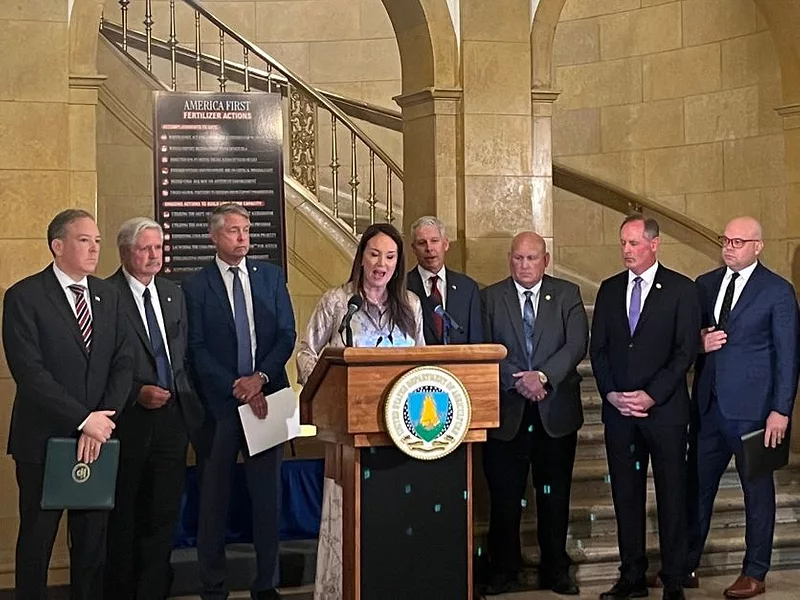
At an event at the Agriculture Department Tuesday, Ag Secretary Brooke Rollins said the Fertilizer Production and Expansion Program would be reimagined to boost U.S. fertilizer capacity.
The program, Rollins said, was “originally conceived with a very good thought in mind, and that is, we have to reshore/onshore our fertilizer production here in America.” However, she said it was focused too much on mitigating climate change and not enough on making fertilizer.
Of 121 projects targeted for funding by the previous administration, “only eight were moved to completion,” Rollins said. “Seven were marked unsatisfactory,” she added, and “in most instances there was zero contact information reported for the awardees.”
“We have now changed that,” she said. “We are in touch with every single one of them. We are talking to them. Those projects that were stalled because of climate requirements are now coming back online.”
Initial reaction from the fertilizer industry was positive. Corey Rosenbusch, president and CEO of The Fertilizer Institute, said he believes USDA is “trying to assess how much of [the funding] has not been allocated, and to see if there's an opportunity to repurpose that.”
He echoed Rollins’ comments about the program, saying when it was first announced “we supported it 100%. I think some of the implementation, when it was first rolled out, was where we had a little bit of heartburn” because of the small-scale nature of many of the projects, including composting “in inner-city Seattle, which is not really something that's going to bolster significant fertilizer supply for the U.S. farmer.”
“Focusing on those projects which do significantly contribute to domestic supply is where we want to focus,” he said on the sidelines of the event.
One project Rollins said had stalled is a planned Atlas Agro plant in Richland, Washington, to produce 700,000 tons a year of anhydrous ammonia from hydrogen. The company was awarded $80 million under FPEP. “We expect construction to begin this year,” Rollins said.
Another project she mentioned is a $3.89 million facility in Iowa “to expand domestic organic fertilizer production capacity through large-scale composting and nutrient processing.”
Besides reinvigorating FPEP, Rollins and other officials said they were trying to use the levers of other government agencies to boost fertilizer production, including the Energy Department’s Energy Dominance Financing Program.
Rollins also said that CF Industries’ $3.7 billion Blue Point ammonia plant should have permitting “wrapped up” within 45 days. When completed in 2029, CF says it will be the largest low-carbon ammonia plant in the world, with annual production capacity of 1.4 million tons.
TFI also welcomed Rollins’ commitment to hire a crop inputs economist in the Office of the Chief Economist. Legislation in Congress seeks to bring more transparency to fertilizer prices, and Rollins said “effective immediately, we are already searching for that input economist.”
In a news release, TFI noted that Rollins was “reestablishing” an inputs economist “to provide independent and consistent analysis and reporting on fertilizer and other crop input markets.”
It’s easy to be “in the know” about what’s happening in Washington, D.C. Sign up for a FREE month of Agri-Pulse news! Simply click here
One outside expert said while the USDA announcement was welcome, it doesn't adequately address the current situation.
"I applaud investment in U.S. fertilizer production and a more competitive operating environment, but U.S. farmers need price relief and greater supply today," said Alexis Maxwell, senior equity analyst with Bloomberg Intelligence.
DEF urea likely to address spot needs
Another area where the administration hopes to see some progress revolves around diesel exhaust fluid (DEF), which is currently in catalytic reduction systems to reduce emissions of nitrogen oxides.
However, farmers have complained for years about the potential for DEF to cause engine “derates that can limit a vehicle’s performance to nearly inoperable levels (as low as five miles per hour),” EPA says.
Urea is used to make DEF, and the administration is hoping that by easing regulations surrounding DEF use, more manufacturers will c Corey Rosenbusch (TFI photo)hoose to make urea fertilizer.
Rollins said one such company, Dakota Gasification, had responded to new guidance on DEF by expanding granular urea production. In an opinion piece in The Washington Reporter, Rollins said that in March, "President Trump directed [EPA] to rewrite the [DEF] rules, spurring the Dakota Gasification Company to deliberately prioritize higher urea production while reducing DEF output."
The company’s owner, Basin Electric Power Cooperative, said Dakota Gasification has “prioritized maximizing urea fertilizer production due to the lack of imports into the U.S. and significant need domestically, as the U.S. is a net importer of nitrogen fertilizers.”
“The plant can quickly adjust production levels between urea and DEF based on market demand conditions, as well as contractual obligations that Dakota Gas has,” the statement said.
Overall, however, the administration’s DEF announcement “has to be taken in the context of – what is every little thing we could do to incrementally increase the supply in an emergency,” such as spring planting, Rosenbusch said. “Big picture, long term, only about 20% of total urea gets used for industrial application. The other 80% is already used for fertilizer, so you're not talking about significant volumes.”
TFI economist Veronica Nigh tells Agri-Pulse that there are significant limitations on switching to production of urea fertilizer from urea used for DEF.
“Not all facilities that make DEF can convert to urea,” she said. In addition, “undoing the usage of DEF is, I think, a lot longer unwind than folks are giving it credit for.”
“Because of the equipment challenges, you wouldn't see the market switch entirely from DEF to urea. I think that rollout is going to be so slow and minimal that it would not make a sizable difference,” she said.

