
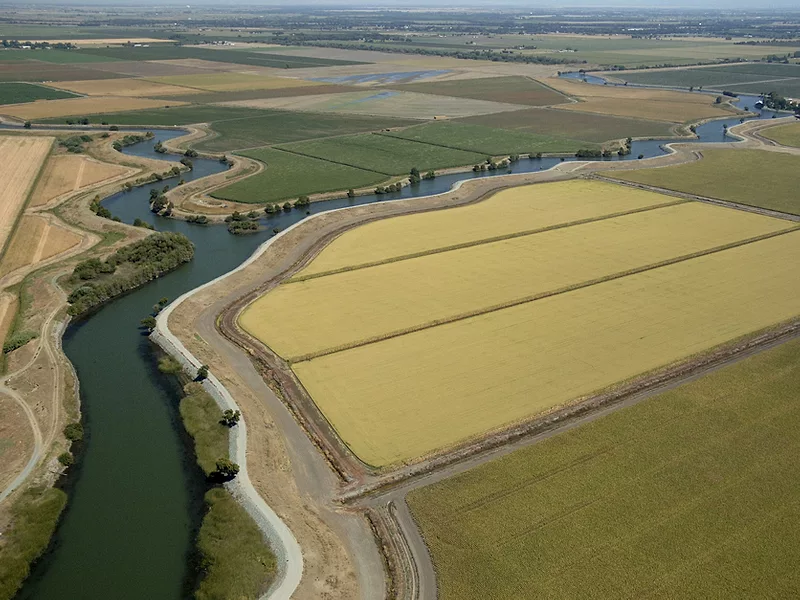
A new Restore the Delta report argues expanding rice acreage in the Sacramento-San Joaquin Delta could help slow subsidence, protect water infrastructure and open the door for a new local bioproducts economy — but only if the region builds the processing capacity to keep more value from the crop close to home.
The report marks a new direction for an environmental group often battling with agriculture over water policy in the Legislature, in regulatory hearings and in the courtroom.
Supported by BEAM Circular, the report comes as rice has moved from a niche Delta crop to a fast-growing land use. Restore the Delta estimates Delta rice acreage has grown fivefold over the past eight years, while the Delta Protection Commission reported acreage in some Delta zones climbed 153% from 2018 to 2022, reaching 17,178 acres.
The central pitch is that flooded rice fields can re-create the anaerobic conditions that built the Delta’s peat soils, limiting oxidation that drives land subsidence.
“Without major levee investment in the next 25 years, over $10 billion in infrastructure faces severe flood risk,” said Morgen Snyder, Restore the Delta’s director of policy and programs, in a statement. “Flooded rice cultivation restores the anaerobic conditions that slow and may stop peat oxidation that has already caused some Delta islands to sink as much as 25 feet.”
The report estimates San Joaquin County alone harvested 11,600 acres of rice in 2024, producing an estimated 49,400 to 74,100 short tons of straw. But the authors caution that straw is not necessarily the best feedstock to remove from Delta fields because incentive programs and conservation goals often favor incorporating straw and flooding fields to support subsidence reduction, greenhouse gas benefits and migratory bird habitat.
Cut through the clutter! We deliver the news you need to stay informed about farm, food and rural issues. Sign up for a FREE month of Agri-Pulse here.
Instead, the report points to milling byproducts — hulls, bran and broken rice — as a more promising economic opportunity. The authors estimate the San Joaquin County crop could have generated about 9,880 tons of rice hulls, 3,952 to 5,928 tons of bran and 7,410 to 12,350 tons of broken rice. Rice hulls can be used in energy generation, construction materials, biochar, wastewater treatment and advanced materials, while bran and broken rice already have feed and food markets.
The problem is that the Delta has no rice mill. Delta-grown rice is trucked to Sacramento County for processing, leaving what Restore the Delta calls a “major economic gap” in the local supply chain. The report’s top recommendation is a regional grain mill, potentially near the Port of Stockton, to reduce transportation emissions, consolidate byproduct streams and support adjacent biomanufacturing.
State funding is also beginning to align with that shift. The Delta Conservancy says funding is available for rice conversion projects to stop or reverse subsidence, reduce greenhouse gas emissions, keep below-sea-level farmland viable, and provide overwintering bird habitat. A solicitation this year says the Rice Incentive Program will use Proposition 4 climate bond dollars and funding for nature-based solutions.
“This is about more than rice,” said Restore the Delta Executive Director Barbara Barrigan-Parrilla in a statement. “It’s about creating a durable economic model that helps protect California’s water infrastructure, supports local communities, and keeps the Delta landscape functioning for generations to come.”

