
USDA school meal proposals on tap for later this year, Vaden says
The Agriculture Department will seek comment later this year on proposals aimed at aligning new federal dietary guidelines with school meal standards, Deputy Ag Secretary Stephen Vaden says.
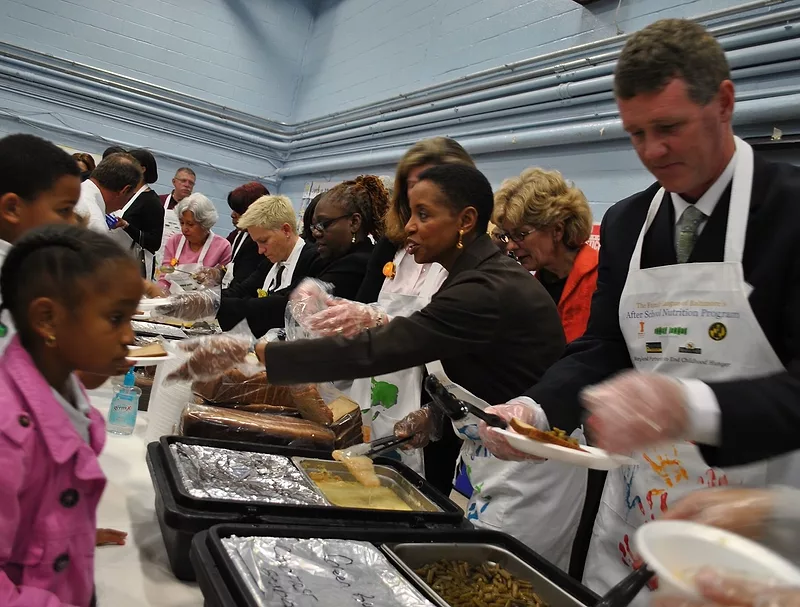
The Trump administration’s message earlier this year on eating real, unpackaged food must now go through a regulatory process that considers both affordability and the best nutrition science, Vaden said Tuesday at a Wall Street Journal Global Food Forum in Chicago.
Vaden also noted that reducing ultra-processed food in schools doesn’t “necessarily have to result from more scratch cooking.”
“What it does mean is purchasing more whole food items and fewer items that have already been pre-seasoned or otherwise processed,” Vaden said. “More fruits and vegetables, more whole meats, fewer things like pizza and what have you, which may be popular on certain days — they certainly were when I was in elementary school — but aren't necessarily the best for you.”
Read more about Vaden’s remarks, prospects for a Senate farm bill, EPA pesticide registration decisions, and state data privacy laws in today’s Agri-Pulse newsletter.
Lahn defeats Feenstra in GOP governor upset
Rep. Randy Feenstra suffered a surprising defeat in Iowa’s GOP gubernatorial primary Tuesday, losing to businessman Zach Lahn despite a late endorsement from President Donald Trump. Feenstra, who conceded before results were official, outspent Lahn by nearly $1 million.
Lahn, who will face Democrat Rob Sand in November, centered his campaign on protecting family farms and pushing back against outside land ownership. In his victory speech, he recounted losing his family farm in 2005 and reclaiming it nearly a decade later. “I fear every day we are losing the Iowa we love. We’ve lost 10,000 family farms since 2000. Our young people are leaving faster than 46 other states because they don’t see enough opportunity here,” Lahn said. He pledged to ban secret land ownership, tax hedge funds and “take on the big ag cartels” if elected governor.
Opening CRP acreage could help fuel beef herd expansion, Cargill executive says
A Cargill executive says opening additional Conservation Reserve Program land for grazing could help with efforts to restock the shrunken U.S. beef herd, which is currently the smallest it’s been since 1951.
In a panel discussion at the Wall Street Journal's Global Food Forum on Tuesday, Cargill Senior Vice President and Managing Director of Beef Jarrod Gillig said opening CRP land to cattle could help offset forage pressures caused by years of drought.
Gillig said that when it comes to rebuilding the beef herd, “a lot of it comes down to grass.” As of January, U.S. cattle and calf inventories stood at only 86.15 million head, according to USDA’s most recent survey.
CRP pays farmers to remove environmentally sensitive land from production. Some haying and grazing are already allowed in emergency situations on CRP land enrolled through the program’s general signup.
USDA-led trade mission heads to Argentina, Ecuador
A delegation of ag industry representatives is traveling to Argentina and Ecuador for trade missions led by Luke Lindberg, USDA’s undersecretary for trade and foreign agricultural affairs, according to an agency press release.
Among those in the delegation: Representatives from California Almonds, the USA Poultry and Egg Export Council, the U.S. Grains and Byproducts Council, U.S. Livestock Genetics Export Inc., the U.S. Meat Export Federation, the U.S. Soybean Export Council, and U.S. Wheat Associates.
The U.S. in 2025 exported $166 million in seeds, essential oils, livestock genetics, tree nuts and other items to Argentina, and $595 million in agricultural products including soybean meal, wheat and other feeds to Ecuador, according to the release.
Grassley urges USDA to rethink delay of chicken antitrust rule
USDA’s 18-month delay of a poultry competition rule under the 1921 Packers and Stockyards Act is getting a big thumbs-down from Sen. Chuck Grassley.
“I'm very, very disappointed,” the Iowa Republican told reporters on Tuesday. “Antitrust laws are pretty important.”
USDA shouldn’t need more time to enforce a law that's been on the books for at least 100 years, he said.
The Trump administration said it needs more time to study effects of the Biden-era rule, leading it to postpone a July 1 implementation until the end of next year.
The regulation is needed for transparency and accountability, according to Grassley. “For too long, meatpackers have used the system to pit chicken growers against one another for higher compensation.”
“This enforcement delay puts a priority of vertical, integrated meatpackers over the livelihood of family farmers,” Grassley said while urging USDA to quickly reconsider the delay.
Screwworm case found 25 miles from border
A case of New World screwworm has been found 25 miles from the U.S.-Mexico border, marking the nearest confirmed detection to the U.S. during the outbreak.
The case involved a five-year-old goat in the state of Coahuila in Northern Mexico, Agriculture Secretary Brooke Rollins said during a press call Tuesday.
Rollins said Mexico has allowed the USDA to “surge in” staff to address the issue. Mexico has also been “very willing to take our money to rebuild some facilities," she added.
“We’ve staved it off now for almost a year,” Rollins said. “Hopefully we can continue to do that."
Colorado river plan will allow for ‘adaptive’ near-term management, Interior official says
The Interior Department hopes to roll out its environmental review of new guidelines for Colorado River management sometime this summer that will establish a 10-year framework and allow for “adaptive management” of the river's flows over the next two years, an agency official said Tuesday.
Speaking at the 2026 Agri-Pulse West Summit in Sacramento, Assistant Interior Secretary for Water and Science Andrea Travnicek said the agency is currently speaking with leaders from the seven states that share the river about what the next two years of water management should look like. States have been divided in past water-sharing negotiations.
“We have the four upper basin states coming together, they’ve got great ideas; the three lower basin states coming together, they’ve got great ideas,” Travnicek said, adding that the question now is “how do we merge those to try to come up with some sort of decision?”
Take note: Officials from Arizona, California and Nevada — the three lower basin states — recently pitched Interior on a plan to use 3.2 million less acre feet of water in 2027 and 2028 to “stabilize the system in the face of deteriorating hydrology,” according to their plan. Meanwhile, the lower basin states have requested mediation.
Final word
“I'm an amateur gardener. I don't use any pesticide that I don't have to use, but when my orange trees are covered with black soot from scale or something, I've got to do something. So I think we're all on the same side here. Nobody wants to use pesticides. They're not a luxury, they're a necessity, and we have to figure out how to get the safest ones, and how to reduce the use, and how to continue to make progress with the technology so we can avoid using chemicals in the future." — Bayer CEO Bill Anderson, responding to a question about the Make America Healthy Again movement during the Wall Street Journal's Global Food Forum on Tuesday.
Kim Chipman, Lydia Johnson and Noah Wicks contributed to today’s Daybreak.
.webp?t=1762183428)


