
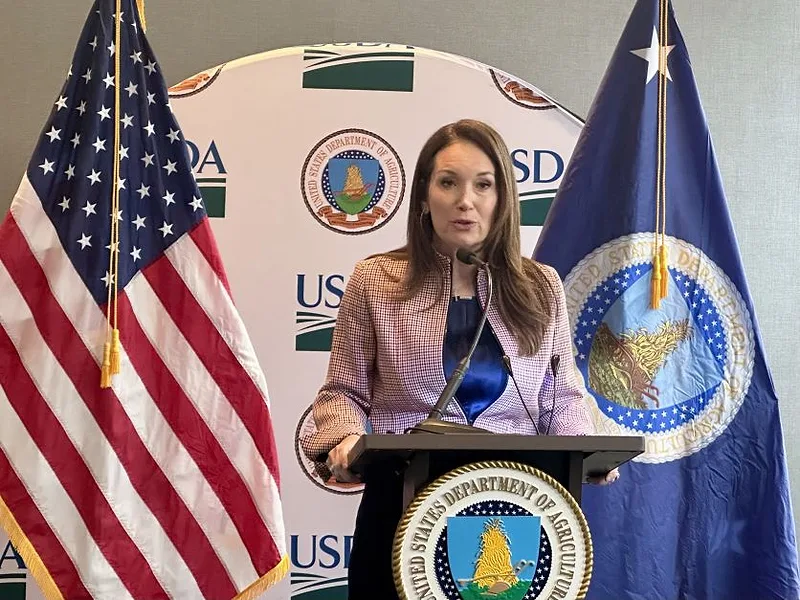
USDA is ‘Johnny-on-the-spot’ with screwworm readiness, Rollins says
Agriculture Secretary Brooke Rollins says while no one has a crystal ball, emergence of New World screwworm in Texas shouldn’t significantly diminish the U.S. cattle herd.
“The cases should be isolated,” Rollins told reporters on Thursday after a roughly four-hour appearance before the House Agriculture Committee.
Rollins said USDA is prepared to handle the pest, which was largely eradicated from the U.S. in the 1960s and 1970s, aside from a few cases found in deer in the Florida Keys in 2016. While the full 400-500 million sterile flies needed to suppress NWS outbreaks won’t be available until next year, there are tools available now, she said.
“We're dropping the flies. We’re Johnny-on-the-spot. We have technology treatment,” Rollins said. “We didn't have any of this in the ‘50s and ‘60s, so we're in a very different scenario.”
Rollins also said she doesn’t expect any meaningful impact on beef prices, USDA has enough staff in place to battle NWS, and no congressional action is needed to deal with the threat.
Take note: Timothy Schell, the director of the Food and Drug Administration’s Center for Veterinary Medicine, told reporters on a press call Thursday that the agency has authorized 12 products used to treat screwworm cases in multiple species.
Schell noted there’s been “high interest and high demand” for a feed treatment, and said FDA was “working very diligently to provide that option as soon as possible.”
Cut through the clutter! We deliver the news you need to stay informed about farm, food and rural issues. Sign up for a FREE month of Agri-Pulse here.
Photo below: Rep. April McClain Delaney displayed a photo of a New World screwworm while questioning Agriculture Secretary Brooke Rollins during a House Ag Committee hearing on Thursday. The Maryland Democrat used the picture to emphasize the importance of scientific research in helping fight diseases and pests.
“He’s looking at me!” Rollins joked in response to the photo. (Agri-Pulse photo)
Other topics of interest at the oversight hearing include: 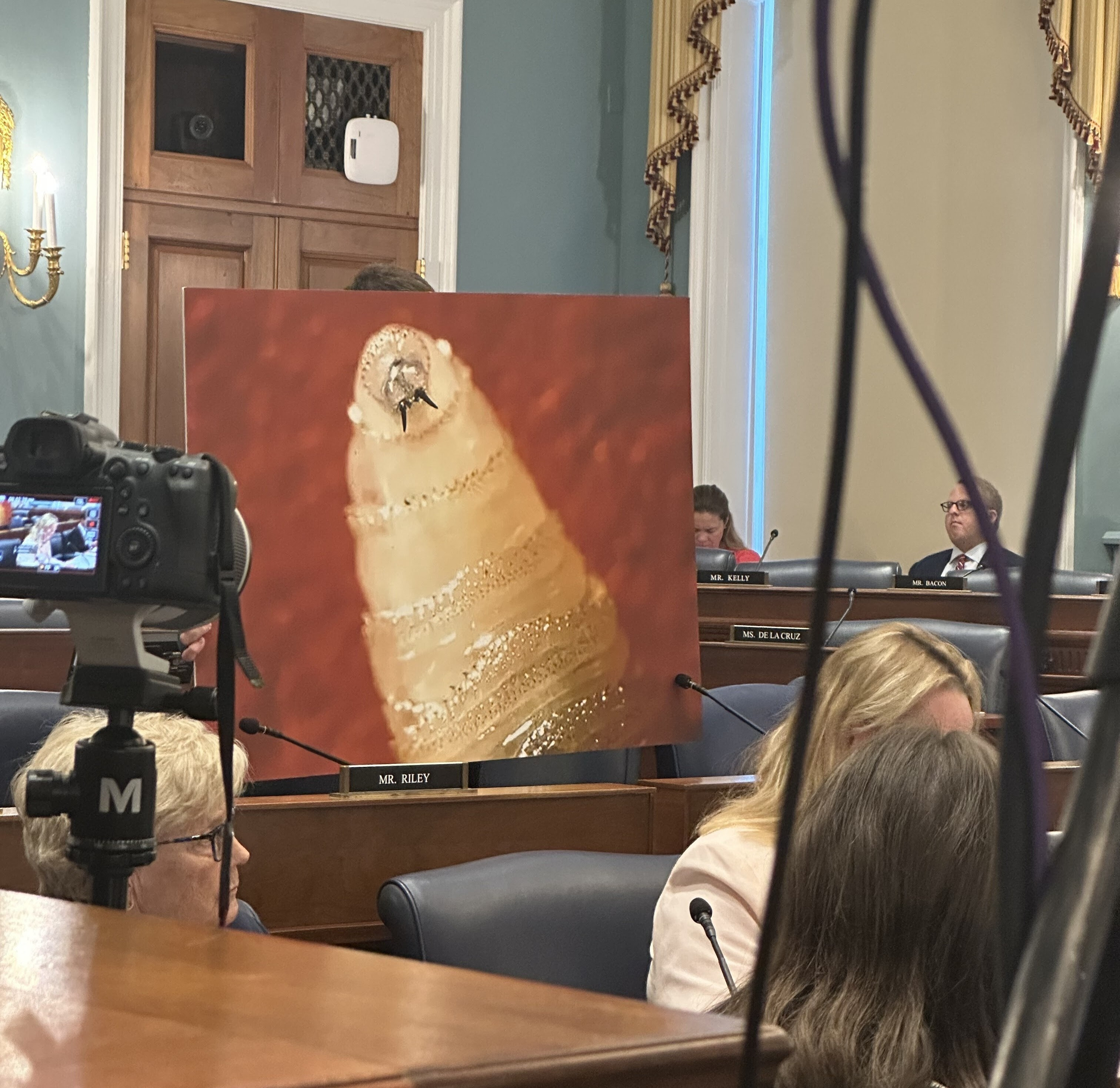
Specialty crops: Several lawmakers criticized USDA’s funding for specialty crop programs as inadequate, even though program assistance was raised to $1.6 billion last week. Rollins said, “this is really a congressional question. We stand by and are ready to assist if that determination [more funding] is made.” Rep. Gabe Vasquez, D-N.M., told Rollins that some of his constituents have been waiting over six months for specialty crop payments.
FSA staffing: Rollins said there was “room for improvement” at FSA offices, saying that some are operating at 50-60% staffing compared to before the Trump administration came into office. Rep. Nikki Budzinski, D-Ill., told Rollins “a streamlined file doesn't help much if there isn't enough staff in the office,” referring to the department’s “One Farmer, One File” initiative. Rollins told lawmakers that ensuring FSA offices are adequately staffed and responding to farmers in a timely manner is one of her top priorities.
DEI grants: Rollins cited DEI initiatives as a major strain on USDA “time, and resources and taxpayer dollars.” She specifically called out a canceled grant about queer and BIPOC farmers and said, “When Abraham Lincoln founded this department in 1862, never in a million years would he ever have been okay with some of the priorities that the last administration had put in place.”
California ag secretary defends Prop 12
California Department of Food and Agriculture Secretary Karen Ross defends her state’s Proposition 12 animal welfare law on the latest Agri-Pulse Newsmakers, airing today, saying it has not caused the widespread supply disruptions critics predicted.
“No one's being forced to make any changes unless they want to sell into this market,” Ross says in the interview, adding that processors can establish dedicated production lines for Prop 12-compliant pork similar to organic product systems. “A lot of people stood in line to be certified to sell into this market because there was a premium for it.”
A Republican-led provision advanced in the House-passed farm bill that would prohibit states from regulating agricultural production practices beyond their borders. But it faces an uphill battle in the higher chamber, where Senate Ag Chair John Boozman said he doesn’t think “there's a single Democrat that would vote for it.”
Boozman has since confirmed the complete provision will not be included in the Senate farm bill text set to be released this month.
Ross acknowledged ongoing concerns about pork affordability, particularly for lower-income consumers and smaller markets where products may not be as widely available. Still, she said the state's focus is now on helping producers and processors navigate compliance requirements.
Ross also framed Prop 12 as part of a broader shift in consumer expectations around animal welfare rather than a unique California phenomenon. “Animal welfare and animal care matters to a lot of people,” Ross said, arguing that younger consumers in particular have driven the change.
A new episode of Agri-Pulse Newsmakers filmed in Sacramento will be released today. Hear more about water, MAHA, and a retirement message from Ross, as well as from Ag Council of California President Emily Rooney and Chris Zanobini, president and CEO of Ag Association Management Services Inc. 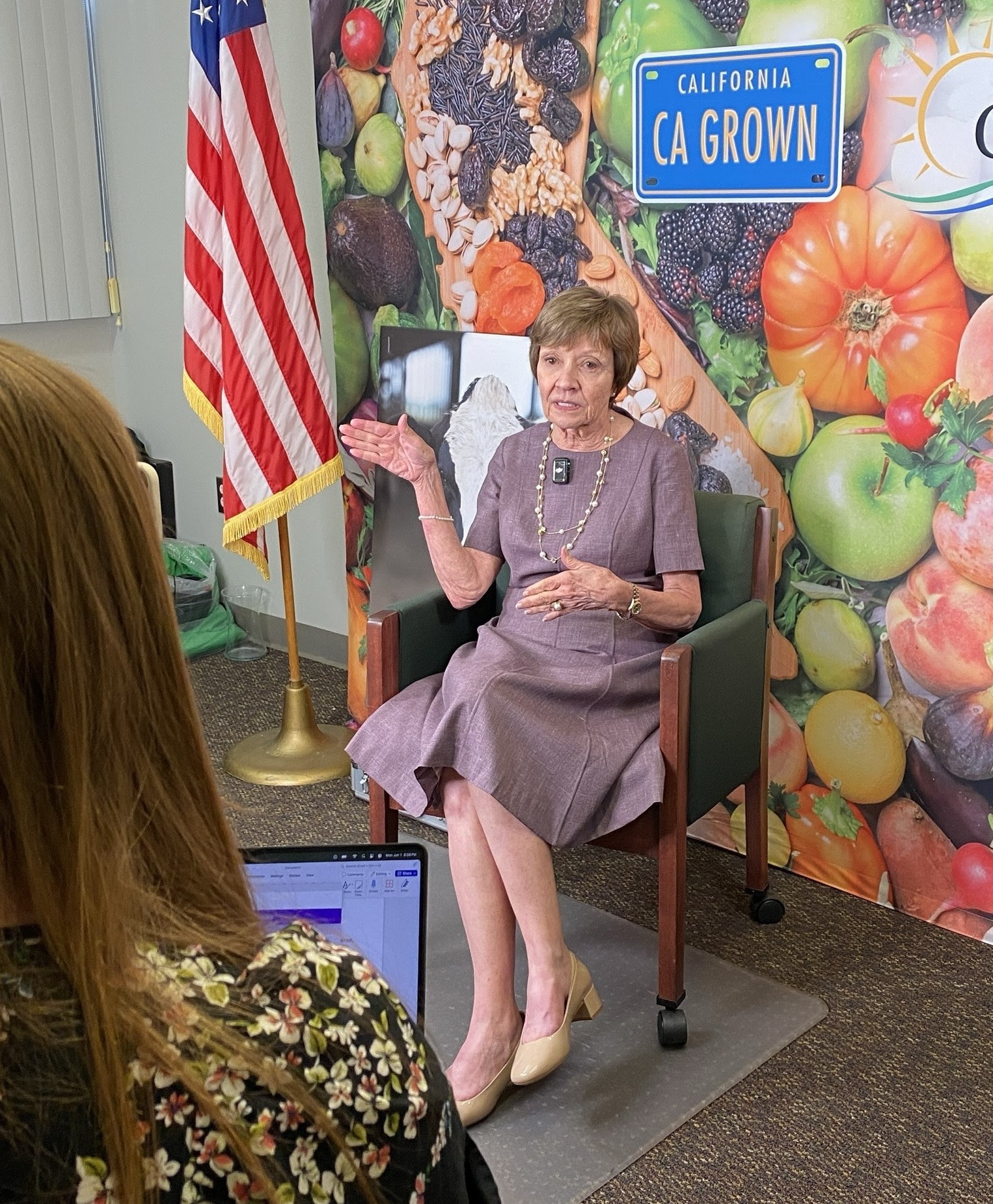 CDFA Secretary Karen Ross records an interview for Agri-Pulse Newsmakers with Associate Editor Lydia Johnson in Sacramento.
New York lawmakers seek USDA disaster declaration for specialty crop growers hit by frost
Six Democratic New York lawmakers are asking Secretary Rollins for a disaster declaration following an April frost that damaged fruit and vegetable crops in the state.
In a letter, the lawmakers — Sens. Chuck Schumer and Kirsten Gillibrand, and Reps. Patrick Ryan, Paul Tonko, Josh Riley and Timothy Kennedy — said a spring freeze that hit apple, grape, stone fruit, pear, strawberry and onion crops caused an estimated economic loss of $30 million.
The event resulted in between 15 and 100 percent crop loss for impacted growers, they added.
House passes $26.3B USDA-FDA funding bill
The House voted 213-210 to pass a $26.3 billion appropriations bill covering the Agriculture Department, FDA and related agencies.
The bill, H.R. 8646, includes $1.2 billion for USDA’s Animal and Plant Health Inspection Service to help combat the New World screwworm. The Trump administration is facing the first case of the livestock-endangering pest in decades, as well as bird flu and other foreign plant and animal diseases.
Democrats have decried the measure over cuts to food aid programs, such as the USDA’s Special Supplemental Nutrition Program for Women, Infants and Children, or WIC.
“Congressional Republicans are pushing a bill to gut WIC by an additional $200 million,” said Rep. Chrissy Houlahan of Pennsylvania. “When Americans are already struggling to feed their families, this change would strip support from already vulnerable moms and children.”
Speaking on the House floor ahead of the vote, Appropriations Ag Subcommittee Chairman Andy Harris, R-Md., sought to refute such criticism.
"The bill provides full funding of $8 billion for WIC. USDA data clearly shows that WIC participation has been declining and is not projected to be as high as originally estimated for fiscal year 2027,” Harris said. “USDA also expects to have sufficient carryover funds to meet all the program needs.”
Final word
“This summer. It's imminent.” – Ag Secretary Brooke Rollins at the House Agriculture Committee hearing about the timing of guidance on biofuel feedstocks that farmers hope to use to fully monetize the clean fuel production tax credit known as 45Z.
.webp?t=1762183428)


