
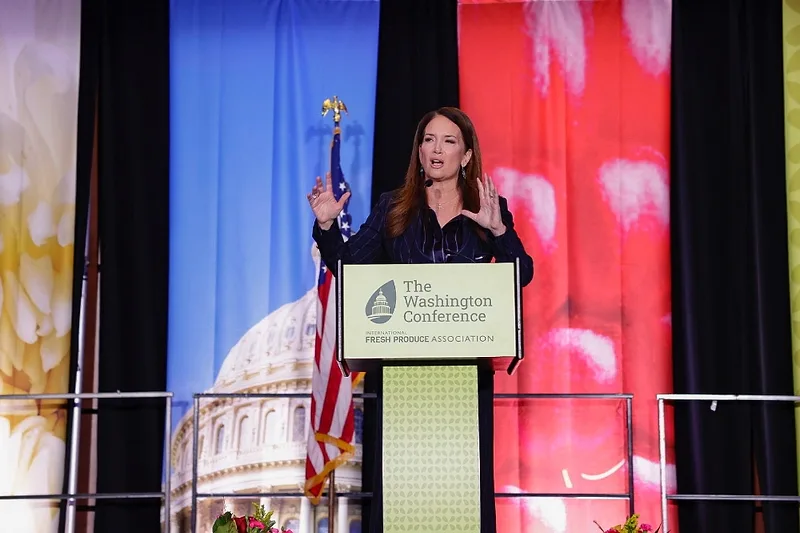
Agriculture Secretary Brooke Rollins used her time with the International Fresh Produce Association to highlight the administration’s deregulation push, as well as efforts to reshape federal nutrition policy, expand export markets, lower labor costs and support specialty crop producers.
Speaking at IFPA’s Washington Conference Wednesday morning before her appearance at the Senate Ag Committee, Rollins described agriculture as central to both national security and public health, arguing that the administration’s Make America Healthy Again movement is creating new opportunities for fruit and vegetable growers.
“We have carried out what will be remembered by the history books as the most significant reset of federal nutrition policy in American history,” Rollins said, pointing to the new dietary guidelines that emphasize nutrient-dense foods, including fruits and vegetables, while moving away from highly processed foods.
Rollins, echoing the message of Health and Human Services Secretary Robert F. Kennedy Jr. the day before, said USDA is working to align its nutrition programs with those priorities. That includes making changes to the Supplemental Nutrition Assistance Program's retailer stocking requirements to ensure stores accepting SNAP benefits carry a broader range of staple foods, like more fresh produce, dairy and protein.
Rollins also promoted regenerative agriculture as a key component of the administration’s health agenda. USDA has committed more than $700 million through its Farmers First Regenerative Agriculture Pilot Program, primarily through the Environmental Quality Incentives Program and Conservation Stewardship Program. According to Rollins, there are over 600 EQIP contracts totaling about $128 million and another 239 CSP contracts worth more than $30 million.
She also criticized overregulation — particularly in California — which she says has driven up compliance costs and made it increasingly difficult for farmers to remain competitive.
“You know that this president's top focus is deregulation and we have worked to implement that at USDA as well,” she said, encouraging those in attendance to share regulations that “are just dumb” with IFPA CEO Cathy Burns so they can be relayed to Rollins’ team at the Agriculture Department.
“I realize that probably some, especially in our bluer states, are maybe state rules that I don't have complete or any control over. But even those rules will help us understand the greater complexity and context of what it is that we're working to do to bring down the cost of business and to roll back government regulation,” Rollins said.
“No rule or regulation is too small for me to focus on,” she added.
The secretary pointed to labor costs as another major challenge facing specialty crop growers and praised the administration’s changes to the Adverse Effect Wage Rate used for H-2A guest workers. Rollins said the previous trajectory of wage increases was unsustainable and the administration is continuing to work with Congress on broader agricultural labor reforms.
House Agriculture Chairman Glenn “GT” Thompson, R-Pa., is calling to broaden a U.S. temporary agricultural worker program under a draft of a proposed ag labor bill, according to text obtained by Agri-Pulse. The proposal – which was developed from recommendations made in a 2024 final report from the House Ag Committee’s Agricultural Labor Working Group – would make it easier for dairies and other businesses to secure longer-term foreign guest workers despite employing temporary employees.
“Chairman Thompson has been dedicated to the agricultural labor issue despite it not being his jurisdiction, and I think that really shows how critical of an issue this is to our industry,” Samantha Ayoub, IFPA’s director of workforce and business policy, told Agri-Pulse on the sidelines of the event. “For produce specifically, we are highly perishable and largely hand-harvested across all of our sectors, so this is critical to our members as they head up to the Hill.”
More than 350 IFPA members are on Capitol Hill today delivering produce boxes to lawmakers and advocating for ag labor reform, protecting fruit and vegetable benefits in the Special Supplemental Nutrition Program for Women, Infants and Children, and increasing USDA purchases of fresh produce, among other priorities.
On trade, Rollins said she has several conversations each week with U.S. Trade Representative Jamison Greer to communicate the ag sector’s priorities. “One of the most important ways I believe we can secure future prosperity for our farmers is opening up new markets and export opportunities so that you all can compete over the long term,” she said.
Rollins also highlighted the record nearly $44 billion ag trade deficit, adding that “no dumping, no importing of things that move our producers out or block our producers” should be allowed.
That echoes the call of 79 House members led by Rep. Austin Scott, R-Ga., who are urging Greer to address what they describe as an "urgent crisis" facing specialty crop growers as Mexican imports continue to gain market share in the United States.
For more news, go to www.Agri-Pulse.com.

