

Agriculture Secretary Brooke Rollins says the $1.3 billion fight against a potentially deadly livestock pest includes federal funds reallocated from a local food buying program.
“There is more flexibility within USDA if there's a major urgent crisis like screwworm,” Rollins told reporters on Wednesday after testifying at the Senate Ag Committee. “We can move funds around to address that.”
The battle to extinguish the first U.S. outbreak of New World screwworm in decades used Commodity Credit Corporation money reallocated from the Biden administration, Rollins said.
USDA canceled $1 billion in funding last year that was split between the Biden administration’s Local Food Purchase Assistance program and Local Food for Schools program. The first provided food to assistance programs such as food banks, while the latter helped school districts buy locally grown food.
USDA was already canceling “a lot of grants that we didn’t think were really ‘farmer first,’” Rollins said.
Staffing surges for screwworm, ag chief says: Asked during the hearing by Ranking Member Amy Klobuchar, D-Minn., and Sen. Ben Ray Luján, D-N.M., whether staff reductions have hurt efforts to control the pest, Rollins argued they haven’t. She said the agency had 10 full-time staffers working on screwworm last January and now has more than 120.
According to an analysis of Office of Personnel Management data conducted by Prospect Partners, the Animal and Plant Health Inspection Service in Texas lost 182 biological science technicians, 12 animal health technicians, and six veterinary medical science employees in 2025. Prospect is an organization founded by former USDA officials.
Cut through the clutter! We deliver the news you need to stay informed about farm, food and rural issues. Sign up for a FREE month of Agri-Pulse here.
Take note: The agency on Wednesday reported a new detection in Texas, bringing the total number of U.S. screwworm cases up to seven.
CCC funds allocated already, Rollins says
Rollins said USDA is “stretched” on using the Commodity Credit Corporation because the $30 billion annual cap has not been increased since 1987. Klobuchar and Sen. Adam Schiff, D-Calif., asked to use funds for increasing domestic fertilizer production and specialty crop disaster assistance during the Senate Ag hearing.
Rollins said some of the funds are committed to cover changes to reference prices in the Working Families Tax Cut Act. A USDA document said $10 billion was transferred from the CCC for the Farmer Bridge Assistance Program in 2025 before the law was implemented. Klobuchar said the CCC has $14.3 billion allotted for emergency funding.
Rollins said the CCC is not tied to inflation, and if it were, it would stand at about $90 billion. She said there are ongoing conversations between USDA and ag committee senators about whether the CCC needs more funding from Congress. “They are on standby,” she said, referring to senators.
Rollins told Agri-Pulse a “little bit” of CCC money will go to expand fertilizer production.
Newhouse: Secure border could spark new congressional support on ag labor reform
Longtime ag labor reform champion Rep. Dan Newhouse, R-Wash., says the “rationalization” members of Congress have used to steer clear of ag labor reform because of an open border isn’t valid now because border security is “dramatically” improved.
Speaking at the International Fresh Produce Association’s Washington Conference, he called on ag labor advocates to tell their members of Congress that “urgency was yesterday” to fix the decades-long issue.
“People are very afraid of the word ‘amnesty,’ and this bill is not amnesty. The last bill was not amnesty,” Newhouse said, referencing House Ag Committee Chair Glenn “GT” Thompson’s newly unveiled ag labor bill. “Use that to help reassure folks that they're not going to get their heads cut off politically because they support something that helps their farmers.”
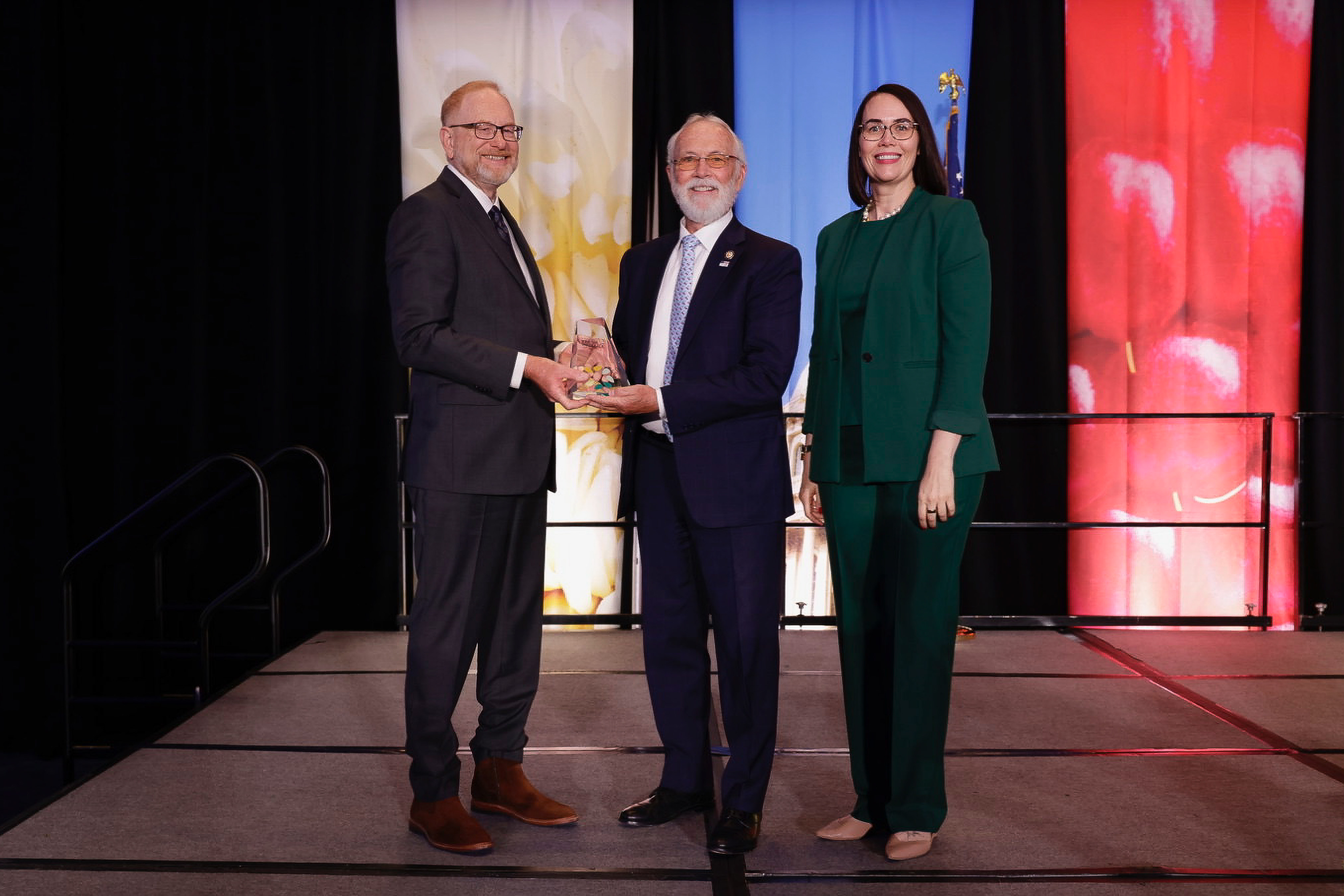 Newhouse, a member of the House Ag Committee who is not seeking reelection after his current sixth term concludes, also received IFPA’s Congressional Leadership Award. (IFPA photo)
 Luján ‘hopeful’ a SNAP deal is within reach
As division over food aid policy threatens to derail efforts to pass a farm bill this year, Sen. Ben Ray Luján, D-N.M., is upbeat on prospects for a deal.
At a “bare minimum,” lawmakers should agree to delay a requirement for certain states to start sharing costs of the federal Supplemental Nutrition Assistance Program, Luján tells Agri-Pulse.
Luján also stressed his view in an exchange Wednesday with Rollins at the Senate Ag Committee hearing.
Congress last year passed the One Big Beautiful Bill Act by postponing SNAP cost shifts for Alaska and other states with 2025 SNAP error rates above about 20%. The measure was needed to secure the vote of Alaska GOP Sen. Lisa Murkowski.
“Why is that not going to be applied to the country?” Luján said.
Luján’s bigger goal is for Congress to reverse $187 billion in SNAP funding cuts.
“Republican senators are now better understanding the devastation it means to their constituents,” he said.
National Milk Producers Federation fly-in focused on H-2A
Members of the National Milk Producers Federation advocated for an expansion to the H-2A farm labor program bill on Capitol Hill Wednesday. Their fly-in comes as a labor bill is in early drafts and is expected to be introduced in the House this month.
The draft that was released would expand temporary work status to 350 days, which would allow for dairy operations to hire workers virtually year-round.
“Generally, the bill that is on the table or the [paragraph] that we see is like a good stepping-stone, not a final destination,” Rachel Ravencroft, director of NMPF’s communications team, said yesterday. “I think it's a workable solution, but there is still more that will probably need to be done, but it just depends on what gets hashed out.”
Producer Brandon Smith said he thinks the addition of H-2A labor in the dairy industry would help in finding employees. “There's just not a pool, like people don't come looking for work anymore. There used to be a pool where you turn people away,” he said.
The federation members expressed their support for renewal of the trade pact among the U.S., Mexico and Canada and for farm bill passage. They also are pushing Congress to pass the DAIRY PRIDE Act, which would allow only dairy products to be labeled with dairy names like “milk,” “yogurt,” and “cheese.”
Final word
“I don’t know that I’m going to renew it because, to be honest with you … we don't need anything that Canada has. We don't need anything that Mexico has, but they need everything that we have.” – President Donald Trump answering a reporter’s question about the U.S.-Mexico-Canada Agreement.
.webp?t=1762183428)


