
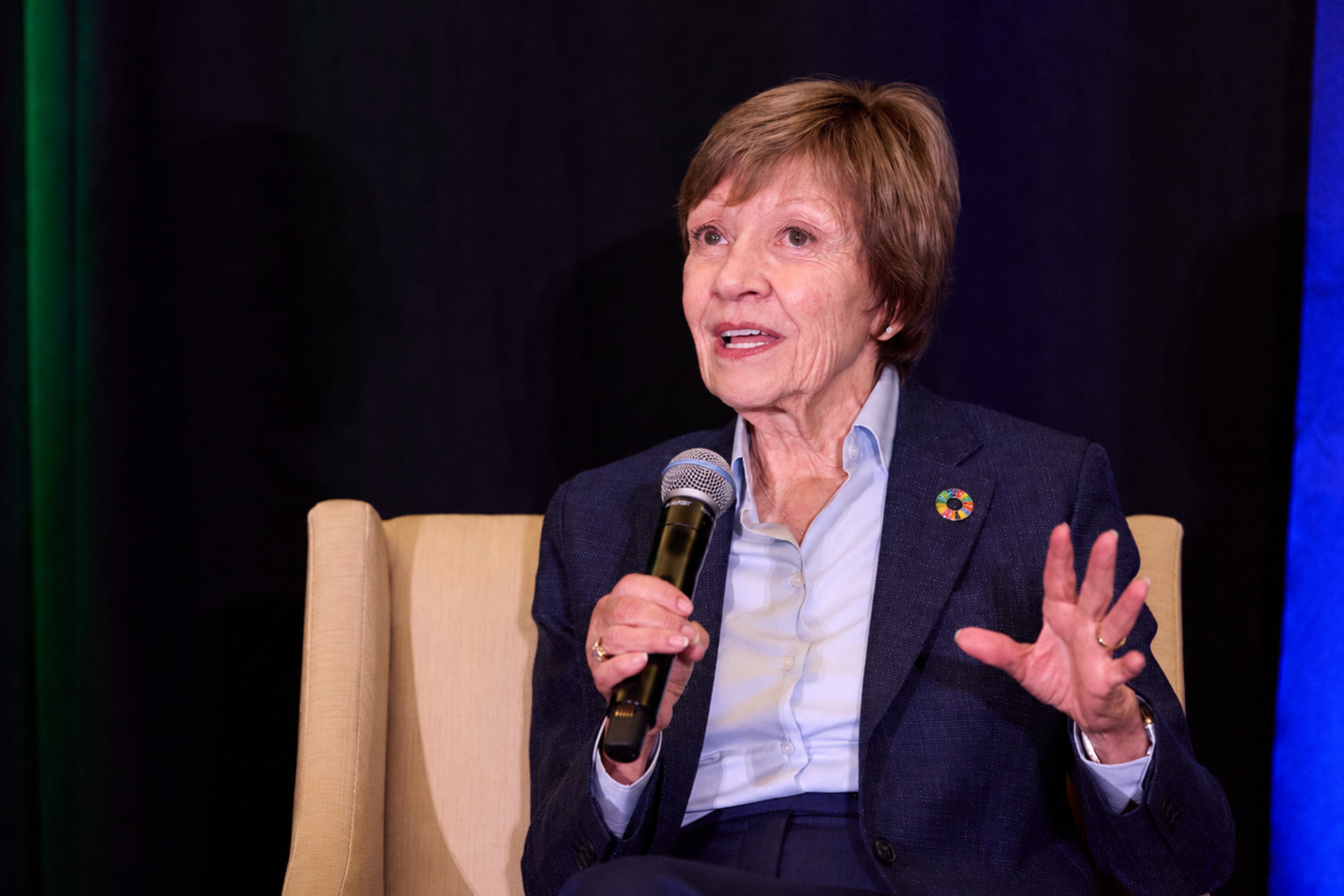
As California Department of Food and Agriculture Secretary Karen Ross prepares to retire at the end of 2026 after more than a decade leading the nation's largest state agricultural economy, she says farmers are facing some of the toughest conditions she's seen since the 1980s farm crisis.
From trade disruptions and weak commodity prices to labor shortages and water constraints, Ross joined Agri-Pulse for a wide-ranging interview to warn that uncertainty is weighing heavily on producers in California and across the country. She also discussed the impact of Proposition 12 on the state so far, reflected on her biggest accomplishments, and provided advice for her successor.
The following interview has been edited for length and clarity.
Ross warns current farm economy echoes 1980s crisis
Q: California, in some ways might feel like its own universe, but the state supplies much of the country's fruits, vegetables, nuts, dairy products, and has the biggest ag economy of any state in the country. What happens in the California agriculture sector that the rest of the country should be paying attention to?
A: "To quote my brother, a farmer in Western Nebraska, ‘whatever you're doing out there, try to keep it there as long as possible.’ We are a highly urbanized state, and a lot of our policy reflects folks who may not have ever grown up around any type of farming.
"It's a big, beautiful state with so many different landscapes and bio-regions, and so we have a lot of environmental rules. We have a lot of worker standards that oftentimes are the first of their kind across the country, and those are all things that are done, you know, through the political process. For our farmers, it really stimulates even more innovation, but it's getting harder and harder to stay efficient, stay in compliance, and to stay really competitive."
Q: How do you view the state of California agriculture and your state's farm economy right now, and what sentiment are you hearing from producers?
A: "In my over 30 years of working here in California, it reminds me of my very first position when I was still in Nebraska. I worked for United States Senator [Edward Zorinsky] running his district offices while I was putting myself through night school at the University of Nebraska-Lincoln. At that time, it was a horrible agricultural economy. We had so many farmer suicides. A good friend of mine was the governor of the state of Nebraska, and we were closing state banks.
Cut through the clutter! We deliver the news you need to stay informed about farm, food and rural issues. Sign up for a FREE month of Agri-Pulse here.
“I never thought I would see so many of our top commodities in a state with 400 different kinds of crops all suffering from so many disruptions in their export markets, tariffs, cost of production, and changing consumer tastes, plus the issue of bankruptcies, ongoing march of consolidation, and just the stress on so many of our farm families. And of course here in California, given we're so dependent upon irrigated agriculture, the water issues and the changing climate for a hotter, drier future really are driving even additional stress levels that people are trying to plan for. You have to make decisions about the transition to the next generation, and it's done with a great deal of uncertainty."
Q: We hear farmers and economists compare today's conditions to the 1980s farm crisis. Having worked through that period, do you think we're approaching that level of crisis?
A: "I think it's very, very serious. I know that because I still own a farm in Nebraska, and my brother started farming in that horrible time. The only difference then from now was that he was paying 18, 19 and 20% interest rates when he was just getting started in farming, but of course, cost of production was also much lower.
"Just the financial crush of what was going on then and now was very similar. I think we've also become even more dependent upon export markets than even 35 years ago. The changing dynamics of what's happening on trade clearly have a direct correlation to some of the pressures we're all feeling – the loss of China, as an example – is just one example of the kind of disruption."
Q: California agriculture depends heavily on exports, generating over $23 billion to $26 billion in overseas sales annually and absorbing about one-third of the state's total agricultural production value. What are producers telling you they need from policymakers amid the market uncertainty?
A: "I think it's common, no matter where I travel in the world, a farmer or any business person really wants certainty, like ‘what are the rules of the game? Tell me they're going to stay this way so I can just put my head down and figure out my own business plan.’ So obviously certainty and being able to say ‘here's these new emerging markets, and this is where we're going to.’ You know, we want to really incentivize people to focus on these markets.
"For us here in California, specialty crops are high-value crops. They're not necessarily the first into a market, but that's why I love traveling with more commodity crops because they’re first and they're so essential. But as people have more discretionary income, that's where they really shift to more specialty crops."
Q: California has invested heavily in groundwater sustainability and water conservation efforts. What lessons have worked well or need improvement, and what can other states facing growing water constraints take note of from what you've done in California?
A: "I feel very fortunate that we've been through a time where we've had some surplus dollars to really invest in partnering with farmers and ranchers to improve irrigation technology and those irrigation practices, which have multiple benefits.
"We've been able to make huge investments of over $120 million in on-farm water use conservation, and making sure that we're also investing in technical assistance to make sure that every farmer, regardless of whether English is their first language or not, at every scale, and everywhere in the state has access. We've invested heavily in resource conservation districts and University of California Cooperative Extension to make sure the knowledge is out there, and that even when dollars decline, we still have the knowledge and the network to help others adopt these practices or make these investments.
"We also started out with the need to save water. Let's make it voluntary practices with some incentive dollars. Incentives make a huge difference, especially for newer practices, so you're de-risking that upfront capital investment and letting farmers prove it to themselves and their neighbors that this really works. The return on investment for this definitely justifies expanding the use of this technology or this type of equipment, and those have been really important learning lessons for us.”
Q: Looking ahead 10 years, do you think California can maintain its current level of agricultural production under existing water constraints?
A: "There's no doubt, we already know there will be a hotter, drier future. It's already been calculated there will be at least 10% less available water because of higher temperatures in years like this where the snowpack literally disappeared in a short amount of time, and there was minimal runoff because of higher temperatures, higher and drier soil profiles. We just know that that's inevitable.
"We also know that because of over pumping in the past, trying to address subsidence and bringing our groundwater levels into a more sustainable basis, so that we have them in times of drought, that there's going to be less available water, so it's anywhere at least 2 million acre feet short.
“Looking into the future, for the next 20 years, the state Department of Water Resources is trying to develop a plan for an additional 9 million acre feet of water that accounts for a robust economy, as well as continued population growth. We all have a lot at stake to use every drop of water as precisely as it reflects what its value is.
"We also know that water availability and water quality are challenges on a global basis, and I believe will be the biggest challenge of food security across the globe in future years because of how precious this resource is."
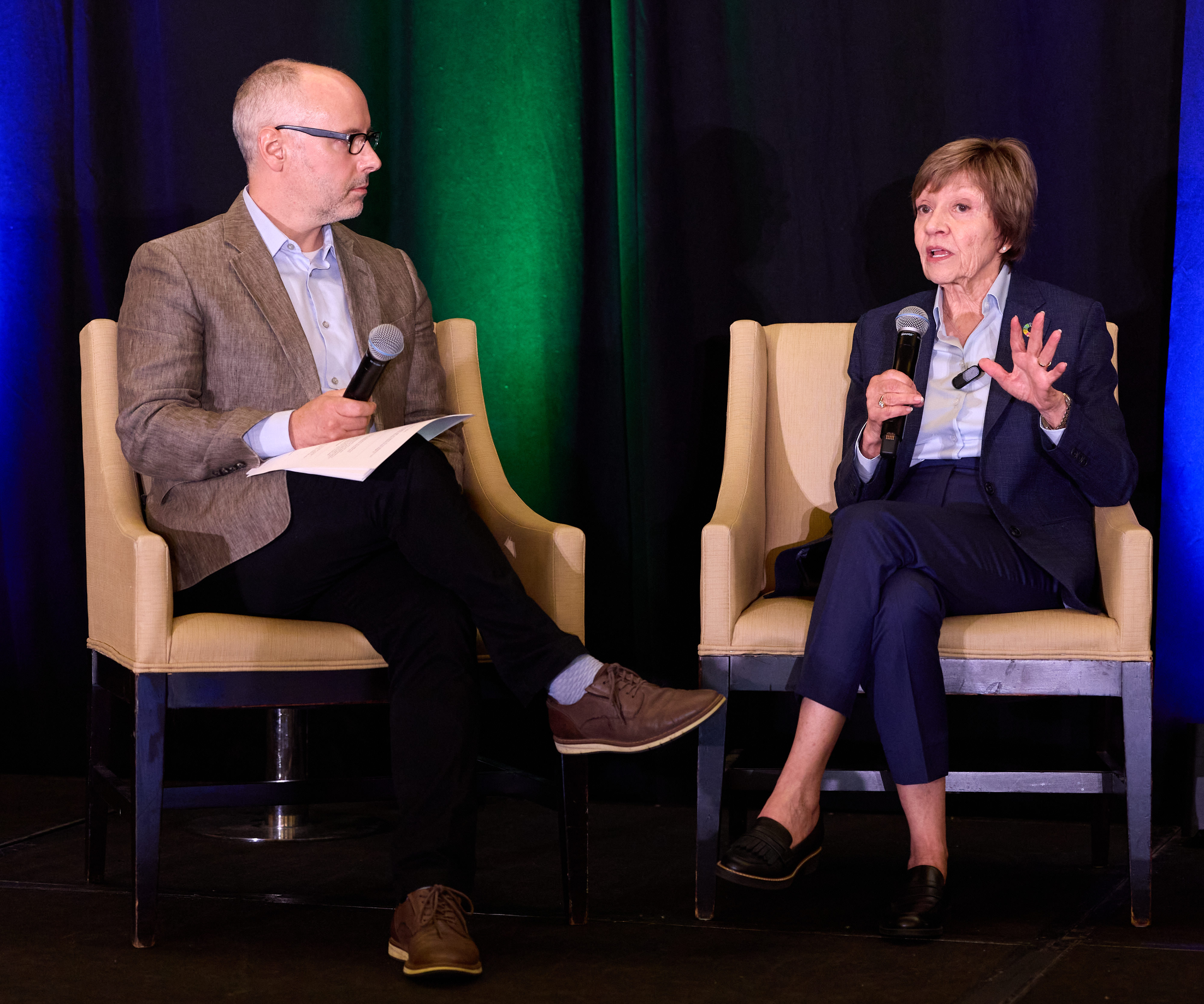 Agri-Pulse Sacramento Bureau Chief Brad Hooker interviews CDFA Secretary Karen Ross at the annual Agri-Pulse Food & Ag Issues Summit in Sacramento. (Agri-Pulse photo)
Q: We talked a lot about specialty crops, which production requires a lot of labor. How serious do you believe the ag labor shortage is today?
A: "The shortage has been a decades-building issue because of our farm labor here. Our farmers are aging, and so are our farmworkers. The changes in immigration policy have put some pressure on that, but there's also been some shifts going back and forth from other sectors. There’s still work to do, but you can just look at the trend line in California agriculture and the utilization of H-2A visas being able to maintain productivity even with the higher costs of the H-2A program.
"We also are preparing for a future where technology and automation are just going to be part of our future. We're not waiting for the new tools and the new gadgets. We are investing as a state of California in workforce development, making real investment in our incumbent farmworker population with a program called AgStep that gives them certifications for skills-based competencies, which then become portable for wherever they might work, and it's been widely received and applauded.
"I'm optimistic that there may be fewer jobs, but they will be different jobs and better jobs in many ways, and they will be built on the expertise of the existing farmworker workforce that we have today. It's really important for us to focus on that, but we do need to do whatever we can to apply technology appropriately at all scales – small, medium and large – to be cost-competitive."
Q: California’s Proposition 12 went into effect Jan. 1, 2024. What would you say to livestock producers in other states who view California standards as something that influences how they do business, and what have you and the state of California learned since this has been implemented?
A: "It was voted on by the citizens of California. At the time that it passed, it passed by the largest margin of any ballot initiative in its history.
"We had to do analysis that became part of voter education. It was very clear working with the economists that took a look at this that it would raise the price of these products in the state of California. The subsequent legislation made it very clear that this would apply to anything sold in this state. No one's being forced to make any changes unless they want to sell into this market, and a lot of people stood in line to be certified to sell into this market because there was a premium for it.
"I would say at the end of the day we're not forcing anyone that doesn't see the economic opportunity to do anything."
Q: Even before Prop 12 went into effect, there were predictions of major disruptions to pork supplies and consumer prices. How do you assess those concerns today? Are you still seeing supply chain disruptions, and what have you learned since implementation?
A: "We have not seen supply chain disruptions at all. Much was predicted by the economists who worked on this that large processors would have dedicated lines, just as they do for an organic product, so they would be able to stream product into the state of California.
"Where I do have concerns still is what it means to the price of pork, which is a very, very affordable protein for many populations in our state. In some of our smaller markets, the lesser availability in certain communities can have a detrimental effect. But the vote of the people spoke, and our job here is to help everyone that chooses to become compliant.
Q: In a bigger picture, do you see Prop 12 as a unique California policy, or do you expect similar measures to be part of a broader trend in national food and agriculture policy?
A: "It's a cultural thing. Younger generations care deeply. I always say, 'Thank you, Disney, for assigning human characteristics to our little critters.' But as you know, Massachusetts passed their own initiative. We've had several states pass laws on this.
"The bottom line is there were already moves to do this because animal welfare and animal care matters to a lot of people, and I think that's also reflected in the overwhelming majority of the Californians that voted. I saw many, many, many young people. They were the ones standing on the corners with the signs when Prop 12 was going through the process."
Q: As you prepare to retire, what accomplishments are you most proud of?
A: "First of all, being able to connect climate-smart agriculture to the market, which is what farm-to-school has been doing for us. I have a passion for feeding people well, and to really start at the youngest age possible to set a lifelong healthy habit of eating and nourishing your body and your mind.
"I feel very fortunate to have partnered with Jennifer Siebel Newsom on this initiative. The governor is so enthusiastic about this as a way of really helping more local procurement happen through our institutions, where our schools are the biggest restaurant on a daily basis, but that it's also pulling through product from small-scale local farmers as it continues to grow, and they're using climate-smart ag practices.
"And I'm so proud of the work that we've done in climate-smart ag, in addition to just the daily routines of what we do on food safety. Twenty thousand farms that are covered by the produce rule of the [Food Safety Modernization Act], and then all the new modernized ways in which we operate our detection and eradication programs when it's necessary. A lot of new sterile insect technologies and disruptors to pest issues has been very exciting to me. And then the investments we've made in our two animal labs will be newer. The newest one will be coming online later this year.
"It's been great to just be a part of a dynamic sector like agriculture in California, to be able to take what we've learned and share it with colleagues across the nation, and to be able to just drive around the state and be in awe of all the people that work in California agriculture.
"I am the luckiest person you will ever meet, and I am grateful every day for this opportunity."
Q: What's your advice for your successor?
A: "Listen to people and look for the commonalities. I always say there's more in common than focusing on our differences.
“I would say work in the beginning to have really good, deep relationships with your sister cabinet members because there's so many aspects in our statutes that we have no authority for here at the Department of Food and Agriculture. We've been able to use the Environmental Farming Act Science Advisory Panel as a way of raising up our issues based on science and good agronomy, and bringing in sister agencies. But if you don't have your sister agencies willing to return your calls or to look around a room and go, ‘Oh, where's the Department of Agriculture early in the regulatory process?’ then you're always going to be behind.
“I would urge all of my successors to really focus on your working relationship with your colleagues and cabinet so that when you have a chance to raise an issue of concern or an alternative way of getting to the end result that everybody wants, you want to make sure that they want to take your call.”

