
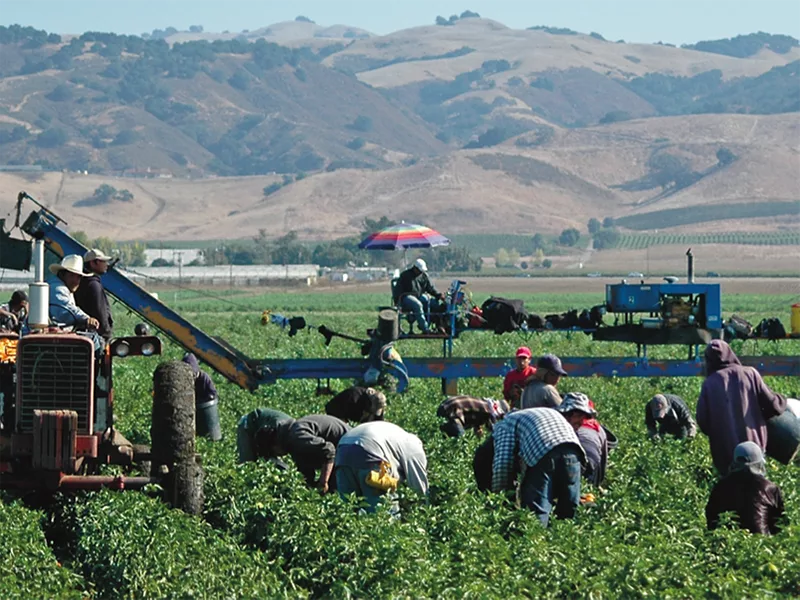
After years of stalled efforts to get farm labor legislation through Congress, ag groups like Western Growers are eager to see if a House Agriculture Committee bill can go the distance.
“Hope springs eternal,” says Dave Puglia, president and CEO of Western Growers, a 100-year-old trade organization representing farmers growing fresh produce in California, Arizona, Colorado and New Mexico.
House Agriculture Committee Chairman Glenn “GT” Thompson says he plans to formally introduce legislation on June 30 aimed at strengthening the U.S. agricultural workforce. Thompson told Agri-Pulse this week that he’s been “working the [House] floor every day to build an army of original co-sponsors” for a bipartisan bill.
Proposed legislation, the Securing Agriculture’s Workforce Act (SAWA), has been circulating around Washington for several weeks. The measure embraces many recommendations made in 2024 by the House ag panel’s Agricultural Labor Working Group.
The bill language so far does “a lot of good with respect to the H-2A program," Puglia told Agri-Pulse, referring to the program that helps employers bring foreign laborers to the U.S. to perform temporary or seasonal agricultural jobs, such as planting and harvesting. More work needs to be done with respect to undocumented workers, he said.
“We’re very hopeful that we can help him move it off the floor of the House and over to the Senate,” Puglia said.
Cut through the clutter! We deliver the news you need to stay informed about farm, food and rural issues. Sign up for a FREE month of Agri-Pulse here.
Thompson’s draft measure calls to broaden the H-2A guest visa program and defines “temporary” as work contracted for a term of fewer than 350 days, regardless of the operation’s need for the job, which would allow dairy producers to use the H-2A program.
The expansion of the H-2A program has been a divisive issue as farm owners and agribusinesses face ongoing worker shortages that some say have worsened under President Donald Trump’s stringent immigration policies. Meanwhile, some Republicans oppose allowing workers from other countries into the U.S. for any kind of employment.
Getting a package through the House would be a major success, though passing it through Congress this year is likely to be a steep climb.
The Ag Wage Reform Coalition, an alliance of 36 groups across nine states focused on revamping farm labor rules, said the draft bill addresses challenges facing U.S. fruit, vegetable, nursery, horticulture and other labor-heavy ag sectors, including surging costs, worker shortages and uncertainty around H-2A.
The measure is the “best opportunity that we've seen in years for comprehensive change to the H2A program,” said Chris Butts, a coalition spokesperson and executive director of the Georgia Fruit and Vegetable Growers Association.
“Without those workers, we don't have an industry in Georgia,” Butts told Agri-Pulse. “We post job applications all day long, and then we just don't get the responses from domestic workers. So, without H-2A there is no fruit and vegetable production in the Southeast.”
For more news, go to Agri-Pulse.com.
.webp?t=1762183428)
